Thursday, January 28, 2021

In Defence of Junk Mail

This is an article I submitted to the Irish Catholic in 2019, but which was never published. I think it's safe to post it here now. Whether it was any grievous loss to journalism is something you can decide for yourself.

It seems somewhat antiquated in this era of lockdowns, when social solidarity is (arguably) more robust than it's been for a long time, but when that very solidarity takes the form of scrupulous avoidance of one another. But here's hoping we will return to "the old normal" before long, and the article will be relevant then again.

Just keep the blog ticking over, you know!

I did some pro-life canvassing during the abortion referendum last year. I had never canvassed on any issue before. Approaching complete strangers is an intimidating prospect to an introvert like me. But the issue was so huge that my conscience wouldn’t let me off the hook. I went out with a local pro-life group, knocking door to door and arguing the case to keep the Eighth Amendment.

Most of the doors remained closed. Either nobody was at home, or they saw us coming and didn’t feel like answering. In these cases, we simply pushed our pro-life literature through the doors, or into the mailboxes.

Many (perhaps even most) of the houses had “No Junk Mail” signs on display. This didn’t deter us. After all, leaflets advocating for the right to life of the unborn child were hardly “junk mail”. So we stuffed them through anyway-- although I always felt rather sheepish about this, fearing the wrath of a householder who caught me in the act.


I found myself remembering the summer of 1998, when I’d had a summer job on the Student Summer Scheme, by which college students were paid social welfare if they did work for a charity or voluntary group. I spent several weeks pushing rolled-up plastic bags through the doors of Dublin suburbs, asking for donations of clothes and bric-a-brac. In this instance, also, we ignored the “No Junk Mail” signs. I remember one man, coming to his front door moments after I had pushed a donation bag through his letter-flap, pulling it out and scrutinising it with a cynical look. “What rubbish is this?”, he asked, taking a weary drag on his cigarette. All these years later, I find myself feeling bothered by that memory.

Of course, it could be argued that pro-life literature and appeals for charitable donations don’t fall in the category of “junk mail”. But let’s say I had been posting flyers for a Chinese restaurant or a pizza parlour. Is it really right to pull up the drawbridge against such materials?

Money makes the world go around. Society expects everybody to try to pay their way, to make something of themselves, to pull their weight. With the exception of the occasional left-wing radical, we all tend to salute enterprise and wealth creation as a good thing. But these are pretty much impossible without advertising. Is it really consistent, then, to take such a hostile attitude when people are trying to promote a business or service? Is “junk mail” such a bad thing if it gives somebody a job, if it greases the wheels of the economy even a little?


Indeed, our attitude to advertising and salesmanship is often contradictory-- especially in the case of Christians. Very often I’ve been bemused by the spectacle of some Catholic commentator thundering against consumerism and commercialism-- and then hardly drawing breath before pitching his or her own book, speaking tour, or YouTube channel!

But it’s not just a question of commercial advertising. I worry that contemporary society has become so privatized, so preoccupied with minding one’s own business and repelling anything perceived as intruding upon one’s privacy, that our public life is in danger of withering away. It is with nostalgia that I read of the well-attended street meetings which were a common feature of Irish politics in the early twentieth century. Today, by contrast, every election and referendum campaign brings the usual complaints against campaign posters, and we even hear regular calls to have them banned. (Personally, I love the colour and sense of occasion these posters create.)

Christians especially have a stake in this question. We have all become familiar with attempts to push Christianity into the private sphere-- a nurse told to hide the cross she wears around her neck, a hospital under fire for putting a Christmas crib in a corridor, even rumblings that the display of religious symbols in Catholic schools might be considered “discrimination” against children from non-Catholic backgrounds. Christians are required by their faith to evangelize, and yet we increasingly face a society which resents any “imposition” of religion outside the church and home. You can pray and worship in private, we are told, but if you try to witness to Christ at work, in education, or in most other places, you are hit with that awful, now-ubiquitous word: “Inappropriate!”


And then there is the matter of political correctness. The range of opinions which it is safe to express in general company, or even on the internet (unless you are shielded by anonymity), seems to grow smaller by the month. Careers can now be destroyed by a single tweet or injudicious remark, often expressing an opinion that may have been considered utterly ordinary within recent memory. Meanwhile, the more aggressive strands of feminism seem eager to discourage men from making any romantic overture to a woman outside the safety of a dating site. “Inappropriate!”

Do we really want the public sphere to become a bullet-ridden no-man’s land? Isn’t it more healthy to accept that if we want to have a flourishing public life-- where people can express the full range of their humanity as they go about their daily business-- we are all going to have to hear each other out, to be a bit more tolerant of perceived offence, and to put up with the occasional intrusion into our beloved privacy?

Thursday, January 21, 2021

Licence to Wed: A Review

A few days ago, I watched Licence to Wed, a silly but fun romantic comedy from 2007. I was really surprised that I'd never even heard of this movie. I discovered it while browsing through movie titles on Amazon Prime. Considering it features Robin Williams (who has been a big star for decades) and John Krasinksi (who was a fairly big star in 2007 and has become considerably more visible since then), it's strange that it's so obscure, all the more so since it was a box office hit. The film also features several other actors from The Office, which is one of my favourite TV shows.

 It received terrible reviews, but that's almost more of a recommendation than otherwise.

I like romantic comedies. Unlike most other films they tend to be set in the world of everyday life, rather than in the worlds of crime, warfare, high finance, show business, and so forth. True, the "everyday life" of romantic comedies is usually a highly glamourised version of everyday life, but that's not the worst thing in the world. It's even a good thing, in many ways.

I've been watching Grey's Anatomy (my wife introduced me to it), and the presence of Patrick Dempsey (as Dr. Shepherd, or McDreamy) reminded me of a film we'd watched together in one of my first visits to America-- Made of Honour, a very silly and throwaway movie in which a male friend (the same Dempsey) is chosen by a bride-to-be as her maid of honour-- a maid-of-honour who happens to be male. I told you it was silly.

As silly as it was, I enjoyed it, and I have happy memories of it. Watching it in America influenced that. The funny thing about America is that it's a place where people expect to be happy. "The pursuit of happiness" is not an abstraction to Americans. They expect to be happy and they actively seek happiness. This has its downside, certainly, since it can lead to a lot of frustration and feelings of failure. But it also does achieve happiness to a suprising degree. The famous "get-up-and-go" of Americans is a real thing, and Americans are much less likely than Irish or British people to simply put up with their lot when it doesn't fulfil them.

Someone (Google tells me it was John Updike) once famously described America as "a vast conspiracy to make you happy". That could be debated, of course, but there's a lot of truth to it. There's a general sense in the air that life is for enjoying and that an enjoyable life is there for the taking. It's easy to be cynical about this, but the point is that when Americans say "have a great day" they actually mean it.

I couldn't have put words to this impression at the time, but it definitely added relish to a lot of the romantic comedies I watched with my wife, in our early days, in America. I had a strange feeling of having walked through the glass that separates the world of TV advertisements from the world I'd known. Everything seemed to glow a little. Love had something to do with it, of course, but it was also the cultural context.

Anyway, for whatever reason, Maid of Honour is the movie which is most associated, in my memory, with this atmosphere, and I had a strange hankering to watch it.


There was a particular scene in Maid of Honour which stuck in my mind especially. It's a scene in which the bride-to-be and Mr. maid-of-honour are planning out the wedding with the cleric who is going to officiate. (I forget what denomination he was; they probably left it vague.) Somehow it pleased me greatly that the wedding was going to be a church wedding and that the main characters were treating the ceremony with a suitable degree of respect. I liked that religion had a part in this world of achievable happiness.

So I found myself looking an American romantic comedy which featured a cleric. Licence to Wed fit that bill exactly.

The plot is very simple. A young couple (John Krasinski and Mandy Moore, as Ben and Sadie) decide to get married, and the bride-to-be wants to be married in her family church. It's mentioned that she hasn't attended it since her schooldays, but her family is friends with its pastor. The church is called St. Augustine's and its unmarried pastor wears a dog collar, but he's addressed as Reverend rather than Father. I assumed he was Episcopalian; some reviewers agree with me, some assume he's supposed to be Catholic. Again, I'm guessing it was left vague.

The Amazon Prime blurb describes Reverend Frank Littleton (who, of course, is played by Robin Williams) as a "charismatic pastor." We see him teaching a children's Catechism class, in which he is quizzing them on the Ten Commandments. Literally quizzing them; the answers are revealed on a gameshow-like answerboard, in rhyming phrases such as "It's not chill to kill."

Reverend Littleton tells that the church is fully booked out for weddings for two solid years...unless they are willing to take the only available slot, which is in three weeks. This means that Reverend Littleton's famous pre-marriage course (which has a one hundred per cent success rate in keeping couples together) will have to become a crash-course, shortened from three months to three weeks. Hilarity ensues, obviously.

One of the most interesting and ingenious features of this film is Reverend Littleton's juvenile sidekick, a precocious kid who is (we are told) part of a "ministers of tomorrow" programme. He follows the Reverend around everywhere and doesn't miss a trick, speaking familiarly of the past cases they've worked on. Given all the sex abuse scandals, this plot point is a little bit eyebrow-raising, but it's actually a very funny and original device.

Predictably, Reverend Frank shows no surprise that the engaged couple are already living and sleeping together. Less predictably, he insists they abstain from sex for the whole duration of the course. The groom-to-be is incredulous at this, and tries to persuade his fianceé to overlook this rule. (It's depressingly predictable that the man is the one pushing for sex; all men are relentlessly horny in Hollywood's eyes. A bit of role reversal here might have been refreshing.)

In any case, the amorous Ben hasn't reckoned with the Reverend Littleton. The resourceful pastor has bugged their apartment, and just as Sadie's resistance was about to break, he comes knocking. In fact, he was sitting in the street outside, listening in to their nocturnal interactions.

Many critics attacked this plot device as "creepy". I didn't find it creepy-- this is a romantic comedy, for crying out loud!-- but it does raise logistical questions. How long could a busy pastor spend sitting in that van?


There's not much mention of Christian doctrine in the movie. In one amusing scene, while Reverend Frank is shooting hoops with Ben, the basketball hits the latter in the face and gives him a nosebleed. For some minutes, the pastor tries to perform a healing miracle on the injured groom-to-be, before revealing it all as a joke and sending him to the doctor. That's about as Christian as this movie gets. But the treatment of religion is still fairly respectful.

The storyline is very similar to Anger Management, the 2003 comedy starring Adam Sandler and Jack Nicholson. In both movies, a male character has to satisfy a demanding and eccentric (but ultimately benevolent) guru in order to win the girl. In both movies, the demands of the guru are apparently crazy and even sadistic, but are eventually seen to make sense.

So what kind of demands are made of the engaged couple? Well, in one scene, at a party where Ben is mingling with is future-in-laws, Reverend Frank encourages them to play a game of word association. When a member of the family is named, Ben has to come up with a word to describe them. He begins very politely, of couse, but is goaded by the Reverend and the family themselves to be more honest. Eventually, as one would expect, he goes to the opposite extreme, scandalising his future relatives. In another scene, Sadie has to drive a car through busy traffic blindfolded, while her husband-to-be gives her directions.


One of the funnier moments in the film comes when Ben is collecting his wife's engagement ring. He's asked for the words "never to part" to be inscribed upon it, but his unclear handwriting results in the ring being inscribed "never to fart". (They assumed it was a "novelty inscription".) There follows a prolonged dispute in which different members of staff, and a customer, are asked to read Ben's handwriting; no prizes for guessing what every one of them reads it as. Yes, it's cheap humour, but it gets a laugh.

This being a romantic comedy, it inevitably climaxes in a crisis, the bride-to-be getting cold feet at the eleventh hour and the marriage apparently called off. (Once again, it has to be the woman who has doubts; it's never the man, is it?) Can Reverend Frank save the day? Well, if you can't bear the suspense of wondering, watch the movie. Even if you can bear the suspense, it might be worth watching anyway.

Saturday, January 16, 2021

A Feast of Facebook

You all know the drill at this stage. I have limited access to a desktop or laptop, and trying to blog on a smartphone is very awkward. But Facebook is all-too-accessible. So here is a smorgasbord of my Facebook jottings. Old hat to my blog readers who are also Facebook friends, of course!

(Given the censorship and liberal propaganda on the established social media networks, I've decided to register a MeWe account, which I did today today. MeWe is a sort of Facebook substitute which is said to be more amenable to conservatives and those outside the woke bubble. But I'm not jumping ship from Facebook yet. Anyway, bon appetit...)


"The same androgynous figures are to be found in many masterpices of the irish Revival - in Shaws Bluntschli and Dauphin, two sensitive men brave enough to admit their fears; in Synge’s Christy Mahon, whose daintiness of speech and patent narcissism appeal to the robust countrywomen who fall in love with him; even in Yeats’s adoption of the female voice as he wrote the “Crazy Jane” poems. While nationalists, addicted to a militarist ideal, sought in emulations of Cúchulainn to purge themselves of the last degrading traces of Celtic feminitiy, these male writers happily embraced the female dimension, the anima, as one basis for liebration." Declan Kiberd

I guess this is why Irish nationalists used Cathleen Ní Houlihan, Dark Rosaleen, and the Shan Van Vocht (Poor Old Lady) as symbols of Ireland, almost ad nauseum. Declan Kiberd is an ass.

* * *

My anglophilia is an integral part of my Irish nationalism. Everything in Irish nationalism that stemmed from whiny colonial victimhood was decadent and destined to turn into leftist resentment against other Church, family, etc. once we had independence. And I think this was a false in even the most admirable nationalists like Patrick Pearse.

* * *

Matt Fradd makes a good point in this interview; that Catholics can't overcome their reluctance to read the Bible without acknowledging that they do find it irksome.

As a matter of fact, I often do enjoy reading the Bible, but buckling down to it is always a task. It's like physical exercise, it regularly gives you a glow but you still don't want to do it.

Even when I was agnostic I felt guilty for my lack of Bible knowledge, given its importance to literature and culture, and made sporadic efforts to become familiar with it.


* * *

"When I tell a new person that I work both as a teacher and a therapist, and enjoy using stories in my practice, I often get the response: 'Oh, that sounds really interesting....' The words will be uttered in a distant, dreamy kind of way. Nowadays this doesn't surprise me, but when it first happened I couldn't help but feel that these words were meant to prepare me for an imminent conversational closing move. However, more often that not, something else occurred. The person who had just asked me what I did would continue with: "But what kind of stories? Like Snow White or Peter Pan?". Then, ignoring the usual give-and-take of discourse between newly acquainted people and as if they very mention of Snow White and Peter Pan activated some distant realm, my interlocutor's personal reflections would come tumbling out. The very word "story" triggered a long-since unvisited store of early memories and longings. Suddenly, I would be granted entry into the private world of favourite stories, the circumstances of telling or reading, of secret whisperings, buttered scones and tea, grandparent's visits or tree huts."

From Reflections of Therapeutic Storymaking: The Use of Stories in Groups by Alida Gerse

* * *

OK, half of my FB friends are Traditionalist Catholics, so I want to say first off that I'm not attacking Traditionalists here. Nor am I attacking Brian Holdsworth, who I really like. I'm not even attacking the content of this video, which is actually good. It's more the title of the video, which reflects a certain attitude among some Traditionalists.

This is the attitude: Traditionalism is the coming thing, it's the rising tide, it's hip, it's what the kids want. Parishes with young families, booming vocations, etc. etc. The spirit of Vatican II crowd are the old guard, they're dying out, they belong in the dustbin of history.

All my life, since I was a little kid, I've considered such triumphalism vulgar and contemptible. I've never wanted to be on board with the coming thing or the rising tide. I'd rather be with the embattled, clapped-out minority fighting the losing battle. If I wanted to be on board with the coming thing, I'd be a liberal secular globalist.

Yes, I would like some cheese with this whine, thank you.

* * *

Among the nice Christmas books I got from my wife this year was A Poem for Every Day of the Year edited by Allie Esiri. I especially like it because there is a commentary on every poem. I read "Poem before Birth" by Louis MacNeice aloud to her and she remarked that MacNeice is not well known in the States. It got me thinking about him. I could immediately think of a couple of poetry-loving Irish friends who told me they've never read him. He's often described as "under-appreciated".

His famous poem "Snow" is one of my absolute favourite poems, I think it is almost miraculous, and I am constantly quoting its best line, "The drunkenness of things being various". My father used to recite his poem "Dublin" all the time, which captures the soul of Dublin better than any other poem. I also loved sections from his long poem Autumn Sequel in my teens and twenties. Before I became a Christian I think MacNeice's philosophy was the closest I had to a religion: life was absurd but the best we could do was preserve our humanity against all dehumanizing forces. A bit like Orwell.

Would any of my US friends be aware of MacNeice? What about my Irish friends, and English friends, and all the others?


* * *

I thought I would make another effort to read Ulysses by James Joyce (not Tennyson), a book I've never been able to get through. I suspect it's mostly a fraud but I want to be able to denounce it knowledgeably. Reading Declan Kiberd's introduction makes me grit my teeth: "Joyce was reacting against the cult of Cúchalainn, which was purveyed in poems, plays and prose by writers such as Patrick Pearse, W.B. Yeats and Lady Augusta Gregory. As a student of twenty-one, he had written a pamphlet attacking the Irish Literary Theatre for its surrender to vulgar nationalism." How original! How brave! How constructive! What an ass! He was undeniably talented, but decadent. All literary modernism is decadent, as is all anti-nationalism. I would have pushed him into a shallow pond.

* * *

I passed a telephone box the other day and thought it would be a good prank to have one person using it and two people queuing outside. Imagine it would turn heads.

* * * 

Signs of a book lover:

1) When you ask them "What are you reading now?", they always have an answer, even if they've barely picked it up in days.

2) When they visit a house for the first time, one of the first things they do is walk to the bookshelves and scan the titles.

3) They can't walk past a bookstall even if they have no intention of buying anything, or no money.

4) They re-read books.

5) They like at least some books which have zero or negative cultural prestige.

6) They can admit to hating at least some books which have immense cultural prestige.

(It should go without saying that you can be a book lover and a complete jerk...)

* * *

Something I read this evening reminded me of a time many years ago, in England, when I saw a guy carrying a huge painting (I assume) into a post office. It was covered in brown paper and I guess he was posting it. What else could he have been doing? Maybe it's grown in my memory, but I have an image of a guy struggling with a brown paper rectangle that was half his own size, or even bigger.

I regard someone like that with awe and intense envy. I find it difficult even to ask to have something exchanged in a shop. I could no more do what that guy did than I could vault over an oncoming truck. Just imagining the looks he got when he approached the counter makes me squirm vicariously.


* * * * 

I have been looking through some papers left by my grandfather and father. I have only a very few of the former, much more of the latter. Although it's said my grandfather wrote a ballad, all I've seen from him are letters regarding community politics. They are somewhat dry though well-written. My father left a memoir, six or seven chapters of a novel, poetry, and lots of letters, mostly to radio stations, politicians, etc. There is much more literary flair in his style, compared to my grandfather's. What I have in my possession is a fraction of a fraction of what he wrote. He wrote incessantly. He edited a community magazine called The Ballymun News for about thirty years. It was monthly back in the seventies, then annual in the eighties, then a few final issues at long intervals. He wrote most of it himself.

My grandfather was an Irish republican and a member of the Worker's Party, which was a radical left-wing party. I wish I could reconstruct his exact views but, sadly, I've been unable to. People's beliefs are the thing I find most interesting about them, but families tend to remember other things, Iike their habits and tastes in food. He died in 1991, just as Operation Desert Storm was beginning. I remember him but rarely spoke to him.

("Republican" has a very different meaning in Irish political discourse than it does in American or British discourse. Indeed, I'd be hard-pressed to describe what it means here, especially as its meaning has been so contested. But Irish unification combined with radical social and political change might be a fair description.)

My father was also, very briefly, a member of the Worker's Party. But he admitted that he could never be a party man. He was Orwellian in his refusal to toe any party line and to speak uncomfortable truths. Economically he was left-wing, but socially and culturally he was conservative, and increasingly so as time went by. I don't think his increasing conservatism came as much from age as it did from witnessing the advance of the liberal agenda. He rarely went to Mass, but he was a convinced Catholic who frequently quoted the New Testament. From my perspective, I was often surprised by both the patchiness and the depth of his religious knowledge. He could argue the truth of the Faith with anyone, but somehow he'd never heard of Gaudete Sunday. I've been unable to work out my grandfather's attitude to religion; "believing but anti-clerical" is my best guess.

My father and grandfather would argue about politics a lot. Mostly to do with Northern Ireland, my father told me. My aunt told me that, towards the end of his life, my father and uncle would argue politics with him just to keep him sharp. Or so they claimed.

Going through their papers, I feel such a strong sense of a legacy, a legacy of idealism and public-spiritedness. Apologies for the absurdly long post, to anyone who made it this far.

Friday, January 1, 2021

Thoughts on Lord of the Rings

I'm re-reading Lord of the Rings and I've been posting miscellaneous thoughts about it on Facebook. I thought some of my blog readers might possibly be interested in them. (They are in reverse chronological order as I posted them.)

Despite the single disparaging reference here, I do actually like Peter Jackson's Lord of the Rings movies. To bring the books to the movie screen was a monumental achievement in itself, and there were far more good things about the movies than bad things. However, it has had the lamentable effect that I can now only imagine the characters as they were cast and portrayed in the movies. Before now, my imagination was more likely to draw on the paintings in The Tolkien Calendar, which was an annual gift from my elder sister back in the eighties. Admittedly many of the artists who contributed to the calendar worked as consultants on the movies, so there is a continuity. But a movie has a far more tyrannical grip on the imagination than a series of paintings by different artists.


Anyway, onto my Facebook posts:

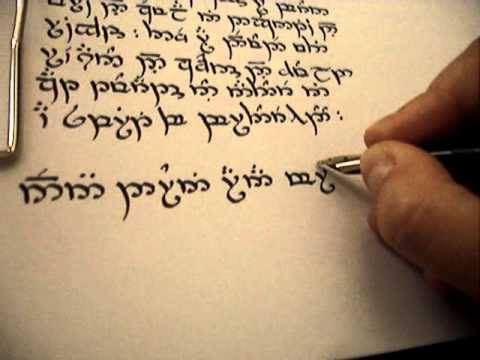
1. Of course, The Lord of the Rings grew out of Tolkien's interest in languages. All of his writings did. He invented fantasy languages as a private hobby and his fictional worlds were invented to give those languages a context.

Which gave me this idea today: an interesting cultural history could be written on the place of other languages in English life, through the centuries. There was a time when educated English people were simply expected to know Latin, Greek and French. At least, quotations in those tongues are often untranslated in old English books, to the nineteenth century and beyond. Is England and Britain more monolingual today than ever before, aside from immigrants (who are unlikely to pass their languages onto their hosts, and who generally lose them in a generation or two)? The question obviously has relevance for Ireland, too. The Irish language is the national exercise bike in the attic. The British were instrumental in almost killing it, but we can't blame them for us not reviving it since independence.

The point has often been made that there is nothing natural about monolingualism, or unnatural about bilingualism or multilingualism. I fear globalization will create more monolingualism rather than less.


2. I am reading Return of the King now. I accidentally turned two pages instead of one and found myself confused by the discontinuity, before I realized my mistake. But it reminded me of something I used to do as a child. I used to take a random book from the shelf (one I hadn't read), open it on a random page, and feel a frisson of wonder and mystery at the fact that a story (or a discussion) was going on at that point, one that I had arrived upon in media res. One that was always going on, on the shelf, even with nobody reading it.

I have this feeling about so many things, especially walking into a place I've never been before-- a café, a house, an alley, anywhere. That place had its own existence before I ever knew about it. The solipsist in me has a sneaking suspicion that places only flicker into existence when I walk into them. But I am grateful for that, because it allows the shocked wonder of realising the opposite-- a wonder Chesterton loved to dwell on.

I feel this about people too. Sometimes I am struck by looking at someone in the street and realising that person is an entire world unto themselves.

I think this theme is quite appropriate to Lord of the Rings because so much of Tolkien's artistry is creating fictional places that do have this solidity, this sense of being real places which are not just stage scenery-- even the least important places in the story, even the wilderness.

3. Lord of the Rings spoiler alert...

I've just been reading the passage in The Two Towers where the "reborn" Gandalf reveals himself to Gimli, Aragorn and Legolas. I never noticed it before but there seem to be strong parallels with the Emmaus road resurrection appearance. The three are on a journey; they don't recognize Gandalf at first; Gandalf asks them what they are doing; then he tells them. Also, the sudden change from despair to jubilation. I wonder if that is all accidental or intended? Aragorn even says: "Beyond all hope you return to us in our need. What veil was over my sight?".

4. One thing that is interesting about C.S. Lewis and J.R.R. Tolkien is that they had both experienced war, possibly the worst war in all history. But their fantasy writings convey the romance as well as the horror of war. Indeed, C.S. Lewis in some essay (I forget which) complains that pacifism had made many of his war acquaintances put on an excessively funereal manner and repress their natural animal spirits.

Don't get me wrong. I'm very, very grateful I've never had to go to war and I would probably pee myself at the sound of enemy gunfire. But it's interesting that not everyone (by a long chalk) who survived the Great War came out a pacifist, or inoculated against any idea of romance in battle. Of course both men were very happy to be invalided out...


4. As I said before, although I was too young to really absorb
Lord of the Rings when I first read it, and in later childhood I only had access to the first volume, it had a huge effect on my imagination. I think it is part of the reason I am such an instinctive nationalist. Almost all of the characters in the book are devoted to the idea of homeland, people, traditions, customs, belonging. They have their own songs and skills and way of life. This has always seemed like the ideal to me. Yes, the book also has themes of the different races overcoming suspicion and enmity, and working together, but the emphasis is on the distinctiveness.

5. One thing I've always thought a bit silly in Fellowship of the Ring is the claim that Frodo's mithril shirt is "worth all of the Shire and everything in it". Surely not. Even if mithril was ten times more precious than gold, as stated, surely it's impossible for a piece of armour (however precious) to be worth more than a whole territory. All the farms, buildings, animals, etc. etc.

6. One of the worst things about Peter Jackson's trilogy was the portrayal of Merry and Pippin. In the books they speak like Oxbridge undergrads. In the films they speak like they have wandered out of a snooker hall.


7. I'm embarking on reading
Lord of the Rings again. It's a book that has had a big influence on my life although in a somewhat strange way. It had a huge prestige in my family when I was growing up, among my brothers and sisters, and indeed uncles and cousins. I read it all the way through when I was seven years old, although it was rather over my head at that age, and I only took in a vague impression.

In later childhood, the only volume I had access to was The Fellowship of the Ring, which I read over and over. So I'm in the rather strange position of being very familiar with the first volume, but much less familiar with the later ones-- even though I've read the whole thing a couple of times in adulthood. (I was too timid to join a library until I was fifteen years old.)

In all honesty the action/adventure/travel sequences bore me a bit. I much prefer the talky, story-telling chapters, like The Shadow of the Past and the Council of Elrond. In fact, I think The Shadow of the Past is my favourite chapter of any novel ever, and has even shaped my whole view of the world.

Reading the prologue I notice that Bilbo returned to the Shire from his adventures in The Hobbit on June 22, my wedding anniversary.

Wednesday, December 30, 2020

The Sound of Breathing: A Short Story

Jessica was the luckiest girl in the world, because her father was the greatest father in the world. He wrote books. He gave talks. He made videos. Everybody admired him. People sent him cards and gifts telling him how much he’d changed their lives. They came pretty much every day, and they were hung all over the hall and sitting room and dining room of their beautiful home.


He’d written three books; Make It Happen, Make It Real, and Embrace Your Fears. He flew all over the world giving lectures (he always called them “lectures”). He seemed to be working all the time. Jessica only realized that other fathers were not like that when she went to school-- for the little time she’d gone to school. She’d been taken out of school when she was seven, and after that she was educated by private tutors and by Daddy himself. Sometimes he would wander in from his study and sit in on her lessons, which always made the tutors nervous. Twice he’d actually stopped the lesson and told the tutors they could go.  They would never be seen again. Then he either got new tutors or just taught her that himself.


Jessica’s mother had died when she was three. Nobody would ever tell her what she died of, and Jessica had learned to stop asking. There was a photograph of her in the hall-- dark-haired and thin, just like her daughter. Jessica always thought she had a sad look on her face, even though she was smiling. But maybe that was just her imagination. Daddy so often warned her against the dangers of the imagination.


Daddy only ever talked about her when Jessica raised the subject. She knew he didn’t like talking about her. Probably it made him sad, though Daddy never seemed sad.


Jessica wanted to please her father more than anything in the entire world, so she very rarely asked about her mother. They couldn’t even visit her grave because she had been cremated and thrown into the sea-- that’s what she wanted, Daddy said.


Once Jessica had asked him if Mommy had gone to Heaven. It was at breakfast one morning, when it was blowing wind outside.


“Jessica”, her father had said, looking square in her face. “There is no Heaven. It’s just a story people tell to make themselves feel better about death.”


When she had started crying at this, he’d lifted her from her chair and hugged her tight to him. She loved his smell, the smell of cigars and aftershave and-- well, Daddy-ness. But this time it wasn’t enough to stop the tears streaming.


“I could lie to you and say that there’s a Heaven”, he said. “But I’m never, ever, ever going to lie to you. You deserve better than that. Lies never make anything better.”


Daddy worked harder than other Daddies, and Jessica also worked harder than other little girls. Lessons went on all day, up until dinner-time, and then sometimes in the evening, too.


“Your mind is at its most flexible now, Jessica”, he told her. “And that’s the magic ingredient, flexibility. Yes, you’re working harder now, when other kids your age are watching TV and playing computer games and just hanging out. But, believe me, when you’re older, you’ll appreciate it. The headstart you are getting now will make a big, big difference. Believe me.”


Then he would start on his favourite subject-- the world that she was growing up into and how she needed to be flexible, adaptable, creative. His eyes would light as he spoke about it.


“It’s going to be a different world, Jessica”, he said. “A lot of the jobs that people do today are going to be done by computers. There may not even be jobs like there are today. Things are going to change so fast, so very fast, that people who can’t change with it, people who can’t be flexible...well, they’re going to get left behind.”


“What will happen to those people?”, Jessica had asked.


Her father shrugged. “There might be some kind of basic income by then”, he said. “Money that the government gives to everybody, whether they work or not. I hope so. But it’s probably not going to be very much. And, however much it is, it means that you are always depending on the government. If you want to be free, if you want to have independence, you’re going to have to be flexible. To make things happen for yourself. To make things real. And you will be, Jessica. You will be.”


“I feel sorry for all the other people”, Jessica had said. “The people who won’t be like that”


“Me too. I hope they get taken care of. But this is the reality. And what do I always tell you about reality?”


“Imagination sees reality”, Jessica recited. “Fantasy hides from reality.”


“I love you”, her father, had said, giving her a huge bearhug.


Jessica didn’t really mind working so hard, although she often wished she had more time to do her own stuff. She knew she was smart and she liked learning. Every time she had a new tutor she could tell how surprised they were at what she could do.


She studied French, German, and Chinese. She studied science and technology. She studied mathematics and geography, music and art. Daddy would often tell her how important creativity was. Knowledge opens doors, he said, but imagination lets you fly.


All the toys she was given were creative toys. She was given paints, modelling clay, building blocks, jigsaws (usually of maps), keyboards, puzzles-- things like that.


Daddy had let her have dolls when she was younger, since she’d begged him for them. But that had stopped when she was five-- the day she’d started talking about her doll, Miss Perfect, talking to her.


“She doesn’t talk to you, Jessica”, Daddy had said. They were sitting in the garden at the time, on a sunny summer’s day. He was in a deck chair and she playing with Miss Perfect. He was smiling but his voice was stern. “You pretend she talks to you, that’s all. And that’s OK.”


“No, Daddy”, she’d said. “She speaks to me. She really speaks to me.”


Daddy had looked worried, then-- worried, and kind of angry. “No, sweetheart”, he said. “It’s a fun game to pretend she speaks to you. I know that. That’s OK. Every kid does that. But she doesn’t really speak to you.”


Jessica had started crying then, because she already knew it was wrong to lie. Daddy took Miss Perfect away from her and she had never seen her again-- her, or any other doll, or action figure, or anything like that.


She’d heard him speaking on the phone a few nights later, as she was coming back from the bathroom, very late one night. “I don’t want her to go the same way as her mother”, he’d said. She thought about that pretty much every day.


Now that she was nine years old, she knew that Daddy had been right. Miss Perfect hadn’t spoken to her, because dolls couldn’t speak. They were made of plastic. She’d only imagined it.


But sometimes, still, she caught herself thinking that Miss Perfect had really spoken to her after all. And then she cried to herself, feeling very guilty. Because Daddy said that was impossible, and Daddy was always right. He was the best father in the whole world, and he was always right.


* * * * * * * * * * * * * * * 


Sometimes, in the middle of the night, Jessica would walk softly to her father’s bedroom and listen at the door. She would listen anxiously, trying to hear the sound of breathing, and she would only creep back to her own room when she’d heard it.


She was terrified that her father was going to die. When she’d told him about that, he’d laughed and said that all kids worried about their fathers dying.


“But you might die”, she’d said. They were in his study, and Jessica was sitting on his huge wooden desk-- the desk with the globe of the world, and the Panda bear made of green glass, and the box of cigars.


“Yes, I might”, Daddy had said. “Anything could happen. A plane could crash through this house right now. But it’s almost certainly not going to happen. I’m only forty-seven. I’m fit. I’m healthy. There’s nothing to worry about.”


The silence in the room had stretched, as Daddy smiled at her, and Jessica worked up the courage to say this next thing. She knew that, if she didn’t speak quickly, he would go back to work, and then he would be lost in work for the rest of the day.


“When you fell down the stairs”, she said. “When you were taken to hospital--”


“I only broke a few ribs, sweetheart”, he said. “That kind of thing happens. Besides, I’m extra careful now. I don’t want to spend any more time in hospital. I have too much to do!”


“I dreamed about it”, she said quickly. “The night it happened. I dreamed about it. Except in the dream-- you died.” Now she could barely speak through the tears.


He pulled her towards him, and hugged her. “No, you didn’t dream about me falling down the stairs that night. You imagine you did. You probably dreamed about it afterwards and now you think you dreamed about it the same night. The mind plays tricks. Memory plays tricks.”


Jessica rubbed her eyes. There was no point arguing with Daddy. He was always right. Besides, she wanted him to be right. Because in the dream-- she couldn’t remember why-- she had pushed him down the stairs. And then she had woken up and heard him falling--


But it wasn’t like that. Now she was crying tears of relief, and hugging Daddy. It wasn’t like that because the mind played tricks.


* * * * * * * * * 


Jessica told Daddy everything, except for one little thing she didn’t tell him.


She didn’t tell him about Kid.


Kid was her dog. He was an imaginary dog. She’d started to imagine a dog because Daddy wouldn’t let her have a real dog.


“You can get a dog when you’re old enough to take care of a dog”, he’d said. “When you’re thirteen, at least. You’re too young to take care of a dog now.”


She hadn’t said anything to that. There was no point arguing with Daddy. But that night, she’d started to imagine Kid. That was almost a year ago now.


He was a German Shepherd dog. He was big, strong and he had deep, soft brown eyes. He followed her everywhere, and went everywhere she went. He protected her.


She would often think about him during the day. In swimming lessons, he would be standing at the age of the pool, waiting to jump in if she sank. (But she never sank.) During her lessons, he would be sitting at her desk, looking at her lovingly as she learned. Somehow it helped her to concentrate.


Even when she slept, he would be lying by her bed, in the dark, so she could hear his breathing…


She pretended she could hear him breathing. Sometimes she caught herself imagining she could really hear him breathing. Then she felt very guilty and remembered Miss Perfect. She listened more carefully and she felt relieved-- it was actually her own breathing.


Kid was her protector. He made her brave.


Once, at a birthday party-- sometimes Daddy let her go to birthday parties, but not very often-- two girls had started to pick on her. The grown-ups were in the kitchen and the kids were all in the large garden, playing. These two girls-- Mandy and Ciara-- had been playing with her in the corner of the garden, a little bit away from the slides and the swings. They’d been really nice until Mandy had said:


“I know about your mommy.”


Jessica had stared at her. “What about my mommy?”


Mandy, who had been so friendly just a moment before, gave her a nasty smile and said: “She was crazy.”


Ciara was also smiling--- a horrible smile. But she said: “Don’t tell her, Mandy. She’s just going to go crying to her Daddy and get us in trouble.”


“No, I won’t”, said Jessica, defiant.


“Bet you will”, said Mandy.


“Who said my Mommy was crazy?”, asked Jessica.


The two girls just stared at her in silence, smiling; then Mandy started to flap her arms in the air, roll her eyes, and groan loudly. Ciara began to laugh. Hot tears came into Jessica’s eyes.


And at that moment...at that moment, Jessica had imagined she could hear Kid growl, right beside her. It was a deep, slow, scary growl. 


Ciara and Mandy suddenly looked terrified, and hurried away from her. They didn’t speak to her for the rest of the party. They hadn’t really spoken to her since.


This is what had happened, Jessica had decided. It only took her a few seconds, standing in the garden, to realize what had happened. She had imagined Kid growing. Kid’s imaginary growling had made her brave, and Ciara and Mandy saw the look on her face. It had frightened them so much they’d run away. That was what had happened.


Sometimes she felt guilty when she thought about Kid, and about keeping him a secret from her father. But wasn’t her father always saying that imagination was good, but fantasy was bad? Kid was just imaginary, so he was good. There was no need to tell Daddy. It didn’t matter.


Now and again she would think about her Mommy, lying in bed, in the dark. She would find herself wishing Mommy was in Heaven, and then she would feel guilty about that, since Daddy had told her there was no Heaven.


Sometimes, lying in the dark, thinking about Daddy saying those words-- “There is no Heaven”-- she imagined she could hear Kid growl, lying beside her bed. Then she would remember she had the best Daddy in the entire world, and before long all she would hear, once again, was the sound of breathing.


* * * * * * * 


Jessica never argued with Daddy. There was no point.


Well, almost never.


Sometimes, when she wanted something so badly, she would argue with Daddy, even though her heart was hammering. In those moments, she would imagine Kid standing beside her, feeling his warm body breathing against her side.


One day in early June, Jessica asked Daddy if she could go to see Sparkle Sisters, a new movie that had just come out. Her friends Linda and Gemma were going to see it, and had invited her to come with them. Gemma’s elder sister was coming with them. They were so excited, they made Jessica excited, too.


She lay awake for a long time that night, gathering the courage to ask Daddy in the morning. He might say yes. He was going to say yes.


“He’s going to say yes, Kid”, she told her imaginary dog. “I know he’s going to say yes.”


He said no.


“But why?”, she asked, sobbing. Daddy was finishing his second cup of coffee, after breakfast. When he finished his second cup of coffee, that was when he went upstairs to work. He didn’t come down again until lunch-time. Sometimes not even then.


“Because it’s rubbish, Jessica!”, he said. “We do go to the cinema. We go to see good movies.”


“How do you know it’s rubbish?”, she asked. She was terrified he was going to walk out of the kitchen and upstairs. It was all over if that happened, she knew.


“Because I’ve heard about these Sparkle Sisters”, he said. “Do you know what it is? It’s just advertising for stupid dolls that are probably made in China by children your own age, in sweatshops. You won’t like it. It’s moronic.”


Jessica’s whole body was heaving with sobs now. For once, Daddy didn’t come to comfort her. He looked like he was in a hurry. He looked disappointed, even angry, like she’d let him down.


“Do you know why you want to go?”, he said, pushing his mug away and standing up from the table. “Because your friends want to go. It’s called peer pressure, Jessica. And I will never, ever let you give in to peer pressure.”


He turned and walked out of the kitchen, and soon she heard his footsteps going up the stairs.


The kitchen swam before her eyes, which were flooded with tears. They stung. She pressed her fists against them, and leaning her head forward, crying as she hadn’t cried in a long time. All she could think of was Linda and Gemma going to see Sparkle Sisters without her, and talking about it afterwards. She would never get to see it in the cinema, even if she lived to be a hundred. It felt like the worst thing that had ever happened in the entire world.


At that moment, she felt something wet and hot against the side of her hand.


She looked up.


Kid was standing there. Just as he had always imagined him. Staring at her with his big, brown, loyal, loving eyes.


“Kid”, she whispered, reaching out. She reached out, and stroked his face. “It’s really you. It’s really you.”


Suddenly, she felt more joy than she had ever felt in her life-- so much joy, it seemed like the entire world floating.


Kid licked her hand again. She sat there, staring into his brown eyes, smiling. “I knew you were real all along”, she said. “I knew.”


Then she heard her father’s voice from upstairs. He was on the phone, his voice raised. “Don’t give me that garbage, Clive. It’s garbage. It’s all lies--”


Suddenly, hearing her father’s voice, guilt hit Jessica like an electric shock. She wasn’t pretending now. She really thought Kid was real. It was fantasy. It was like Miss Perfect, or Mommy in Heaven. It was the worst thing in the entire world, worse than wetting yourself…


Suddenly, Kid growled.


She looked into his eyes. The loyal, kind, gentle eyes had gone. Now he was looking at her with a dangerous, scary look.


“Kid, no”, she said. “I didn’t mean to-- I didn’t mean to--”


The dog lunged towards her, and pain exploded through her mind as she felt his fangs sink deep into her neck. She could feel the hot blood trickling down her chest, and she fell over. Everything was going dark and spinning and confused.


I’m sorry, Daddy, she thought.


She heard the door open, and she heard her father shout his name. But then he was screaming, too, and Kid’s growls and barks seemed to be all around her.


Her father screamed and screamed, and then he stopped screaming. She heard him fall. She heard Kid’s growls move further and further away, out of the kitchen, through the hall..


She lay there, all in darkness and pain and guilt, listening to the sound of her own breathing, as she hacked and gasped and choked.


Tuesday, December 22, 2020

A Smoking Hot Babe for Christmas, Again

Well, it's time for another of my little blog traditions, posting "The Burning Babe" by Robert Southwell, the Elizabethan Jesuit and martyr. 


I've loved this poem for many, many years. What I appreciate most in poetry is depth and power combined with polish and elegance. This poem, I feel, achieves that combination masterfully.

Prolonged metaphors (or conceits) are usually tiresome and laborious, but here the conceit seems natural, lively and in no way incongruous. I love fire imagery in poetry (the Burning of the Leaves by Laurence Binyon is one of my favourite poems), and it works especially well in this seasonal poem. I'm not sure whether the "cosy" aesthetic of Christmas was established in Southwell's time, but in our time, the poem is a pleasant departure from this. (Don't get me wrong. I love Christmas cosiness as much as anybody, and probably more than most. But surely the meaning of Christmas, or of any season that touches upon sacred mysteries, cannot be confined to one aesthetic, and can even be stifled by the monopoly of one aesthetic.)

As I've said in previous years, I think the sixth line ("as though his floods...") is very clumsy. In days before the cult of the author had become exaggerated beyond all measure, anthologists had no hesitation in "improving" the works of authors, even revered and deceased authors. I feel sorely tempted to hack at that awful sixth line. But I'll forebear.

The second last line contains a deft piece of stuffing-- Christmas stuffing, I suppose. "With this he vanished from sight and swiftly sunk away". Were they two separate actions? Surely the one is the same as the other. But the ear is not offended, and so the mind is happy.

The line "so will I melt into a bath to bathe them in my blood" is very satisfying to me. The sudden change from fire imagery to blood imagery is startling, and yet similarly dramatic, even lurid. This is a very elemental poem.

For the last two years or so, as I've mentioned before, I've been memorizing lots of poetry. I have about ninety poems memorized now. "The Burning Babe" was a fairly early addition to that list, so I've been reciting it mentally for a long time now. (I don't remember poems I've put to memory unless I regularly "refresh" them.) Reciting a poem over and over is a real "stress test" of its power as a poem, and this one stands up admirably.

Nollaig shona daoibh go léir!

The Burning Babe by Robert Southwell

As I in hoary winter’s night stood shivering in the snow, 
Surpris’d I was with sudden heat which made my heart to glow;
And lifting up a fearful eye to view what fire was near, 
A pretty Babe all burning bright did in the air appear;
Who, scorched with excessive heat, such floods of tears did shed
As though his floods should quench his flames which with his tears were fed.
“Alas!” quoth he, “but newly born, in fiery heats I fry, 
Yet none approach to warm their hearts or feel my fire but I!
My faultless breast the furnace is, the fuel wounding thorns, 
Love is the fire, and sighs the smoke, the ashes shame and scorns;
The fuel Justice layeth on, and Mercy blows the coals, 
The metal in this furnace wrought are men’s defiled souls,
For which, as now on fire I am to work them to their good, 
So will I melt into a bath to wash them in my blood.”
With this he vanish’d out of sight and swiftly shrunk away,
And straight I called unto mind that it was Christmas day.