Thursday, March 13, 2025

Some Thoughts on the End of History

I'm currently reading The End of History and The Last Man by Francis Fukuyama. It's one of those books that are frequently cited but (I imagine) much less frequently read. Certainly I've known about it for decades, and I've often name-dropped it. But I'd never actually picked it up and looked inside, until now.

The book became a standard reference because it captured a particular mood in a particular moment; that is, the end of the Cold War and the feeling that this was it, that history had more or less reached its natural stopping point. Of course, life would go on, and things would still happen, but the defeat of the Soviet Union and the triumph of liberal democracy was the end of serious competition between ideologies. Capitalism and liberal democracy would eventually triumph all over the world, even if it took a long time.

As with most famous books that come to stand for a particular argument, The End of History has been rather unfairly treated. It's not at all a triumphalist book. Fukuyama is very well aware of the drawbacks of liberal democracy and modern capitalism. Nor is it as strident or definitive as it's been portrayed. The author is quite tentative in his predictions. At least, that's my impression so far.

But I can understand why Fukuyama became a name to bandy about. Although I can just about remember the fall of the Berlin Wall, I was very conscious of "an "end of history" atmosphere when I was growing up. I didn't particularly think of it in terms of the end of the Cold War, but it was still an atmosphere I absorbed through my pores. It was best conveyed by a top ten hit in 1990 that I can remember very vividly, and whose lyrics seemed entirely accurate to me. The song was "Nothing Ever Happens" by Del Amitri, and its lyrics began thus:

Post office clerks put up signs saying "Position Closed"
And secretaries turn off typewriters and put on their coats
And janitors padlock the gates for security guards to patrol
And bachelors phone up their friends for a drink while the married ones turn on a chat show
And they'll all be lonely tonight and lonely tomorrow

"Gentlemen time please, you know we can't serve anymore".
Now the traffic lights change to stop, when there's nothing to go.
And by five o'clock everything's dead and every third car is a cab
And ignorant people sleep in their beds like the doped white mice in the college lab.

This is exactly what the eighties in Ireland felt like to me. (Yes, the song was released in 1990-- in between the fall of the Berlin Wall and the collapse of the Soviet Union-- but I remembered it as an eighties song.) 

But what, in my young mind, was I comparing modern banality against? A few different things, I think. 

The Lord of the Rings was one of them. Tolkien captivated me with a vision of high romance, a pre-industrial idyll. I read the book at a very young age, and although I didn't quite understand everything that was happening in it, I certainly absorbed the atmosphere, the aesthetic.

Probably more importantly, I contrasted modern banality against the legacy of Irish cultural nationalism, which I imbibed through my family, my Irish language school, and various other sources. This offered me a whole different set of atmospheres and associations: the timeless world of mythology, thatched-roof cottages and rocky Western islands, country fairs and wandering bards and rollicking ceilidhs, and all that sort of thing. Very far from the society conjured by Del Amitri.

And this sense of banality wasn't confined to the eighties. All through my childhood, teens, and adulthood I was dogged by this sense of aftermath, or perhaps of anti-climax. In one poem, I complained that: "Time is an air-conditioned office now, and history an infinite replay." (The sense that cultural history has come to a standstill is now very common. See here, here, here, here, here, here, and plenty of other sources that you can discover with a quick internet search.)

It's hard to avoid the conclusion that Fukuyama's End of History wasn't just the victory of liberal democracy (which doesn't seem like a bad thing in itself). It was, rather, the victory of worldwide consumerism. And what's worse, consumerism itself seems to have stagnated at a certain point, regurgitating the styles and pop culture of the past.

Interestingly, Fukuyama doesn't think that consumerism (or a desire for a Western standard of living) is what drives the expansion of liberal democracy. A robust market economy, he argues, is perfectly compatible with authoritarian societies-- and this seems clear from the recent history of China.

No, Fukuyama argues that the rise of democracy relies on another motive, one which he draws from ancient Greek philosophy and calls "Thymos".

"Thymos" is often translated "spiritedness", and it encompasses various different emotions we can name in English: a sense of one's own dignity, or the dignity of one's own community; honour; a sense of outrage at injustices against oneself, one's community, or even other people; and so on. Thymos leads people to take risks and make sacrifices which would make no sense if we were entirely ruled by rational self-interest. "It is only thymotic man...who is willing to walk in front of a tank or confront a line of soldiers", says Fukuyama.

Fukuyama relates thymos to the desire for recognition-- the desire for recognition of oneself as a human being with rights and dignity, but also the desire for one's community to be recognized and respected.

And here I'll bring in a film that I watched recently-- I just finished watching it last night, actually.

The film is Hunger (2008). It's a dramatization of the 1981 hunger strikes in Northern Ireland, a strike that led to the death of ten hunger strikers. As a caption at the end of the film informs us, there were considerably more prison officers murdered by the IRA in the same time period. (I should mention here that I have absolutely no sympathy for the IRA terrorist campaign. In fact, I regard it with utter revulsion. But Hunger strives to concentrate on the human element of the hunger strikes, and to avoid taking sides.)

Hunger is a gruelling film to watch. Not only are we shown the main character's physical deterioration as he starves himself to death, but the movie lingers on the grim details of the prisoners' lives: excrement-smeared walls (as they refused to "slop out"), cavity searches, beatings, and other horrific spectacles. (Incidentally, I can't imagine Patrick Pearse or Eamon De Valera smearing excrement on their cell walls under any kind of provocation.)

The 1981 hunger strikes were a classic case of what Fukuyama calls thymos, and indeed a classic case of the struggle for recognition. The hunger strikers were seeking recognition as political prisoners, while the British insisted on treating them as ordinary criminals. This struggled centred on apparently trivial matters such as the right to wear civilian clothes (rather than prison clothes) and the right not to do prison work.

And this, to me, illustrates very well the futility and pointlessness of the Northern Irish "Troubles", and indeed the futility and pointlessness of identity politics in the West today.

At their heart, the Northern Irish Troubles seemed like a conflict between two tribes who were barely distinguishable, and who were becoming more like each other all the time. They looked the same, spoke the same, and (for the most part) had the same way of life.

Hunger tends to emphasize this sameness, especially since it mostly minimizes dialogue and concentrates on the nitty-gritty of bodies, spaces, and procedures. 

Catholicism is shown as a negligible factor in the life of the prisoners. One scene shows the celebration of Mass in the prison, but only one prisoner pays any attention to the priest-- the others are loudly chatting and fraternizing. 

The dramatic centre of the entire film is an extended debate between the protagonist and a visiting priest on the ethics of the hunger strike. But the debate is conducted in entirely secular terms, and any reference to religion are more or less ironic. As for the Irish language, we hear one prisoner try to speak to another in Gaelic, but his cell-mate has no idea what he's talking about.

All of this very much fits with my own impression of Sinn Féin supporters and Northern Irish republicans, growing up. For all they invoked the 1916 Rising, they were a million miles from the Irish nationalism of Pearse and De Valera. They seemed determinedly anti-romantic and hard-headed. They wore jeans, cursed, told smutty jokes, immersed themselves in pop culture, and basically lived like any other member of Western consumer society. If they spoke some Gaelic or sang Irish folk ballads, it was only as a tribal badge. Cultural revival wasn't even an aspiration; "Brits Out" was the aspiration-- apparently an end in itself.

The same applied to Catholicism-- that, too, was a tribal badge, and almost certainly didn't extend to going to Mass or listening to the Church about divorce, abortion, or artificial contraception.

And that logic seems to have worked itself out fully today. Sinn Féin now support the European Union and globalization, are gung-ho for secularization, and have leaders who hardly even pretend to speak Irish anymore. 

These days, Northern Ireland has signage in Gaelic and Ulster Scots-- the product of long and bitter political battles-- while everybody carries on speaking in English. (Arlene Foster once claimed that more people speak Polish than Irish in Northern Ireland. I'm sure she was right. It's true of the Republic, as well.)

I think this is typical of identity politics everywhere. We have ever more demands for recognition from "communities" of every sort, while the great blender of consumer culture keeps crushing us all into one homogenous mush.

This is why I think nationalists (and groups of every sort) should stop fretting about recognition and representation, and start fretting about reality. Does it really matter if some Hollywood romantic comedy indulges in Paddywhackery or "stage Irishness"? Does it really matter if somebody calls Bono British? Does it, ultimately, really matter whether there is a United Ireland, if there's no real difference between Ireland and the rest of the world anyway?

I don't care about a nationalism focused on national prestige, or the respect of other people, or even independence as an end in itself. To me, nationalism is mostly about the preservation of distinctiveness. Why? Because it makes the world richer and more interesting. One's nation doesn't have to be any better than any other nation, from this point of view. In fact, it could be the crummiest nation in the world and it would still be worth preserving.

If thymos has a role in Ireland today, perhaps we should use it to resist a much more insidious foe than the Black and Tans or the B-Specials: consumer culture, globalization, and the loss of anything that made Ireland (or anywhere else) worth fighting for in the first place.

(I also believe that nationalism and liberal democracy are perfectly compatible, and I'm in favour of both. Here is an excellent critique of Fukuyama's rather sniffy attitude towards any nationalism other than the anoydne civic nationalism that progressives love to imagine but that barely seems to exist in the real world.)

Wednesday, February 26, 2025

Willing the World

An Interesting Paragraph

"It was a melancholy time for my family, too, because my brother James was slowly dying from cancer and I remember, on referendum day, crying all the way in a bumpy bus from Galway to Clifden, in Connemara, thinking of his thin shoulders underneath his jacket as he turned to pour tea. He was an Irish Nationalist who did not care for either side in the abortion referendum. He disliked Holy Joes, or anyone he thought was parading virtue; he also disliked the secularising liberals and smart alecks who he thought were out to destroy Ireland's Gaelic and Catholic heritage. When I woke in Clifden the next morning and heard the result, I knew that James would be gratified; the referendum had been carried by two to one, though the turnout had not been spectacular. It would please James that the secularising liberals had been defeated and that Gaelic Catholic Ireland had spoken; and yet he would also be glad that it had not been too decisive a turnout and that the Holy Joes would have scent cause for triumphalism."

That's a paragraph from Mary Kenny's Goodbye to Catholic Ireland, a book I have read several time. This particular paragraph lodged in my memory, and provides a good entry-point to my theme in this blog post.


It seemed interesting to me that James (RIP) was about to depart from the world, and yet he cared about what kind of Ireland would exist after him. And not even a long view of what Ireland would be like, which somehow seems appropriate to the dying, but a strong preference for what would happen in the short term. He was pleased at the continuation of a very specific status quo.

We all seem to will certain things about the world. Obviously, we have self-interested desires. We want to be prosperous, free, healthy, and many other things. Most of us also have altruistic desires. We hear about people buried under rubble in the news and we want them to get out alive. We buy free range eggs because we don't want hens to suffer unnecessarily. And so on.

What interests me in this blog post is a third category of desires, desires which can't quite be categorised as either self-interested or altruistic. For instance, the desired outcome of Mary Kenny's brother for the referendum, as described above. If abortion was a straightforward moral issue to him, he would have presumably preferred a more emphatic pro-life victory. But he didn't. Even if he did in fact care about the substantive issue, he wanted Ireland to be a certain way; for it to preserve its Catholic Gaelic heritage, but not in such an emphatic way that the Holy Joes would be gloating.

Some Examples

I'm intrigued by this third category of desires, that are neither self-interested nor altruistic. I think we all have very many of them, and I've pondered a lot on their nature.


For instance: every now and again (often in UCD) I see people playing cards in public. This pleases me immensely. It's not that I want to join in. I have no intention of joining in. It's not that I'm altruistically pleased at the enjoyment of the card-players. They might enjoy watching bad television more. If their enjoyment was the point, there are probably thousands of activities that might give them more enjoyment. I'm pleased because I'm glad to see people still playing cards, even though there's nothing tremendously worthy or elevated about card-playing. (Why does it please me? Perhaps it's the aesthetic element of cards, perhaps it's nostalgia, perhaps it's that no electronics are involved, perhaps it's the sense of continuity with the past, perhaps all these things and more...)

Here's another example that just came to mind: trick or treaters. How disappointed would you be if there were no more trick-or-treaters, one Halloween? Even if you curse when the doorbell rings on Halloween night, even if you find the whole thing a nuisance, I think most people would feel some sense of loss if trick-or-treaters just weren't there either anymore, or if they dwindled away to nothing over five or ten years. The trick-or-treaters, in a way, are there as much for the sake of the people giving the sweets as they are for their own sake. Not that the trick-or-treaters themselves are taking this into consideration, but this is why the practice endures.


What kind of a world do you want? What kind of a society do you want? This question is thrown around rather nonchalantly, and responses tend to focus on ideals or principles: a world where everybody can develop their talents to the fullest, a world where nobody is discriminated against unjustly, and so on. I just googled the phrase and one of the first hits I got was: "I want a world where everything is welcome, everything is valid, everything is acknowledged, embraced, and accepted."

That's a noble vision (maybe), but I would suggest that the world that any of us really want is much more specific than this. It would be a long list of particulars which would be considerably bulkier than a telephone directory, most likely. And most of it would be things we haven't even thought about before, but-- if we did think about them-- we would agree they are part of the world as we would have it.

A Walk in the Park

These considerations bring me to this question: what do we will about the world? I could write this blog post without bringing up this phrase of "willing the world" (though I'd need a different title), and it might be easier, since I'm finding it hard to put it into words. But it's really the kernel of the matter, in my view.

I think we are all willing a particular version of the world all the time. The aggregation of all those ideals makes a composite, a collective ideal. This might not correspond to the actual concrete way things are, although surely it shapes it significantly. But it does become a reality of its own-- a sort of mental model of how the world should be, including contradictions and tensions.

But what do I mean by "willing"? Well, here's an example.

Imagine you are walking through a city park one weekday morning. You see an old man and his grandson (presumably) feeding the ducks. Seeing this pleases you. If you were to choose the world down to its smallest detail, you would make sure to find a place for people feeding ducks.


On one of the benches, a teenage Goth girl is reading some absurdly pretentious book, like
Naked Lunch by William S. Burroughs. You think the whole Goth phenomenon is rather silly, but at the same time, you can't help feeling it adds something to the world. It seems fitting that a certain number of young people should become Goths. Besides, you're glad to see anybody reading a physical book and not just staring at their phone. And therefore, we can say that you will this young Goth's activity and current activity.

Then you look up, and you see a billboard just outside the park. It's for a washing powder. It's very gaudy and brash and vapid. The grinning faces on it are ludicrously happy about the whiteness of their whites. The triviality bothers you. You will it not to exist.

I could go on describing the various things in the park, but let's take a step back and look at the situation itself.

For instance, the weather. Let's say it's a bit colder than you would like and that it's beginning to drizzle a little. You wish the weather was a little nicer right now, but you don't will it. You don't will a world where the weather was always nice, because that seems to be a negation of the very concept of weather. (Although maybe some people would will this, or perhaps, just will that the country they live in would have a different climate to the one it does.)

But let's go even more basic. Let's look at the whole existence of public places. I think nearly everybody wills the existence of public places, common areas. I can find floods of articles online about this. So walking through the park you might be willing the existence of this park as a public space, if you come to think of it.

Going Deeper

Or you could go even more basic. Everybody is in the park because they want to be. "We live in a free society", as people like to say. (I love that phrase.) Everyone who is in the park might also, conceivably, be working as slave labour somewhere, or just imprisoned. Most of us will  be glad about this, presumably.

And you could get ever more basic, right down to the fabric of reality itself; time, space, embodiment, consciousness.


Ultimately we reach existence itself, the irreducible fact of existence.

How energetically do we will existence itself? I'm of the mind that we should all will it as energetically as G.K. Chesterton: "There is at the back of all our lives an abyss of light, more blinding and unfathomable than any abyss of darkness; and it is the abyss of actuality, of existence, of the fact that things truly are, and that we ourselves are incredibly and sometimes almost incredulously real. It is the fundamental fact of being, as against not being; it is unthinkable, yet we cannot unthink it, though we may sometimes be unthinking about it; unthinking and especially unthanking. For he who has realized this reality knows that it does outweigh, literally to infinity, all lesser regrets or arguments for negation, and that under all our grumblings there is a subconscious substance of gratitude."

Strangely enough, some people are enthusiastic (even passionate) about particular aspects of existence, but rather half-hearted or even averse to existence itself. This is baffling to me.

Willing and Social Philosophy

How does all this make a difference to anything? Well, first of all, I would say it makes a difference to one's own mental life. The more things in the world you can affirm, or will, the happier you're likely to be. (I'm not saying that people should will things just for the sake of being a Pollyanna. I'm just making the simple observation that if you are more at odds with your environment than otherwise, you're less likely to be happy. It might be the case that you should be at odds with your environment, nonetheless.)

I think it also makes a difference when it comes to social philosophy.

Since the Second World War, I'd imagine the most popular social philosophy has been "live and let live". There's a lot to be said for that philosophy, and it's especially attractive against a history of religious wars and totalitarian states.

But it's always seemed like a very cold philosophy to me, and I suspect it generates a great deal of alienation.

The philosophy of "you do you" has strengthened in Ireland with the ebbing of Catholicism and Irish nationalism. Today, most people would probably say that a person's choices are their own business, provided they don't hurt anybody else and that they are a good citizen.

And yet, personally, I prefer a world where everybody does have an opinion when it comes to everybody else's choices.

Take, for instance, the time between the foundation of the Irish Free State and the social revolution of the sixties and seventies.


What was expected of you? Well, I think it's fair to say that every baptized Catholic in Ireland was expected to go to Mass every Sunday, to pray, and to follow the teachings of the Catholic Church. To do so was seen as admirable, and not to do so was seen as negligent.

It's easy (give our current dispositions) to see the downside of this. But isn't there any upside, too? What you did actually mattered, way beyond just being a good worker or a good citizen.

"I will not make windows into men's souls", said Queen Elizabeth I, when she wasn't persecuting Catholics. It's an admirable sentiment in many ways. But who wants to live in a windowless cell?

What I've already said about Catholicism also applies to Irish nationalism. Nationalism sees human being as an asset. They embody the life of the nation. Nationalist governments generally want to encourage baby-making.

When Irish nationalism was the governing social philosophy of Ireland, Irish people were called upon to learn the Irish language, to revive traditional Irish music and sports, to give their children Irish names, to holiday in Connemara, and so forth. Obviously, this wasn't a perpetual campaign being dinned into everybody's ears all the time, but it was always there in the background.

I sense this atmosphere most of all in evocations of the West of Ireland at this time. A painting or a photograph of the Aran Islands or the Burren wasn't just a picturesque image. It was an ideal, a symbol. The geography itself was willed.


Today, learning and using the Irish language is still seen as a good thing, but it's no longer seen as a duty. The same applies to all the other manifestation of Irish nationalism I mentioned.

But, but, but...

I can imagine someone arguing: "But this is all fine as long as you approve of the governing philosophy, as you approve of Catholicism and nationalism. But what if it's a social philosophy of which you disapprove? What if it's leftism and political correctness?

Even in that case, and without ever wanting to celebrate evil, my own preference is for a society that wants something from-- besides my taxes and my vote and my obedience.

This is what I wrote in a blog post from 2017: "I must acknowledge that I also like the whole idea of a paternalistic society. Despite having some libertarian leanings when it comes to free speech and other issues, I'm not at all in sympathy with the libertarian temperament, still less the anarchist temperament. I want society to have hierarchy, expectations, obligations, privileges, roles-- I don't want the shared life of society to consist simply of housekeeping. I want it to be much more than that. I want it to be more like the life of a family."

I push back against political correctness with all my strength, but I'd rather have something to push against than just nothing, a void.

I was very taken with a particular moment in the excellent German film The Lives of Others, when a dissident writer finds himself talking to an ex-Stasi officer after the fall of communism. The ex-Stasi officer says: "But what's this I hear? You've not written since the Wall fell? That's not good. After all our country invested in you. Although I understand you, Dreyman. What is there to write about in this new Germany? Nothing to believe in, nothing to rebel against...
Life was good in our little Republic. Many people only realize that now."


The Stasi officer is not a good guy in the film, but he has a point. Indeed, search for "end of history malaise" on the internet and you'll get quite a lot of hits. We'd won the Cold War, but what now?

An Image to Finish With

This has been such an unusual blog post, I'm not sure how to end it, just as I'm not sure if the reader has any idea what I'm talking about-- or even if I'm making any sense. (The Irish playwright Hugh Leonard recorded this saying of his father's: "What are you talking about, or do you know what you're talking about?")

But here's an image from my own life experience to finish up on.

It's of Ballymun Shopping Centre (since demolished), back in the early nineties. It was sometime near Halloween. There was a nip in the air and a gloom in the early evening, both of which I tend to find galvanising. I think I was about fourteen or fifteen.


I was looking in the window of Miss Mary's, one of the centre's newsagents. I was specifically looking at the boxes of AirFix model airplanes, a hobby I had recently developed (and which was very much a passing thing). I was also enjoying the Halloween display in the shop window.

Although I'm not musical, the best comparison for what I felt at that moment (or, more likely, when I remembered the moment) is a musical chord. Everything harmonised; the shop window, the time of year, the atmosphere of Halloween, my own presence. For perhaps the first time, I didn't feel at odds with my environment. My imagination, somehow, had absorbed it all and invested it with meaning. I willed it.

Saturday, January 4, 2025

A Short Story for the New Year: The Second Hand

Happy New Year! I'm going to be very busy in the next few weeks, so I probably won't have time for blogging. To keep the blog ticking over, here is a horror short story I wrote a few months ago. A few of my regular readers have read it already. Nobody is predicting I'm going to be stealing Stephen King's crown any time soon, but I hope it's worth a read.

I love being a family man, but I still hanker for time on my own. So when Marion and Eamonn flew off to my niece-in-law’s wedding, and I couldn’t go– it was the weekend of the Yeats conference, and I’d already committed to give a paper– I’ll admit I was looking forward to the time away from them.

Don’t get me wrong. I love my wife and son more than I’ve ever loved anything. Would I sacrifice myself to save them from a fire, or a terrorist attack, or some such situation? Without a moment’s hesitation. I’ve been in love with Marion since we were both fifteen years old, and my whole universe changed when Eamonn came into the world, that blizzardy January evening six years ago.

But…well, I can’t help it. Sometimes I hanker for brief but total isolation. I like pottering and daydreaming and looking at the reflection of a lightbulb in a cup of coffee. I like listening to the ticking of a clock, the whistle of the kettle. Marion is always listening to the radio, and Eamonn is already enraptured with the computer screen— something I’d resolved to protect him from in my idealistic days of early fatherhood, but which became (to be honest) an all-too-convenient pacifier before long. Really, I don’t think I’m any more indulgent with technology than most harried parents. At least I can say he’s well ahead in his reading age.

I drove them to the airport around eight. Eamonn was excited, but I wonder how he’d hold up on the six-hour flight to New York. Or, for that matter, on the hour-long stopover in JFK, before they fly to Rhode Island. I was glad he was having an adventure.

He’d had a tough year of it, with the fall and the broken leg this time last year. He’d fallen down the stairs one night, making his way to the kitchen to get a glass of water. It must have been hereditary, as I’d done the same thing about ten years ago, breaking my wrist.

And, in the meantime– the house was all my own, for two glorious evenings! I could do anything I want– watch any of the DVDs Marion never wanted to watch (mostly historical dramas), read uninterrupted for hours, or just soak in the bath all night and listen to some podcast. Actually, that sounded like just the thing.

So, ten minutes after I’d got home from the airport, I was laying back in a just-hot-enough tub while half-listening to a podcast on Yeats. I’d decided I should make it a Yeats podcast, given the conference this weekend, but I made it something as light and frothy as the bubble bath– a fairly middlebrow account of his unrequited love for Maud Gonne.

Lying there, feeling my body responding gradually to the warmth, I realised that I'd always felt sorry for Yeats. No, not just sorry….but a little bit condescending.

I was convinced that winning the love of your life was the jackpot prize in life, by far the best thing that could possibly happen to anybody. Even genius and fame and a Nobel Prize paled in comparison. I would never say such a thing out loud– it sounds horribly smug–  but I couldn't help my conviction that I was a member of a very small fraction of amazingly lucky people. From the first moment I'd laid eyes on Marion, I knew she was It. Yes, I've had plenty of other crushes down the years, both before and after we’d married. But it wasn't the same, it wasn't even comparable. 

I'd never had to settle, like most people had to settle. I never had to lie awake at night thinking of “the one that got away”. Poor old Willie Yeats! Poor everybody that ever had to do that!

All this gushing about my wife-- what about Eamonn, you might ask? Well, my feelings for Eamonn seemed like a natural overflow of my feelings for Marion. The two loves were like the light and heat of a flame (to take a comparison I would probably dismiss as hackneyed in my professional capacity).

I sunk deeper into the tub so that the water was up to my ears. I found myself enjoying the podcast, not for its narrative of Yeats's great passion– that was old hat to me, and the podcast added nothing new– but for its description of the love-letters he wrote. All of a sudden (this kind of reaction was quite common with me) the very idea of handwritten, personal documents seized my imagination; each one a unique expression of a distinctive personality, a moment in time and place. Not living in a computer server somewhere, in the digital ether, but in satisfying, tactile paper and ink.

So strong was this impression that I had a hankering to put my hands on handwritten documents at that very moment.

It only took me a few moments to remember the filing cabinet in the attic. It was full of my parents’ old papers, and I probably hadn’t looked into it (aside from the odd cursory glance) in over ten years.

Within moments I was in my bathrobe and slippers, and making my way upstairs.

The attic was a place I rarely entered, and the panel opening onto it was stiff. It took some effort to push it open, after finding the wooden stepladder to make my way up there. But I hoisted myself up without great difficulty. It was a fairly roomy attic, though nowhere near roomy enough to be converted to a bedroom. We had left an electric lamp up there, which I found after a little groping. It threw a pale white light in the little space, though it wasn’t bright enough to reach the corners.

Aside from boxes of books, there wasn’t much in the attic other than the filing-cabinet. Neither Marion nor I were clutterbugs– although we were both voracious readers.

The filing cabinet was small, metal, and olive-green. It had a very seventies or eighties look about it. It was mostly full of my father’s papers. A professional historian, his one book The Irish Huguenots was still a standard text in universities. There had been three different editions, and with his typical perfectionism he’d written draft after draft after draft of each one; I’d proofread the last one. In all honesty, it was a solid but dull piece of work; my father saw books as receptacles for knowledge. He was baffled by my love of poetry and literature.

My mother was no great writer, either, but she was a fairly dutiful correspondent. There were dozens if not hundreds of letters to her sister in Australia and her parents in Cork, written in her characteristically spiky writing.

I spent about two hours going through the papers in the filing cabinet, savouring the smell of the old paper and the dusty air. The only sound was the ticking of the second hand of my watch. It was such a soft sound, it only made the silence seem deeper, more peaceful.

I smiled at my mother’s frequent references to my health. I’ve never been seriously ill in my whole life, but she was a confirmed hypochondriac. I found it irritating at the time; now, with both my parents gone, their foibles suddenly seemed endearing.

It was then that I found it.

It was standing on its spine against the left-hand edge of the bottom drawer, hidden behind piles of other documents. It was a hardback copybook with a marble-effect cover.

The first page read The Personal Diary of S.J. Ward, 1995.

I was taken aback. I vaguely remembered having written a diary once– not for very long– but I’d assumed it had disappeared forever ago.

I turned the page, and there was a notice on the next one, in block capitals: TURN BACK, UNWELCOME READER! NOTHING GOOD WILL HAPPEN IF YOU KEEP ON READING!

Smiling at my teenage self’s sense of drama, I turned the page.

The diary was from my sixteenth year. It was written with the intensely self-conscious purple prose of a teenager just discovering the magic of the written word. There were three whole pages describing the rock of Cashel during a school visit.

A little later, on the tenth of March, there was this entry: “Went to see Outbreak with Marion Treacy. Pretty hokey. Eddie Rocket’s afterwards, hot dog and milkshake. Kept talking till seven p.m., walked her home. She seemed to have a good time.”

I couldn’t help smiling at my adolescent understatement. This was a truly life-changing day, our first date. There was a sense of unreality about it, a sense of unreality that endured for weeks afterwards, as I waited for her to discover what a dud I was. It never happened, miraculously. I’d probably been so matter-of-fact because I didn’t want to jinx it, or some such notion.

For the next few couple of days, there was nothing other than the trivia of the school timetable, television, and my first encounter with Hamlet, reading it off my own bat.

Then, on the thirteenth: “Shocking news this morning. Finn Marlowe was hit by a truck in the early hours of the morning. Dead instantly. Very weird atmosphere. Lots of whispering, girls crying. All sorts of rumours.”

All sorts of rumours? I strained my memory, trying to recall them. Oh yes…Finn was supposedly on LSD when he was hit by the truck. Or magic mushrooms. Or something.

It wasn’t hard to believe, because he was a bit of a weird kid. He didn’t speak much, and when he did speak, it tended to be a long monologue. He was ordinary height, thin, and always seemed very stiff. He had very fair hair, almost white-looking, and a sort of whiny expression. He always did up his shirt’s collar button, which most of the boys (including me) left open.

He wasn’t really bullied, that I know of, but he wasn’t popular, either. He didn’t seem to want to be popular. I do remember girls crying that morning his death was announced, but I’m pretty sure it was from shock rather than grief. 

Finn was fairly bright, and unquestionably talented when it came to art. He was always drawing between classes, but his pictures tended to the weird and macabre: the Grim Reaper, gargoyles, that sort of thing. I think he was into heavy metal or something.

Marion told me about a time he’d actually shown her his sketch-book, out of the blue. They were alone in the art class at the time, just after putting their portfolios away, and everybody else had cleared out. He seemed excited, she said. There were a few normal pictures, like studies of birds, but mostly it was really dark stuff. She remembered a picture of a witch being burned at the stake; the witch was a beautiful woman and flames were barely obscuring her abundant bosoms.

Marion remembered telling him his drawings were were great, then clearing out as quick as she decently could, embarrassed.

Of course I remembered Finn dying– a kid dying at school seems like a radical departure from the script of normality– but I had no idea it had happened so soon after I’d started dating Marion.

The funeral didn’t come till the 26th. My entry was: Finn’s funeral today, in St. Laurence’s. As ever, death comes along with a stream of platitudes, the horror masked by conventions, not to forget the inevitable sick jokes. 

The memories were coming back to me, clearer now. 

Decades later, I could admit to myself something that I was barely aware of, at the time; that death, especially premature death, gives a certain added relish to life. I noticed the same thing in the wake of 9/11. The shock and horror  were quite genuine; but, somehow, daily life around that time seemed sharper, heightened, more palpable. (I suppose if my work as an English academic has done anything for me, it’s made me more sensitive to atmospheres, even atmospheres we don’t like to admit to.)

The silence of the attic was broken by the jingle of an ice-cream van, coming from streets away. It’s always seemed to me a perversely melancholy sound. I found myself, randomly enough, remembering the refrain of the Wallace Stevens poem: The only Emperor is the Emperor of ice-cream.

I turned back to the diary. A sixteen-year-old in love took death in his stride, to say the least. I could watch myself, in entry after entry, becoming more confident that Marion (miracle of miracles!), actually liked me. 

On July the ninth I wrote: “Long conversation with M. outside the library, all about life and joy and honesty with yourself. She told me she can speak to me better than she can speak to anyone. Joy unsurpassed!”

As the diary went on, and aside from the ever-pressing business of tests and essays, my mentions of Marion became more lyrical, sometimes not even tied to any incident.

Then, when I turned the page to August, there was a shock.

Under a description of a morning’s browsing in bookshops with Marian, I’d written: “I have to admit, I can’t imagine feeling about anyone the way I feel about M. And– can it be true?-- I think she feels the same about me!!

Written underneath, in somebody else’s handwriting, were the words: Scum scum scum.

Incredulously, I examined them. They were unmistakeable. They were so neat and even, they looked almost like print at first, but a second look showed them to be handwritten.

I stared at them for minutes on end, baffled. Who on earth could have put them there? Why? My brother or sister? I couldn’t imagine it. They were always absorbed in their own lives. It was hard to imagine them ever reading my diary, much less writing a nasty comment. Besides, it wasn’t their handwriting.

I sat there, staring at the light from the electric lamp, listening to the gentle ticking of my watch.

Could it have been me? Could I have written it? Was I harbouring some kind of sub-conscious self-hatred that manifested itself in the very place where I finally admitted Marion liked me? Pop psychology, codswallop, I would have said at any other time…but how else to explain the thing?

I began to scan through the pages more urgently.

A few pages on, I had written: “How is it possible to feel this happy? It’s a horrible cliché to say it feels like a dream. I would never stoop to such cliché. But it feels like a dream!”

And, to the edge of those words, in the same block letters: Scum filth die.

Feeling cold all over, I thumbed through the rest of the diary. There wasn’t much left of it; it ended in early May. And there were no recurrences of that weird, horrible writing.

Tucked into the middle of the hardback copy, however, were some photographs.

About half of them were of me and Mairon; at the beach, on a park bench, just hanging out in her parents’ gardens. The others were all sorts: Christmas, the school production of The Tempest, a sports day.

One, however, showed a group of us on the school trip to the Rock of Cashel, standing with it in the background, on a sunny day.

There were about fifteen of us. I was standing towards the left of the group, smiling dutifully but not very enthusiastically at the camera.

The second from right from Marion, who looked like she had been laughing.

And right beside her was Finn. 

For once, he was smiling. It was as though all the sullenness had dropped for him, and he looked like a normal, happy-go-lucky kind of kid.

I felt a twinge of pity, of sympathy. Had he positioned himself just there for the group shot? He was grinning into the camera, with no idea that he only had weeks left to live. Ecstatically happy just to be standing beside the girl he liked, I guess. I knew how that felt.

Downstairs, I heard a thud. My heart began to hammer.

I looked around the attic for something heavy, something I could have in my hand as I went down to investigate. I couldn’t. Wildly, I found myself imagining a brass candlestick.

Then I heard a beautiful sound– the miaowing of Barty, the cat from 38.

I must have left the kitchen window open, and the cat must have knocked down– a book from a table, most likely. Barty frequently wandered in when he could find a way, looking for strokes and attention.

For now, he’d have to be disappointed. I was too intent upon the mystery of the diary.

I looked at those two grotesque entries again, trying to convince myself it was some kind of sick joke. But by what hand? When? And why?

I’d always considered myself a sceptic, more or less. I was grateful that a great man like Yeats could believe in his fairies and spirits, since it resulted in such great poetry– something that was rarely created by rationalists. But they weren’t to be taken seriously.

Or were they?

I flicked through the copy-book again, drawn back towards the morning where we’d heard the news that Finn had died.

March the thirteenth.

March the thirteenth!

The very day Eamonn had fallen down the stairs, a year ago. I remembered now.

I looked at my watch, which had a date reading just below the six on the dial.

Today was the twelfth.

I felt cold all of a sudden, a coldness that had nothing to do with the temperature in the attic.

The early hours of the thirteenth of March. Eamonn falling down the stairs. Finn walking under a truck.

I had fallen down the stairs in the early hours of the morning myself, all those years ago. I couldn’t remember the date, but I was pretty sure it was spring.

Then I started remembering other things.

One day in my twenties, walking home from the chipper after a night out, well after midnight, a motorbike skidded and slid into a tree just in front of me. The guy wasn’t hurt, and neither was I, but it was a close thing.

And then there was that holiday in Salzburg, where I celebrated St. Patrick’s Day with Irish students and emigrants. The tile that had slid from a roof just as I was walking under it, in the early hours of the morning. A freak accident, everybody said. It missed me by inches.

My mind was racing now, trying to think of every possible misadventure that might have struck me, Eamonn or Marion in the early hours of March the thirteenth. It was ridiculous, but I couldn’t help myself.

I couldn’t think of any others.

But the thing was, I had always been one for an early bedtime, and so was Marion. So I guessed that, most years on the thirteenth of March, in the early hours, I was fast asleep in bed. And so were Eamonn and Marion.

I sat there in the pale white light, staring at the face of the boy who had loved my wife, and trying to convince myself that he was now consigned to oblivion. Or, at least, to some other world, safely distinct from this one.

Then something occurre to me. It didn’t even make sense. If I was really onto something, if this boy could reach beyond the grave in the early hours on the date that he had died– because that’s what I was contemplating, insane as it seemed– why would I be safe even in bed?

Why wouldn’t he just block an artery in my heart, give me a brain aneurysm, make the ceiling fall on top of me, something like that?

That’s unanswerable, I thought, feeling a slow release of tension from my body. If this kid from the forgotten past really had the power to get to me, even one day a year, I would have been dead long ago.

But then…I flicked through the pages, looking at those horrible words again.

Scum scum scum.

Scum filth die.

They seemed barely coherent, like the welling up of some volcanic disembodied rage.

What did I really know about such things? How did I know what this force could do, what it couldn’t do? Whether it was Finn as we had known (or barely known him), or some horrible remnant of unreasoning hatred, jealousy and rage?

Why did I assume it made any sense, that it had any consistency, that our human logic applied to it at all?

A line from “The Dead” by James Joyce came to my mind. What was it? Ah, yes: “Some impalpable and vindictive being was coming against him, gathering forces against him in its vague world.” I’d always loved those words. I didn’t love them now.

And then– only at that moment, somehow–  the worst thought of all occurred to me.

In the early hours of March the thirteenth, Eamonn and Marion would be exactly where they were right now: tens of thousands of feet above the Atlantic Ocean.

I looked down at my watch. It was a little over two hours to midnight.

The sound of my watch’s second hand, counting down the moments with horrible precision, filled the shadowy attic. They stretched ahead of me, filling the horizon with dread.

Wednesday, December 11, 2024

A Hoary Christmas-Tide Tradition

Traditions! I never shut up about them, do I?

Indeed, I briefly had a blog called Traditions Traditions Traditions!, which lasted only four posts, but which I sometimes think of reviving.

Well, this blog has its own tradition of posting "The Burning Babe" by Robert Southwell at Christmas. I've just checked and I've done this every year since 2015!

I did a quick search for critical literature on the poem, and discovered that it's inspired a whole book, written by Anne Sweeney and published in 2006. It's titled Robert Southwell: Snow in Arcadia: Redrawing the English Landscape 1586-1595.


Here's how it begins:

‘The Burning Babe’ is probably the only poem most readers will know of Robert Southwell’s. I recall reading it as a child; it seemed pleasantly atmospheric to a childish imagination, the holy Babe appearing like a bright bauble against the dark of a snowy English Christmas evening. It is homely, yet cryptic in the Elizabethan style, and blessedly short, a silly sentimental thing that manages, apparently on these merits, to make its way into most anthologies of the English poetic canon. It came as something of a shock to me as an undergraduate to learn that Ben Jonson, with his reputation as a hard man of letters, had singled out this bagatelle for admiration – indeed, he wished he himself had written it; there can be no greater possible encomium from a great ego. What did he admire in it? There have been some fine commentaries on Robert Southwell’s life and work, but none of them has explained to my satisfaction why a man like Jonson would have admired this poem so. This book is an attempt to answer that question.

A "bagatelle", really? Presumably Sweeney is provocative in her choice of words, and she doubtless revised her estimation of "The Burning Babe" if she wrote an entire book on the subject. (I guess I'll find out, since I've put the book next on my reading list.)

Anyway, decide for yourself. Here it is:

As I in hoary winter’s night stood shivering in the snow,
Surpris’d I was with sudden heat which made my heart to glow;
And lifting up a fearful eye to view what fire was near,
A pretty Babe all burning bright did in the air appear;
Who, scorched with excessive heat, such floods of tears did shed
As though his floods should quench his flames which with his tears were fed.
“Alas!” quoth he, “but newly born, in fiery heats I fry,
Yet none approach to warm their hearts or feel my fire but I!
My faultless breast the furnace is, the fuel wounding thorns,
Love is the fire, and sighs the smoke, the ashes shame and scorns;
The fuel Justice layeth on, and Mercy blows the coals,
The metal in this furnace wrought are men’s defiled souls,
For which, as now on fire I am to work them to their good,
So will I melt into a bath to wash them in my blood.”
With this he vanish’d out of sight and swiftly shrunk away,
And straight I called unto mind that it was Christmas day.

And here is a fine spoken rendition of the poem, by a chap who modestly refrains from giving his name.


Monday, September 2, 2024

My Fifty Favourite Poems of All Time

I spent a sleepless hour or two after midnight, this weekend, coming up with this list. 

Why fifty? Well, it seems a manageable sort of number.

Despite the title of the post, I can't really claim this is my definitive fifty favourite poems. In another mood, at another time, it might have looked somewhat different. But these are all poems which have a huge personal significance to me, lines from which regularly come unbidden into my memory, and (most importantly) which move me immensely. Most of them are poems that I've loved for decades now. I can't even imagine my life without some of them.

I tried to put them in vague order of preference, but for the most part, this is very fuzzy. It's really the top ten or so where the order matters the most. I can pretty confidently assert that "Ulysses" by Tennyson is my single favourite poem of all time, and that "To Helen" by Edgar Allen Poe comes second. I'm not particularly confident of the placing after that-- is "The Burning of the Leaves" really more important to me than "Locksley Hall?"-- but I'm fairly sure that there's nothing in the top twenty that doesn't deserve to be there.


Beyond that, the placing of a poem is less important than its presence on the list.

Arthur Quiller-Couch, the first editor of The Oxford Book of English Verse, famously wrote that "the best is the best, though a hundred judges have declared it so". Well, this list makes no claim about what's best (these are my personal favourites, nothing more) but I share his general sentiment. Pretty much all of the poems here are standards of poetry anthologies, although many of the Irish choices would only be encountered in Irish poetry anthologies. Popular taste, over time, is a sure sign of greatness in poetry-- although my guess is that this requires a poetry-reading public, which today (for the first time ever?) doesn't exist. Hopefully this is just a hiatus.

Having said that, I've omitted a few of the most popular poems of all time. (You can compare my selection with the BBC's "favourite poems" poll of 1995.) There's no "Daffodils", no "Road Not Taken", no "Elegy in a Country Churchyard". It's not because I don't love those poems. I do, especially the first. I just couldn't put them above other poems on my list. Similarly, there's no John Betjeman on my list, even though I'm a huge admirer of Betjeman. There's just no stand-out poems among his works that appeal to me so much they would get in the top fifty.

On looking at this list, somebody said to me: "You like Yeats, don't you?". Yes, I like Yeats. In fact, I could easily have filled half of the places on this list with Yeats poems.

I think "Lines on a Young Lady's Photograph Album" by Philip Larkin might be the template for half the poems I've written. But don't hold that against it!

"Fanfare for the Makers" by Louis MacNeice is a poem (or excerpt from a poem) that had a massive influence on my as a teen, and indeed ever afterwards. But I don't like the last line. Life can't be confirmed by suicide. Suicide only confirms despair.

Anyway, I hope the list affords you some diversion, and perhaps introduces you to some new favourites of your own.

Ulysses by Tennyson

Friday, August 23, 2024

The Poetry of Words and Phrases

The miracle of language never ceases to beguile me. With my tongue, lips and vocal chords, I can create vibrations in the air which, when they reach your ear, are decoded into ideas and pictures and emotions. This process, already magical and wondrous, can be captured by words on a page-- so that words can travel over continents and through the ages. Every now and again, the whole phenomenon strikes me with fresh wonder.

I've written a lot about poetry on this blog. People have given various definitions of poetry, but one of the more memorable ones is "the best words in the best order". In a way, though, I think words are a sort of poetry even before they're put into any order. You might even say that every word is a poem in itself, although "detergent" and "update" aren't particularly lyrical. (Ironically, the word "poetry" isn't inherently poetic, in my view.)

On the other hand, many words are inherently poetical. Others are  more subjectively appealing.

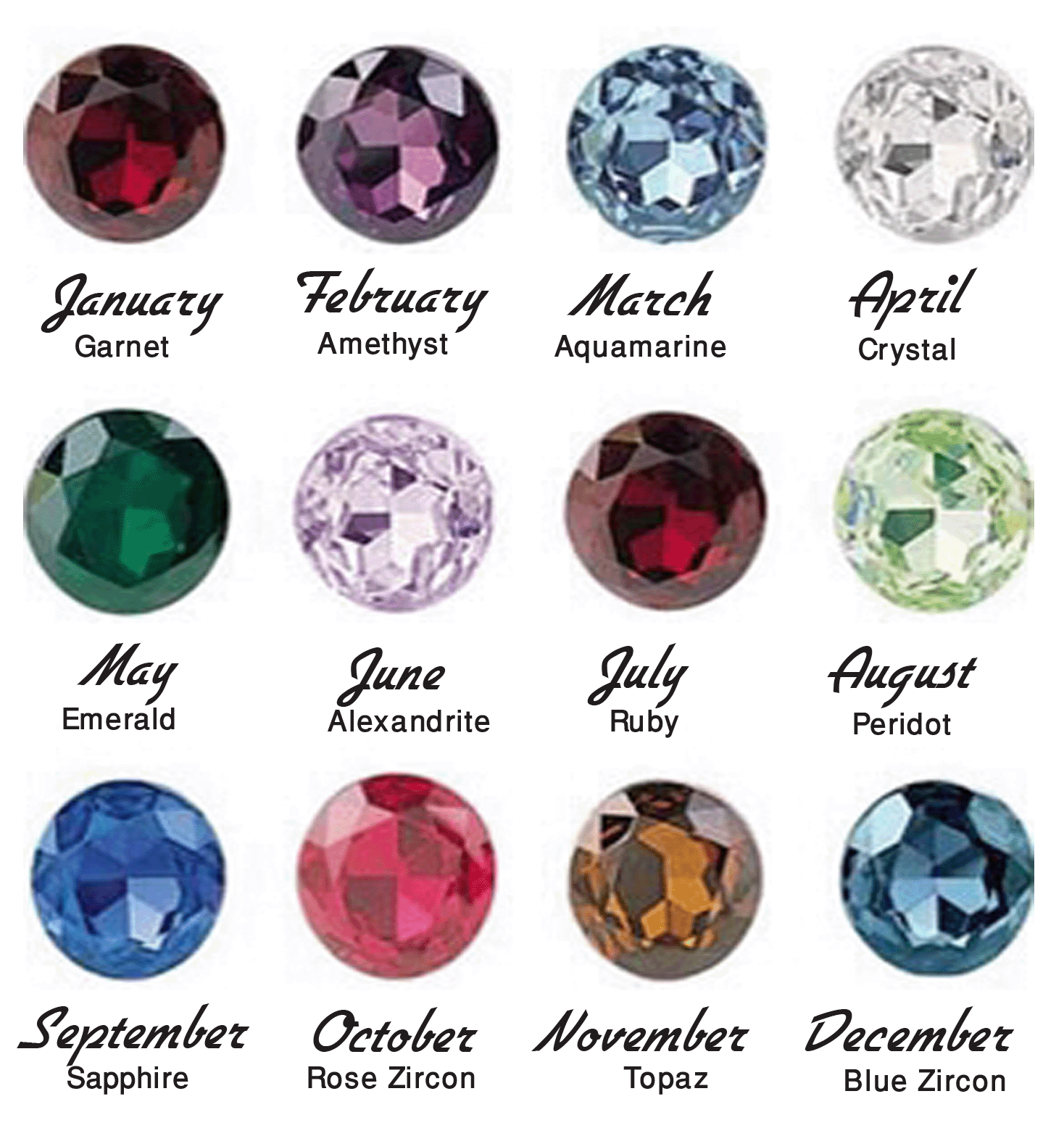
What sort of words are inherently appealing? Well, the example that comes to my mind most readily are the names of gemstones: sapphire, amethyst, aquamarine, chalcedony, emerald, obsidian, and so forth. Now, you might say these words are appealing because of their association with the gemstones they describe, but I think that's only part of it. And quite often I have no image or knowledge of a particular gemstone and I still find the word poetic.

Wilde's masterpiece of decadent poetry "The Sphinx" draws lavishly on these poetic names:

On pearl and porphyry pedestalled he was too bright to look upon:
For on his ivory breast there shone the wondrous ocean-emerald.

(There's a lot more where that comes from.)

This particular strain of poetry is also to be found in the Bible, particularly the Book of Revelation's description of the walls of the New Jerusalem: "The first foundation was jasper. The second was sapphire. The third was chalcedony. The fourth was emerald. The fifth was sardonyx. The sixth was sardius. The seventh was chrysolite. The eighth was beryl. The ninth was topaz. The tenth was chrysoprasus. The eleventh was jacinth. The twelfth was amethyst."

I'm guessing that many of these terms come from Latin and Greek, which perhaps give them that flavour of the exotic, antique and classical from which much of the poetry derives.

Colours and hues often have very poetic names, as well: indigo, heliotrope, burgundy, onyx, cerulean, turquoise, aquamarine, magenta.

Funnily enough, I would make the argument that many diseases have perversely appealing names: gonorrhea, chlamydia, rubella, melanoma, meningitis, and so forth. (You may not agree on that, though).

Another class of words that seem to be inherently poetic, although I think this certainly has a lot to do with meaning as with sound, involve faintness or obscurity: silhouette, whisper, echo, shadow, ghostly, phantasmagoric, rumour, shimmer, flicker, and so forth.


I could go on with lists of word-groups that seem to be generally appealing, but I'll move on to words and phrases that appeal especially to me.

One of my very favourite words is "lobby", and another is "foyer". Of course, "foyer" has a bit of a French glamour to it, but I think the main reason I love both these words is because they describe liminal spaces. I also love (to varying degrees) corridor, plaza, mezzanine, mall, street, alleyway, and avenue. I feel I should include "attic" in this list, even though it's not a liminal space in the same sense as the others; it's not a "between" place like the others. But it's liminal in another way, although it's hard to put my finger on its liminality. (This article addresses this very subject, although it's a bit too woke for my taste.)

Why do I like terms for liminal spaces so much? It's hard to say. There's something very exciting about a liminal space, especially one that is a mixture of "inside" and "outside". All life, all drama is lived in the space between me and you, us and them. Public or semi-public places seem ripe for this drama.

A final place-word which appeals to me enormously, even though it's not really liminal, except insofar as every place could be liminal in some way: canteen (as in, a cafeteria). I love the word canteen. It's so cheerful, down-to-earth, unpretentious, and redolent of a collective life of some kind. I like restaurants which are more like canteens, such as the restaurant in IKEA.


Here's a round-up of some other words I especially love: kaleidoscope, sepia, merry-go-round, horizon, gossamer, alabaster, brandy. I could add many, many more, and I probably will.

Poetry has already begun, in the more conventional sense, when we put words together. So perhaps it's legitimate to say that phrases are already poems, ready-made poems, as it were.

Finally, a list of phrases that excite me (mostly quarried from a previous post):

Softly-falling snow.
The cold light of day (which is supposed to be sobering, but which I find reassuring).
Deep waters.
Dizzy heights.
The morning after the night before.
Down memory lane.
The silver screen.
Till the cows come home.
All human life is there.
Blue moon. (I'm told the song of this title was my mother's party piece.)
The dead of night (also the title of one of my favourite films, Dead of Night from 1945).
The middle of nowhere.
The back of beyond.
In at the deep end.
Burning the midnight oil.
The last bus home.
Night train. (There was a radio show with this title in my childhood, which was broadcast all night long-- or at least, that's the impression I got.)
The graveyard shift.
The old, old story.
The small hours.
The wee hours.
Any phrase involving "country", in this sense: bandit country, cowboy country, gator country, Brontë country, Kavanagh country, etc.

What are some of your favourite words and phrases? No, really, tell me!