My book is now available on Kindle, for seven euro or so.
So if you hold off buying new books because you can't afford the shelf space, hesitate no longer!
Buy it here.
Monday, June 24, 2019

Friday, June 21, 2019
Irish Christian Poets and Writers on Facebook
I've mentioned my desire to set up a Christian writer's group before. Although I hope this to be a group where people actually get together, I thought Facebook would be a good springboard for it.
If you're on Facebook, and you want to join the group, go to this link and send a request to join. You don't have to be Irish.
If you're on Facebook, and you want to join the group, go to this link and send a request to join. You don't have to be Irish.
Dom Gregory Dix on the Celebration of the Mass
I was very moved to discover this passage, quoted in an article by Dwight Longenecker on Corpus Christi. It is taken from Dom Gregory Dix, an Anglican liturgical scholar:

"Was ever another command so obeyed? For century after century, spreading slowly to every continent and country and among every race on earth, this action has been done, in every conceivable human circumstance, for every conceivable human need from infancy and before it to extreme old age and after it, from the pinnacle of earthly greatness to the refuge of fugitives in the caves and dens of the earth. Men have found no better thing than this to do for kings at their crowning and for criminals going to the scaffold; for armies in triumph or for a bride and bridegroom in a little country church; for the proclamation of a dogma or for a good crop of wheat; for the wisdom of the Parliament of a mighty nation or for a sick old woman afraid to die; for a schoolboy sitting an examination or for Columbus setting out to discover America; for the famine of whole provinces or for the soul of a dead lover; in thankfulness because my father did not die of pneumonia; for a village headman much tempted to return to fetich because the yams had failed; because the Turk was at the gates of Vienna; for the repentance of Margaret; for the settlement of a strike; for a son for a barren woman; for Captain so-and-so wounded and prisoner of war; while the lions roared in the nearby amphitheater; on the beach at Dunkirk; while the hiss of scythes in the thick June grass came faintly through the windows of the church; tremulously, by an old monk on the fiftieth anniversary of his vows; furtively, by an exiled bishop who had hewn timber all day in a prison camp near Murmansk; gorgeously, for the canonization of S. Joan of Arc—one could fill many pages with the reasons why men have done this, and not tell a hundredth part of them. And best of all, week by week and month by month, on a hundred thousand successive Sundays, faithfully, unfailingly, across all the parishes of Christendom, the pastors have done this just to make the plebs sancta Dei—the holy common people of God."

"Was ever another command so obeyed? For century after century, spreading slowly to every continent and country and among every race on earth, this action has been done, in every conceivable human circumstance, for every conceivable human need from infancy and before it to extreme old age and after it, from the pinnacle of earthly greatness to the refuge of fugitives in the caves and dens of the earth. Men have found no better thing than this to do for kings at their crowning and for criminals going to the scaffold; for armies in triumph or for a bride and bridegroom in a little country church; for the proclamation of a dogma or for a good crop of wheat; for the wisdom of the Parliament of a mighty nation or for a sick old woman afraid to die; for a schoolboy sitting an examination or for Columbus setting out to discover America; for the famine of whole provinces or for the soul of a dead lover; in thankfulness because my father did not die of pneumonia; for a village headman much tempted to return to fetich because the yams had failed; because the Turk was at the gates of Vienna; for the repentance of Margaret; for the settlement of a strike; for a son for a barren woman; for Captain so-and-so wounded and prisoner of war; while the lions roared in the nearby amphitheater; on the beach at Dunkirk; while the hiss of scythes in the thick June grass came faintly through the windows of the church; tremulously, by an old monk on the fiftieth anniversary of his vows; furtively, by an exiled bishop who had hewn timber all day in a prison camp near Murmansk; gorgeously, for the canonization of S. Joan of Arc—one could fill many pages with the reasons why men have done this, and not tell a hundredth part of them. And best of all, week by week and month by month, on a hundred thousand successive Sundays, faithfully, unfailingly, across all the parishes of Christendom, the pastors have done this just to make the plebs sancta Dei—the holy common people of God."
Accommodation Query
If anyone knows of cheaply priced accommodation in the Dublin area for a Catholic couple, feel free welcome to contact me at Maolsheachlann@gmail.com. Even a room would do.
This couple are having all kinds of accommodation woes.
This couple are having all kinds of accommodation woes.
Wednesday, June 19, 2019
Chinese Whispers: A Poem
This is a poem I wrote in 1997, but (strangely) never blogged until now. I actually think it's pretty good. The poetry of my late teens and early twenties was actually better than most of the stuff I wrote when I was older. I was much more painstaking about it. I'm quite proud of the would-be-Keatsian flourish at the end of this one.
Chinese Whispers
The morning lights the room as dreams disperse.
I climb into my clothes in awkward haste
To chase the morning bus I've often chased.
But from forgotten dreams strange spirits hang
Like half-remembered lines from an old verse
And fill the world with an elusive tang.
Where do dreams come from? What mysterious zone
Cut off within the dark side of the brain?
And why do these vague vestiges remain?
No answer-- so I shove the questions down.
But as I move my thoughts don't seem my own.
They frolic as the bus moves into town.
And suddenly the streets become a dream;
Their concrete blocks and Georgians facades
Seem unconnected thoughts some dreamer adds
Together in a surrealistic brew.
I feel life come unstitched at every seam
And everything I see, I see anew.
And as I disembark into the crowd
I think of how old times, long since played out,
Live on in noises made in every mouth.
All history becomes one ancient day.
I look around the street, absurdly proud
Of man, as if I watched from worlds away.
These streets, these channels of a common mind,
What were they raised from? Wilderness and waste.
There is no province man has not embraced.
His thumbprint lies on everything I see.
Where did we come from? Nowhere I can find
The footprints fade into antiquity.
And let them fade-- my head begins to swim,
This many-coloured morning wracks my brain.
Let life's exquisite mystery remain,
Leave unrevealed the roots from which we clamber!
What is a dream, but life, confused and dim?
Where is the past, but locked in living amber?

It's interesting to me to read back on this twenty-one-year old poem, and to see how the same themes that preoccupy me now, also preoccupied me back then. Most obviously, a fascination with dreams and the dreamworld, in all the many meanings of the word "dream". I've written about that in many blog posts, but especially in this one about The Wizard of Oz. As well as this, a fascination with history and tradition and the living past, and with mystery. And then there is the dialectic of memory and oblivion, which I was writing about very recently.

Chinese Whispers
The morning lights the room as dreams disperse.
I climb into my clothes in awkward haste
To chase the morning bus I've often chased.
But from forgotten dreams strange spirits hang
Like half-remembered lines from an old verse
And fill the world with an elusive tang.
Where do dreams come from? What mysterious zone
Cut off within the dark side of the brain?
And why do these vague vestiges remain?
No answer-- so I shove the questions down.
But as I move my thoughts don't seem my own.
They frolic as the bus moves into town.
And suddenly the streets become a dream;
Their concrete blocks and Georgians facades
Seem unconnected thoughts some dreamer adds
Together in a surrealistic brew.
I feel life come unstitched at every seam
And everything I see, I see anew.
And as I disembark into the crowd
I think of how old times, long since played out,
Live on in noises made in every mouth.
All history becomes one ancient day.
I look around the street, absurdly proud
Of man, as if I watched from worlds away.
These streets, these channels of a common mind,
What were they raised from? Wilderness and waste.
There is no province man has not embraced.
His thumbprint lies on everything I see.
Where did we come from? Nowhere I can find
The footprints fade into antiquity.
And let them fade-- my head begins to swim,
This many-coloured morning wracks my brain.
Let life's exquisite mystery remain,
Leave unrevealed the roots from which we clamber!
What is a dream, but life, confused and dim?
Where is the past, but locked in living amber?

Tuesday, June 18, 2019
Claustrophobia in IKEA
IKEA came to Ballymun (where I live) in 2009. It was a big deal. There was even a play anticipating its arrival in the local arts centre, called Waiting for IKEA.

Other than putting my head in once, I'd never shopped there until this year. Since then I've made shopping trips to it, and I've had several dinners and breakfasts in its restaurant.
Níl me ar tí caitheamh anuas ar IKEA (I'm not going to start bitching about IKEA). IKEA is fine. It sells handsome, affordable furniture and household goods. The restaurant is cheap and tasty enough (and I even rather enjoy the cafetaria atmosphere). I understand the company treats its employees well. I have no beef with IKEA per se.
But every time I've eaten in the IKEA restaurant, and very often when I've shopped in IKEA, I've found myself falling into a strange and unpleasant mood. It's a mood I've experienced elsewhere (in airports, for instance), but it seems especially vivid in IKEA.
"Claustrophobia" is one way to describe it, although it should be understood that I'm using the term very loosely.
It's a social and cultural sort of claustrophobia, rather than the more literal sort. Somehow, sitting in that flat and grid-like restaurant, and watching the other diners carry their trays to their tables, modern society seems painfully homogeneous, prosaic, utilitarian, dull and conformist to me. I feel as though I'm suffocating.
Now, I'm well aware of the many responses that could be made to this-- and I accept that they have considerable merit.
Has any society ever really been anything except conformist? We can romanticize the Eskimos or the medieval Gaels or the maypole-dancing denizens of Merrie England, but surely they were much more conformist than we are. When everybody danced around the maypole, what was unusual about dancing around the maypole?
Don't we have our own cultural forms, such as the cinema and the car booth sale, which are quite picturesque in their own right?
Don't we now romanticize cultural forms which were seen as drab in their own time? G.K. Chesterton never tired of mocking the frock coat and the top hat (or stovepipe hat, as he called it). He saw them as horribly prosaic, and compared them unfavourably with the dress of previous ages. But we see them as elegant and picturesque today.
As for utilitarianism, isn't it perhaps fair to say that people have always been utilitarian, but they simply believed in supernatural agency in the past and no longer do so? Folk cures or local superstitions that seem quaint or delightful to us, may simply have seemed as straightforward as filling out an application form to them. And even the most ardent defender of Christendom would have to admit that the priesthood and religious orders were very often pursued as a means of advancement, rather than as spiritual vocations.
When people told stories about Robin Hood or Fionn MacCumhail in the long winter nights, weren't they simply using the entertainment that was available to them? How do we know they wouldn't all have chosen to watch Top Gear if they could have?
There's another response which could be made to this claustrophobic reaction of mine, one that comes from my own soul rather than one I anticipate from other people.
The thing is, I love ordinary life. I've always felt ferociously protective of the things that make up the common round of living for most people--- having breakfast, going to the movies, playing a board game, reading a library book, taking a bubble bath, standing at a train platform, and so on.
Groundhog Day is my favourite movie because it's all about the wonder of ordinary life, of the routine things we too often take for granted. G.K. Chesterton constantly wrote on this same theme-- one of the reasons (perhaps the main reason) he is my favourite author.

And yet, as we've seen, Chesterton never hesitated to decry a given social or cultural change-- for instance, the transition from fireplaces to central heating, or from social singing to passively listening to other people singing.
How do we remain loyal to a primordial sense of gratitude, a love of the ordinary and everyday and actually existing, without falling into the quietism expressed in Alexander Pope's famous formula: "Whatever is, is right"? Chesterton himself was aware of this problem, and wrote about it.
Life is wonderful. We can never exhaust the wonder of a single moment of life, or feel enough gratitude for it. The world is indeed a wonderland.
And yet-- there is better and worse. There are things worth preserving, worth defending, and other things are worth resisting. Il faut cultiver notre jardain (ní mór dúinn ár ngairdín a shaothrigh).
So what do I mean when I complain about modern life being homogeneous, prosaic, dull or conformist?
It's hard to describe, because it's a vague feeling.
When I look at the people streaming through IKEA, or through the concourse of an airport, I find myself craving something different. I find myself yearning for the sight of some eccentric, dressed all in tweed and wearing thick horn-rimmed glasses, carrying a huge sheaf of mysterious papers under his arm.
Or a Scottish man in a kilt.
Or a priest, or a nun-- not in civvies.
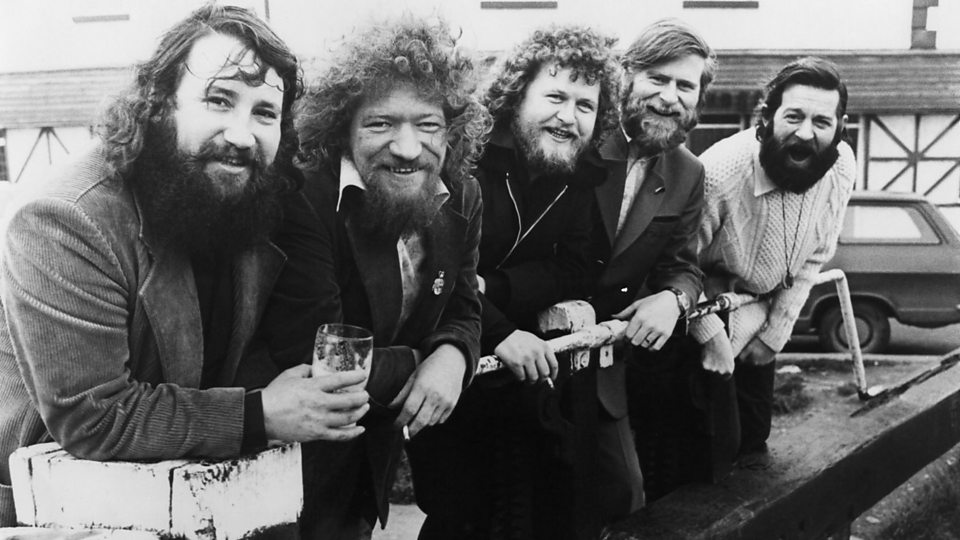
Or a barrel-chested Irishman with a huge bristly beard, an Aran sweater, and a cloth cap, humming a street ballad.
Or two nerdy-looking young chaps sitting at a table playing chess, their fish and chips shoved to one side.
Or two old guys having a loud discussion about the English Civil War, or Keynesian economics, or the philosophy of Martin Heidegger, or Freud.
Or a Hasidic Jewish family in their dark clothing, the father sporting a wide-brimmed hat and a long beard. Or a Sikh in his turban.
Or two clean-shaven Mormon missionaries in pressed white shirts and dark slacks, their name-badges improbably proclaiming them to be "elders".
Or a hippy. Or a hipster. Or a Goth. (Yes, I'll even take such sub-cultures over bland conformity.)
Or a self-proclaimed poet bearing a black-thorn stick and with his collar open at the neck, selling copies of his self-published pamphlet The Mysterious Window and Other Poems.
Or...
Well, you get the point. Something different. Something distinctive. Something for the mind and imagination to seize upon, something that makes life seem as rich and flavourful as a currant cake or a Christmas stocking. A character that might turn up in a Dickens novel or a situation comedy.
Perhaps this isn't fair. Perhaps I should look past the surface. Perhaps, if I could turn invisible and visit all the different tables in the IKEA restaurant, the conversations I overheard would be as startling and as intriguing as any eccentric individual that would turn heads in the street.
But the thing is-- and I feel a little bit bad admitting this-- I don't think this is the case. You see, I do overhear conversations in restaurants and pubs and cafés. It's unavoidable. And what I hear rarely leaves me with the feeling that the interior of everyday life is much more varied or surprising or picturesque than the surface.

Instead, I have a depressing image of vast crowds of people wearing jeans and sweatshirts, pushing trolleys through the aisles of shops whose air is filled with bland pop music, talking about Downtown Abbey and soccer and Donald Trump-- whatever is in the headlines at the moment.
That's a caricature, but (like all caricatures) I think it bears some resemblance to reality.
I'm always frightened of my own tendency towards nostalgia. But is it really the case that "things were ever thus?"
What about dress? I don't have much of an eye for dress, and miss the subtleties of fashion. But when I look at old photographs, it occurs to me that clothing was less globalized and homogenized in the recent past. For instance, virtually all Irish women seem to have worn headscarves up until the nineteen-sixties at least. And this seems to have been particular to Ireland.
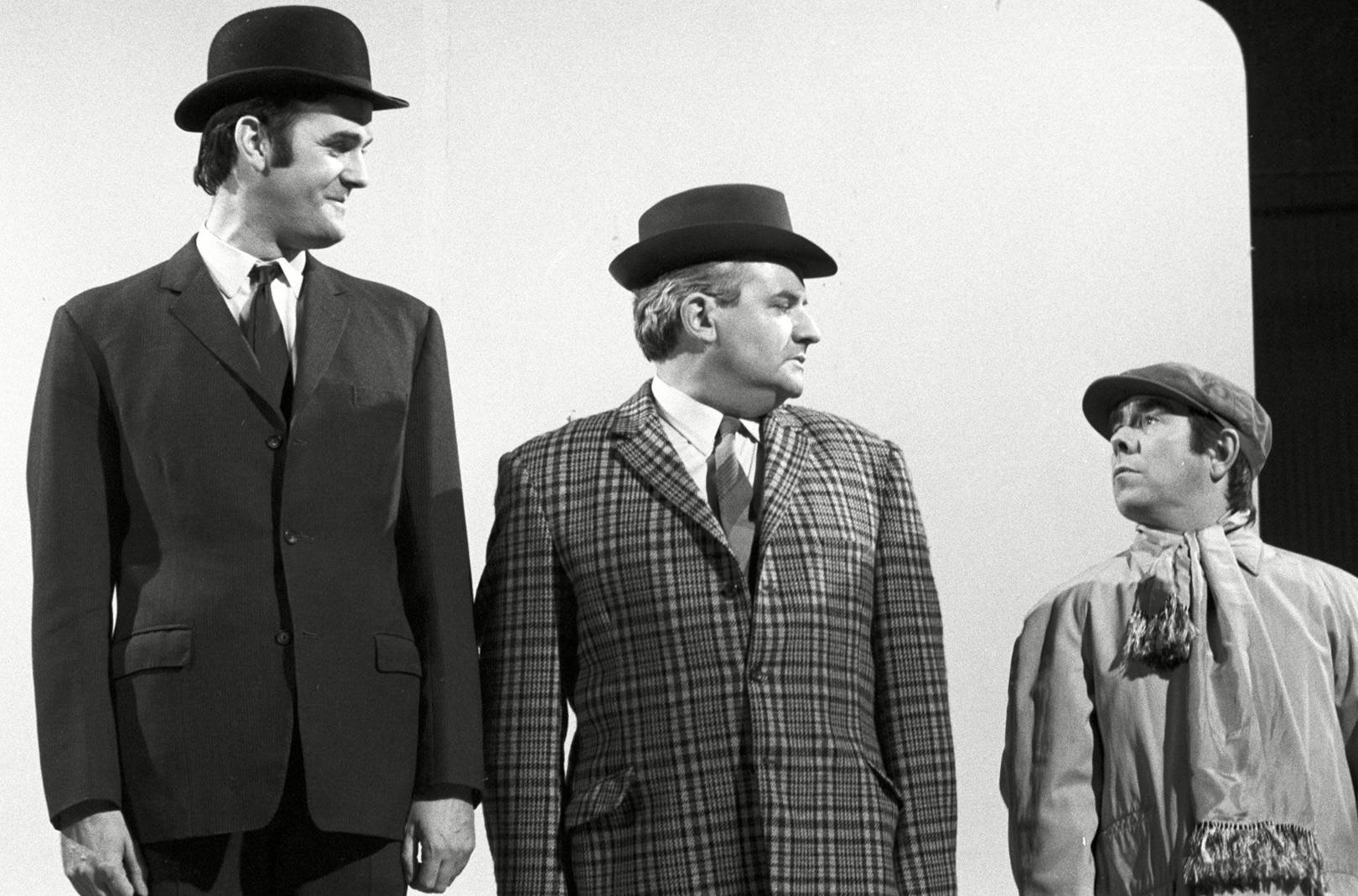
I think there was more variation within countries, as well-- based on class, region, and profession. Take, for instance. the famous "class" sketch from The Frost Report, in which three comedians represent the upper class, the middle class, and the working class-- each one recognisable from their clothing. Once again, I get the impression from the footage and photographs I've seen that this is a reasonable, if exaggerated, representation of how different classes dressed. (This is one of the reasons I don't believe class is necessarily a bad thing-- I think it can add colour to the spectacle of life.)
I've worked in a university all my life. I'm delighted that the stereotype of the tweedy, elbow-patched professor still endures. Once I even saw such a figure puffing on a pipe. I felt like walking up to him and shaking his hand. Sadly, I rarely see students wear the coloured college scarf-- at least not with the ends draped jauntily over each shoulder, in the time-honoured manner.
I also suspect there is an erosion of high culture, and especially of poetry, which has drained some of the picturesqueness out of everyday life. It's hard to measure such things, since they are based on scattered impressions over many years, but it seems to me that people have become (over several generations) less and less likely to sprinkle quotations from Scripture, poetry, history, and literature into their ordinary conversation. They are more likely to draw on movies and TV and rock music. I don't despise those sources, but they don't seem quite as rich or elevating.
(Pop culture can add to the picturesqueness of everyday life, however. I treasure the day I saw a fully-suited Imperial Stormtrooper walking down O'Connell Street, at the time Star Wars: The Force Awakens was first released. It was a moment of visual poetry.)
But what about me? Am I adding to the character of everyday life? Am I relieving its blandness in any way? (An bhfuil mé ag thabhairt faoiseamh ar bith in aghaidh an leimhe seo, mé fhéin?)
This has been a lifelong anxiety of my own. I feel guilty about it. I've always felt a strong inclination to cultivate eccentricities. Perhaps one could say this was from a desire for attention. But I actually believe it was much more motivated by the considerations I've outlined here. I don't remember doing it for attention.
In school, I went through a craze of writing the word "Homestead" on my class-mates' copy-books. Homestead was a brand of household goods. This was a self-conscious form of zaniness on my part. Someone eventually jumped on the bandwagon by writing "Cadbury's" instead.
One day, I heard a member of family describe how his friend, on buying a book in a bookshop, had taken the book out of its paper bag, and proceeded to eat the paper bag in front of the shop assistant. I thought this was the most wonderful thing I had ever heard, and felt it was imperative to emulate it. Within an hour, I had walked into my local shop with a half-a-dozen clothes pegs attached to my hair, and casually asked for milk (or something like that). I reckon I was about ten or eleven at at this time.
Even today, I feel this urge. I feel it especially when it comes to my reactionary and unfashionable beliefs. A few years ago, I made a large badge displaying the Chi-Ro symbol. I already had the badge-making kit, which I used to make a "Vote No to Save Marriage" badge during Ireland's gay marriage referendum. (I had to make my own badge in that instance, as nobody else seemed to be making them.) It aroused considerable interest and speculation. I was aware it might be seen as ostentatious and excessively pious, but I was confident that my motives were not self-congratulation or boastfulness. I wanted to evangelize, and to push against the secular tide. And I also wanted, in the spirit of this post, to add my own dash of picturesqueness to everyday life. (I eventually lost my nerve and stopped wearing it, though.)

I have examples from other peoples' lives-- although the first is actually from someone else's death. A few years ago, I attended the memorial service of a woman who had loved frogs. Everybody knew she loved frogs, that she was the frog lady. Her cremated remains were held in a frog-shaped urn, and there were many other frog references throughout the service. I admired this, and rather envied her.
On another occasion, in America, I visited an elderly woman who had en entire bedroom devoted to cowboy memorabilia. She was a perfectly sane and normal person, but she had another eccentricity as well-- she handwrote little TV listings magazines, listing the imaginary schedules of imaginary channels. Once again, I was admiring and somewhat envious. That's the sort of thing I'm talking about. That and much more.
I hope that makes sense. I hope it makes some sense. My thoughts are running more and more on this theme recently, so I will probably return to it again before long.

Other than putting my head in once, I'd never shopped there until this year. Since then I've made shopping trips to it, and I've had several dinners and breakfasts in its restaurant.
Níl me ar tí caitheamh anuas ar IKEA (I'm not going to start bitching about IKEA). IKEA is fine. It sells handsome, affordable furniture and household goods. The restaurant is cheap and tasty enough (and I even rather enjoy the cafetaria atmosphere). I understand the company treats its employees well. I have no beef with IKEA per se.
But every time I've eaten in the IKEA restaurant, and very often when I've shopped in IKEA, I've found myself falling into a strange and unpleasant mood. It's a mood I've experienced elsewhere (in airports, for instance), but it seems especially vivid in IKEA.
"Claustrophobia" is one way to describe it, although it should be understood that I'm using the term very loosely.
It's a social and cultural sort of claustrophobia, rather than the more literal sort. Somehow, sitting in that flat and grid-like restaurant, and watching the other diners carry their trays to their tables, modern society seems painfully homogeneous, prosaic, utilitarian, dull and conformist to me. I feel as though I'm suffocating.
Now, I'm well aware of the many responses that could be made to this-- and I accept that they have considerable merit.
Has any society ever really been anything except conformist? We can romanticize the Eskimos or the medieval Gaels or the maypole-dancing denizens of Merrie England, but surely they were much more conformist than we are. When everybody danced around the maypole, what was unusual about dancing around the maypole?
Don't we have our own cultural forms, such as the cinema and the car booth sale, which are quite picturesque in their own right?
Don't we now romanticize cultural forms which were seen as drab in their own time? G.K. Chesterton never tired of mocking the frock coat and the top hat (or stovepipe hat, as he called it). He saw them as horribly prosaic, and compared them unfavourably with the dress of previous ages. But we see them as elegant and picturesque today.
As for utilitarianism, isn't it perhaps fair to say that people have always been utilitarian, but they simply believed in supernatural agency in the past and no longer do so? Folk cures or local superstitions that seem quaint or delightful to us, may simply have seemed as straightforward as filling out an application form to them. And even the most ardent defender of Christendom would have to admit that the priesthood and religious orders were very often pursued as a means of advancement, rather than as spiritual vocations.
When people told stories about Robin Hood or Fionn MacCumhail in the long winter nights, weren't they simply using the entertainment that was available to them? How do we know they wouldn't all have chosen to watch Top Gear if they could have?
There's another response which could be made to this claustrophobic reaction of mine, one that comes from my own soul rather than one I anticipate from other people.
The thing is, I love ordinary life. I've always felt ferociously protective of the things that make up the common round of living for most people--- having breakfast, going to the movies, playing a board game, reading a library book, taking a bubble bath, standing at a train platform, and so on.
Groundhog Day is my favourite movie because it's all about the wonder of ordinary life, of the routine things we too often take for granted. G.K. Chesterton constantly wrote on this same theme-- one of the reasons (perhaps the main reason) he is my favourite author.
And yet, as we've seen, Chesterton never hesitated to decry a given social or cultural change-- for instance, the transition from fireplaces to central heating, or from social singing to passively listening to other people singing.
How do we remain loyal to a primordial sense of gratitude, a love of the ordinary and everyday and actually existing, without falling into the quietism expressed in Alexander Pope's famous formula: "Whatever is, is right"? Chesterton himself was aware of this problem, and wrote about it.
Life is wonderful. We can never exhaust the wonder of a single moment of life, or feel enough gratitude for it. The world is indeed a wonderland.
And yet-- there is better and worse. There are things worth preserving, worth defending, and other things are worth resisting. Il faut cultiver notre jardain (ní mór dúinn ár ngairdín a shaothrigh).
So what do I mean when I complain about modern life being homogeneous, prosaic, dull or conformist?
It's hard to describe, because it's a vague feeling.
When I look at the people streaming through IKEA, or through the concourse of an airport, I find myself craving something different. I find myself yearning for the sight of some eccentric, dressed all in tweed and wearing thick horn-rimmed glasses, carrying a huge sheaf of mysterious papers under his arm.
Or a Scottish man in a kilt.
Or a priest, or a nun-- not in civvies.
Or a barrel-chested Irishman with a huge bristly beard, an Aran sweater, and a cloth cap, humming a street ballad.
Or two nerdy-looking young chaps sitting at a table playing chess, their fish and chips shoved to one side.
Or two old guys having a loud discussion about the English Civil War, or Keynesian economics, or the philosophy of Martin Heidegger, or Freud.
Or a Hasidic Jewish family in their dark clothing, the father sporting a wide-brimmed hat and a long beard. Or a Sikh in his turban.
Or two clean-shaven Mormon missionaries in pressed white shirts and dark slacks, their name-badges improbably proclaiming them to be "elders".
Or a hippy. Or a hipster. Or a Goth. (Yes, I'll even take such sub-cultures over bland conformity.)
Or a self-proclaimed poet bearing a black-thorn stick and with his collar open at the neck, selling copies of his self-published pamphlet The Mysterious Window and Other Poems.
Or...
Well, you get the point. Something different. Something distinctive. Something for the mind and imagination to seize upon, something that makes life seem as rich and flavourful as a currant cake or a Christmas stocking. A character that might turn up in a Dickens novel or a situation comedy.
Perhaps this isn't fair. Perhaps I should look past the surface. Perhaps, if I could turn invisible and visit all the different tables in the IKEA restaurant, the conversations I overheard would be as startling and as intriguing as any eccentric individual that would turn heads in the street.
But the thing is-- and I feel a little bit bad admitting this-- I don't think this is the case. You see, I do overhear conversations in restaurants and pubs and cafés. It's unavoidable. And what I hear rarely leaves me with the feeling that the interior of everyday life is much more varied or surprising or picturesque than the surface.
Instead, I have a depressing image of vast crowds of people wearing jeans and sweatshirts, pushing trolleys through the aisles of shops whose air is filled with bland pop music, talking about Downtown Abbey and soccer and Donald Trump-- whatever is in the headlines at the moment.
That's a caricature, but (like all caricatures) I think it bears some resemblance to reality.
I'm always frightened of my own tendency towards nostalgia. But is it really the case that "things were ever thus?"
What about dress? I don't have much of an eye for dress, and miss the subtleties of fashion. But when I look at old photographs, it occurs to me that clothing was less globalized and homogenized in the recent past. For instance, virtually all Irish women seem to have worn headscarves up until the nineteen-sixties at least. And this seems to have been particular to Ireland.
I think there was more variation within countries, as well-- based on class, region, and profession. Take, for instance. the famous "class" sketch from The Frost Report, in which three comedians represent the upper class, the middle class, and the working class-- each one recognisable from their clothing. Once again, I get the impression from the footage and photographs I've seen that this is a reasonable, if exaggerated, representation of how different classes dressed. (This is one of the reasons I don't believe class is necessarily a bad thing-- I think it can add colour to the spectacle of life.)
I've worked in a university all my life. I'm delighted that the stereotype of the tweedy, elbow-patched professor still endures. Once I even saw such a figure puffing on a pipe. I felt like walking up to him and shaking his hand. Sadly, I rarely see students wear the coloured college scarf-- at least not with the ends draped jauntily over each shoulder, in the time-honoured manner.
I also suspect there is an erosion of high culture, and especially of poetry, which has drained some of the picturesqueness out of everyday life. It's hard to measure such things, since they are based on scattered impressions over many years, but it seems to me that people have become (over several generations) less and less likely to sprinkle quotations from Scripture, poetry, history, and literature into their ordinary conversation. They are more likely to draw on movies and TV and rock music. I don't despise those sources, but they don't seem quite as rich or elevating.
(Pop culture can add to the picturesqueness of everyday life, however. I treasure the day I saw a fully-suited Imperial Stormtrooper walking down O'Connell Street, at the time Star Wars: The Force Awakens was first released. It was a moment of visual poetry.)
But what about me? Am I adding to the character of everyday life? Am I relieving its blandness in any way? (An bhfuil mé ag thabhairt faoiseamh ar bith in aghaidh an leimhe seo, mé fhéin?)
This has been a lifelong anxiety of my own. I feel guilty about it. I've always felt a strong inclination to cultivate eccentricities. Perhaps one could say this was from a desire for attention. But I actually believe it was much more motivated by the considerations I've outlined here. I don't remember doing it for attention.
In school, I went through a craze of writing the word "Homestead" on my class-mates' copy-books. Homestead was a brand of household goods. This was a self-conscious form of zaniness on my part. Someone eventually jumped on the bandwagon by writing "Cadbury's" instead.
One day, I heard a member of family describe how his friend, on buying a book in a bookshop, had taken the book out of its paper bag, and proceeded to eat the paper bag in front of the shop assistant. I thought this was the most wonderful thing I had ever heard, and felt it was imperative to emulate it. Within an hour, I had walked into my local shop with a half-a-dozen clothes pegs attached to my hair, and casually asked for milk (or something like that). I reckon I was about ten or eleven at at this time.
Even today, I feel this urge. I feel it especially when it comes to my reactionary and unfashionable beliefs. A few years ago, I made a large badge displaying the Chi-Ro symbol. I already had the badge-making kit, which I used to make a "Vote No to Save Marriage" badge during Ireland's gay marriage referendum. (I had to make my own badge in that instance, as nobody else seemed to be making them.) It aroused considerable interest and speculation. I was aware it might be seen as ostentatious and excessively pious, but I was confident that my motives were not self-congratulation or boastfulness. I wanted to evangelize, and to push against the secular tide. And I also wanted, in the spirit of this post, to add my own dash of picturesqueness to everyday life. (I eventually lost my nerve and stopped wearing it, though.)
I have examples from other peoples' lives-- although the first is actually from someone else's death. A few years ago, I attended the memorial service of a woman who had loved frogs. Everybody knew she loved frogs, that she was the frog lady. Her cremated remains were held in a frog-shaped urn, and there were many other frog references throughout the service. I admired this, and rather envied her.
On another occasion, in America, I visited an elderly woman who had en entire bedroom devoted to cowboy memorabilia. She was a perfectly sane and normal person, but she had another eccentricity as well-- she handwrote little TV listings magazines, listing the imaginary schedules of imaginary channels. Once again, I was admiring and somewhat envious. That's the sort of thing I'm talking about. That and much more.
I hope that makes sense. I hope it makes some sense. My thoughts are running more and more on this theme recently, so I will probably return to it again before long.
Thursday, June 13, 2019
Thank You
Today I found myself feeling very grateful towards the readers of this blog.
Some of you have read this blog from its beginnings back in 2011. Some are more recent readers.
I'm very touched and very grateful for the kindness of my readers; reading, commenting, emailing, praying, and many other gestures and generosities.
I do pray for my readers, as well.
Some people can write without caring whether anyone ever reads what they write. I'm not like that. Although the act of writing is extremely enjoyable in itself, writing without anyone to read what you've written (to me) would be like cooking and throwing the food in the bin.
Even when I write my diary, I'm writing for myself in the future, and also with the hope that someone else may read it some day.
I'm not a very self-confident person and I greatly appreciate encouragement. It means a huge deal to me that people read this blog. Go raibh míle maith agaibh.
Some of you have read this blog from its beginnings back in 2011. Some are more recent readers.
I'm very touched and very grateful for the kindness of my readers; reading, commenting, emailing, praying, and many other gestures and generosities.
I do pray for my readers, as well.
Some people can write without caring whether anyone ever reads what they write. I'm not like that. Although the act of writing is extremely enjoyable in itself, writing without anyone to read what you've written (to me) would be like cooking and throwing the food in the bin.
Even when I write my diary, I'm writing for myself in the future, and also with the hope that someone else may read it some day.
I'm not a very self-confident person and I greatly appreciate encouragement. It means a huge deal to me that people read this blog. Go raibh míle maith agaibh.
Subscribe to:
Posts (Atom)