Tuesday, July 22, 2025

Woke Gets Everywhere

One of the things I hate most about woke is how all-pervasive it is. Why this should be the case is something of a mystery, since I think most people are more anti-woke than woke. Perhaps it's because most people are also generally agreeable and don't like to get into an argument. The woke brigade take advantage of this. (Every faction takes advantage of this, but the woke brigade are in the ascendant now.)

I've mentioned my interest in the concept of atmosphere, atmosphere in the sense of a social or emotional ambience. I'm rather afraid you're groaning right now, dear reader, and wondering why I'm so interested in atmosphere.

Well, in a nutshell, because it's so elusive and yet so vital to human life. Most things can be pinned down pretty well. For instance, you can say a particular town flourished because it was on a new railway line, or that a new haircut became popular because an actress in a big Hollywood movie wore it.


But atmosphere is extremely hard to pin down. Impossible, probably. For instance, when people write about the nineteen-seventies, they talk about the "atmosphere" of an increased interest in traditions or roots or belonging, or any other number of atmospheres.

When we evoke atmosphere, it's generally not a shorthand for something that could actually be itemized if we took the trouble. It seems irreducible in very many cases. (Sometimes, even in work meetings-- where, one would imagine, brass tacks are what's on the menu-- I often hear people say "There's that sense of...", or some such usage.)

Anyway, I'm very interested in atmosphere. But I'm interested in atmosphere mostly as something nice, or at least neutral. I'm interested in atmospheres the way many people are interested in food, clothes, or transport.

So I can imagine myself (in an alternative world) founding a field of study called "Socio-atmospherics", that would engage in activities such as studying this or that atmosphere. You might, for instance, study it by collecting examples of how people have described it or tried to evoke it.


So you might take the atmosphere of fish and chip shops, for instance, and collect instances where they are described-- articles, passages in novels, that kind of thing. You might even take photos of them and try to work out what aesthetic fish and chip shops generally strive for.
 
Socio-atmospherics wouldn't be confined to places, of course. It could also examine times, situations, subcultures...anything, really.

Well, contrast that to what I found when I came across a journal called Emotion, Space, and Society that describes its mission thus: "Emotion, Space and Society provides a forum for multidisciplinary and interdisciplinary debate on theoretically informed research on the emotional intersections between people and places. These objectives are broadly conceived and seek to encourage investigations of feelings, encounter and affect in various spatial and social contexts, environments and landscapes." (I have access to these kind of academic journals through my job in a university library.)

Bingo, right?

Not really.


Here are a list of article titles from Emotion, Space and Society:

"“Media is absolutely disgusting”: Emotions and affect towards political elites, information sources and conspiracy theories in anti-lockdown protests."

"Safe behind the gate: Safety perceptions of residents in barrios cerrados in La Plata."

"Violence as ‘adii: atmospheric manifestations of normalised violence in the occupied West Bank."

"Eco-emotions in climate deliberation: A deliberative mini-public on consumption and mobility in Spain."

"Creating safer spaces in higher education: failure and discomfort in spacing for difference."

"Esports events & hegemonic masculinity: Reflections on participant-observation at Evolution Championship Series 2019."

You get the picture. 

One doesn't need to read these articles to know their ideological slant. The first article is inevitably going to assume that all "conspiracy theories" on public health questions are deluded (or "misinformation"); the last article is going to assume that masculinity is "hegemonic" and that all women's and men's problems both come from The Patriarchy.  Feminism has nothing to do with it!

I still hope there are a few interesting articles in there that aren't weighed down with ideological baggage. I actually glimpsed a couple of promising-looking ones and intend to do a deeper trawl.


But it's sad that I have to
trawl. Here's the thing: I don't want to be fulminating against political correctness all the time. I don't want everything to be politicized.

Even the most left-wing person could surely find plenty to write about, within this journal's remit, without lurching into their victimhood and oppression narratives.

It's hilarious that leftists stereotype conservatives (and anti-woke libertarians etc.) as people who are just itching to be offended by anything remotely resembling woke. Some people might be like that. I enjoy some ideological combat as much as anybody. But not all the time. Most of the time (like most people, I think) I just want to watch a film, read a history book, listen to a joke, or read an article about socio-atmospherics.

Saturday, July 19, 2025

What I Want in a Book

I love books. You love books, don't you? Of course you do. I doubt anybody who doesn't love books reads this blog.

Today I found myself thinking-- not for the first time-- about what I want in a book.

I'm not really talking about the content of a book here. I'm not talking about what makes a book a great book, or even a good book. I'm talking about what I want from any book.

This thought came to me in the context of first lines and last lines.

Basically, I want a first line to come with a flourish, and I want the same with the last line. It might be a strange quirk but nothing irritates me more, in the context of books, than a purely functional opening sentence and final sentence. It's the literary equivalent of a curt nod. Or even the lack of a curt nod.

I don't care what sort of book it is. In fact, the more mundane or trivial the subject, the more I want the book to open and close with a flourish. I want a book to take itself seriously, especially if this takes some chutzpah.

So even if it's a parish history, or a get-fit manual, or a guide to pub games...I want it to play up its subject a little bit, or preferably a lot. I want it to welcome me, and to leave a ringing goodbye in my ears. (My all-time favourite example of this is the last lines of the introduction to The Year in Music 1978 by Judith Glassman: "It is music and, in 1978, as always, it was ineffable and inexplicable, mere vibrations in the air with a power to cheer or sadden, to gladden and amaze, to move, so soothe, to awaken. It was the expression of an ancient art wrapped in layers of myth, echoes of Prometheus who shares his fire anew on each fresh, darkened stage. It was glorious and inexhaustible." That's the sort of showmanship I want from authors!)

What really bothers me are books that are really just files between two covers, repositories of information. I hate that.

And this preference, really, determines all my wants in a book.

I want a book to make an effort. I want some hype, some pizazz.

So a book without an introduction seems to me like a house without a welcome mat. But what I really like is an introduction, a preface, and a foreword.

And, while we're at it, I'd also like an afterword, a postcript, an epigraph, a dedication, an acknowledgements page, and so on. "A note on the type" is especially nice, since it's so utterly gratuitous. Whoever looked for one of those?

Oh, and there should certainly be a publisher's logo. I have a lot to say about publisher's logos, but it might be too much of a digression. (One of my colleagues wrote an excellent two-part post on this subject, here and here.)

There's some things I could live without. I don't like it when a novel has the opening section of the author's next novel at the end. I never read those. Maybe because they seem too crassly commercial, or because I don't want to get invested in a story I might not finish. Similarly, any advertising material is dispensable, such as ads for other books by the publishing house.

An index is useful in a non-fiction book, but it doesn't bother me when it's not there. I don't care about bibliographies or "further reading" lists.

Also (for whatever reason), my wants in a book apply to its written contents only. I've never cared about gilt edges, bookmark ribbons, colour plates, or any of that sort of thing. And I get irritated and impatient when other people coo over them. (Having said that, there should be a bit of this in a Bible, even a cheap Bible. And also in a Collected Poems-- although it hurts me these days to even mention poetry.)

There's something magical about a book. Any book.

In the same way every human being seems to me like a reiteration of the mystery of humanity, every book seems like a reiteration of the mystery of the world itself. And by "the world", I mean the whole cosmos and everything imaginable. (Then why didn't I just say that? Because I think "the world" actually expresses more than "the cosmos", that's why. The world is bigger than the cosmos.)

Just writing a book about something confers dignity and status upon that thing. In my mind, at least. The fact that a text has a title and a cover (even a virtual cover) elevates it to a subject in its own right. Imagine, for instance, a book called The Hanging Signs of Hudderfield. Not a novel with a quirky title (I hate those), but a book literally devoted to that subject. In a way (as I see it), such a book would bring something new into the world. The hanging signs of Huddersfield already existed; now they have become the subject of a book.

This might seem like a throwaway sort of claim, somewhat smart-alecky and idle. But I actually mean it with all my heart and it's one of the ideas that brings me most pleasure in the world. The joy I take from scanning a book of shelves and seeing that someone has written a whole book on this or that subject (which one might not have expected them to) is immense, bottomless.

Within the confines of that book, the author and the reader are primarily concerned with only one thing. If you are reading The Hanging Signs of Huddersfield, everything else recedes into the background. World War Two is important. Dinosaurs are important. Laurel and Hardy are important. But within the covers of the book, nothing gets top billing over the hanging signs of Huddersfield. There is something here that penetrates to the very essence of life and reality; the magical fact that every place and every moment and every soul has its own irreducible importance.

(A question for my readers: do you care about pictures in a blog post? I try to put them in because they break up the text, but it can be a pain sometimes. If they are helpful, though, I am happy to continue with them.)

Friday, July 18, 2025

Unique Discoveries

I've come to realize that I mostly use this blog for expressing fascinations. Whether this is a good or a bad thing, I don't know.

I have recently been reading about Tutankhamen, and the discovery of his tomb. I had some interest in ancient Egypt in my early teens. I can't say I ever lost interest in the subject, but I never really followed through on it. So I'm coming back to it after a long time away.

I've been reading The Tomb of Tutankhamen by Howard Carter himself. It's very well written, and reading it has, on several occasions already, greatly excited me.


The most exciting thing about it all, or at least the aspect that raises it all to a pitch of high excitement, is for me the presence of writing.

Without writing, the archeology of ancient Egypt would still be very exciting. (I've used 'exciting' four times in a short space, now. I realize that. It's the exact right word.) Without writing, indeed, the archaeology of ancient Egypt would be enigmatic in a way that has its own poetry.

But the fact that the ancient Egyptians did have writing raises it to a whole other level.

What's especially exciting is that the hieroglyphics, even where they were known, were incomprehensible for fourteen centuries. Nobody in the world knew what they meant, and their meaning was there but not known. Very deep waters indeed.

Irish people like to boast that Newgrange is OLDER THAN THE PYRAMIDS. That's impressive, but the fact that it lacks writing makes it much less interesting than them.


Without wanting to diminish the wonder of modern technology, it seems to me that writing remains the most amazing "technology" of all time. It's awe-inspiring that a set of shapes can convey almost anything from one mind to another, even across centuries. Certainly it never ceases to amaze me.

Almost as impressive as the tomb of Tutankhamun himself is the royal cache where more than fifty royal mummies were found, including Ramesses the Great (Ozymandias, and the Pharaoh of the Exodus). The mummies were moved from their own tombs, and what really gets me is that the priests kept a record of their movements, on linen "dockets" added to their wrapping.

The thought that so many mummies (in the cache and elsewhere) remained unseen and unknown for centuries is something I find spooky. It's hard to explain why.

I didn't set out to write a blog post about ancient Egypt. I wanted to write about unique discoveries, especially unique discoveries involving writing. 

We live in a time when knowledge can be shared across the globe in a moment, and a huge amount of it is accessible to anybody anywhere.

But that makes records that are not like this doubly fascinating. For instance, a handwritten manuscript that has not been digitized or copied in any way. I fantasize about being the first person to read one of these. (Well, the first person in a long time, I mean.)


When I was a kid, my home had a big, wooden, cream-painted chest of drawers full of family papers. It was stuffed with all sorts of things, but especially the innumerable writings of my father and grandfather, along with back issues of The Ballymun News, the newspaper/magazine my father edited. I dearly wish I still had those papers. I very often have dreams of going through them again. Sadly, they are long since gone-- God knows where.

There's another dream I've only had once but which has always stuck with me. In this dream, I came across a sort of ditch (or bunker or dug-out)-- a very shallow and muddy hole in the ground, room-sized but with a very low ceiling. Somebody I know was living there (or at least, occupying it) and had become the custodian of a set of papers-- papers which were the only records of an alien civilization. There was nothing high-tech about them. There were just papers, handwritten as far as I can remember, and stuffed into the muddy space. My acquaintance had become totally fixated on them. I don't blame him. I've never fully left that ditch myself.

(Although I don't attach any paranormal or supernatural significance to dreams, I do think that some dreams can be hugely important in revealing the deepest parts of our own soul.)

The incredible archive of cassette recordings found in Jonestown are another example-- especially Q 875, the mysterious tape recorded on the day after the mass suicides.


I've very often felt the desire to write a story based around a collection of unique documents. I've sometimes thought this could take the form of someone going through an archive of diaries, letters etc. left by some commune after its dispersal. (You see why Jonestown came to mind, although I wasn't thinking of mass suicide or anything like that.) The essence of this story would be that the person investigating is alone in the house. The only sounds he hears is the hum of the fridge and the whistling of pipes. The voices from the archive are completely soundless.

Have I communicated the fascination? I hope so.

Ultimately, the most fascinating unique records are the unique records everybody carries around in their memories. 

Sunday, July 13, 2025

Remembering the Belloc Society

Visiting the Central Catholic Library puts me in mind of the Belloc Society, which had its meetings in this space, along with the Chesterton Society in which I was involved.

It's a strange memory and, somehow, makes me aware of how hard it is to appreciate anything for what it's worth. At least, for me.

Myself and my friend Angelo set up the G.K. Chesterton Society of Ireland in 2010 and we had our first meeting in the Library Bar in the Central Hotel, a wonderfully cosy little place which no longer exists.

For our next meeting, we were invited to assemble in the Central Catholic Library, where we had all our subsequent meetings.

I really suffered from "imposter syndrome" with the Chesterton Society. I was frightened nobody would turn up (as sometimes happened), then when people did turn up (as sometimes happened), I was frightened they would be bored or exasperated by my chairing. I was always trying to calculate how much investment they had in the proceedings.

It's a problem that's perplexed me all my life, as it possibly perplexes other people. How much of a "big deal" should anything be? 

For instance, is it permissible to be excited about snow? Is that childish? Does my friendship mean as much to my friend as his does to me? Can I reveal that I remember some trifling detail a fairly distant acquaintance told me about themselves ten years or twenty years ago? Or is that "creepy"? Should I care that it's my birthday? How pleased should I be at a compliment? Does this person watch movies to pass the time or do they take them seriously like I do? Should I pretend to be interested in the details of a person's commute, a subject that seems to fascinate other people endlessly but which bores me beyond endurance? All that.

I always feel like I'm studying the behaviour of humans to masquerade as one of them. Maybe everyone feels like that.

(Here's an example. I went to the pub one night with some work colleagues and their friends, many many years ago. There was an argument and somebody stormed off. Not being a seasoned pub-goer, I assumed such things happened all the time and it would be gauche of me to "make a big deal of it". No, I should be totally blasé. I later learned someone else had written a blog post about the incident.)

I was always scared of being either too ceremonial or formal at Chesterton society meetings, or too little.

Anyway, at some point, a Belloc Society formed, presumably inspired by the Chesterton Society. I remember being surprised by this at the time. I remember being even more surprised that there were Belloc fans who took Belloc as seriously as Chesterton fans took Chesterton, and enough to assemble a meeting. This really surprised me in a way it's hard to explain. I'd assumed Belloc was the poor relation today, no matter how celebrated he was at the time.

And there was definitely a difference, even though both groups were small and had some overlap. Bellocians seemed rather more militant than Chestertonians. I remember feeling slightly shocked at some of the criticisms of Pope Francis I encountered at a Belloc meeting, and even more at a (fairly mild) less-than-complimentary reference to John Paul II.

After one Belloc meeting we all went to a nearby pub, and after another one we all went to the café in the National Gallery. I remember thinking: "This is becoming quite something." It was even getting a small amount of funding from some benefactor.

It was at a Belloc meeting I first met Roger Buck, the author and YouTuber, probably familiar to most of my readers. We have had extensive correspondence since. Indeed I think it would fill at least one book.

Both groups petered out after a few years, although in the last year there have been a couple of Chesterton Society events, entirely on the initiative of my co-founder. It's clear there's still an interest out there.

One of the two guys who ran the Belloc Society died in 2023, God bless his soul. He looked a bit like Frank McGuinness but could hardly have been more different in outlook. I remember him saying once: "If being Catholic was a crime, would there be enough evidence to convict you?"

Here's the thing about such "little platoons", formal or informal. I've realized that they're actually a bigger deal than I thought they were.

They might feel like a bunch of people sitting around talking. Well, they are exactly that. So what? People make connections at them, and friendships, and they raise morale by making us realize that other people are thinking and caring about the same things as us. It's not a given they'll exist, in any particular case.

In a country where there's over thirty-four thousand NGOs, many (most?) of them pushing an anti-Christian social agenda, any group pushing in the opposite direction will have an outsize importance.

My general reading, especially of history and politics, has emphasized to me that ideas really do matter. For instance, Russell Kirk and William Buckley seem to have really played a role in the conservative movement that culminated in the election of Ronald Reagan. Eoin MacNeill's article "The North Began" is generally credited with inspiring the foundation of the Irish Volunteers, without which 1916 would never have happened, without which Irish independence would never have happened. Those are dramatic examples, of course.

The hegemony of the liberal left today seems to have begun with various small pressure groups in the sixties and seventies.

Arguments repeated patiently again and again do seem eventually to have an effect, as mind-numbing and pointless as their repetition can seem at the time.

I think that, unfortunately, many of my own semi-instinctual assumptions are rather Marxist. I really do tend to assume that the structure determines the superstructure-- that the ideas current in a society are really just an expression of economic and social interests and tensions. But this doesn't actually seem to be the case when you investigate it. At least, not wholly the case.

Anyway, I hope I'm not making too much of a big deal of my Belloc Society memories. But should I be worried about that?

Saturday, July 12, 2025

The Atmosphere of Dublin

Well, I've had a horrible day (which included sending three emails of complaint to different institutions), and it's a stiflingly hot night. Today was the hottest day of the year so far, apparently.

Therefore I'm going to blog to distract myself.

I said in my last blog post that my next post was going to be about Chesterton and atmosphere.

Except that I've already blogged about that. I thought maybe I had.

So now I'm going to blog about the atmosphere of Dublin. I spent all day in the city centre today, so it's a good day to do it.

Trigger warning. This blog post will contain poetry. I see no way around it. I'll try to keep the poetry short as I realize that everybody, except about five people, now hates poetry with a loathing beyond all measure. (Luckily, all five of those people either write or read this blog.)

First things first. I've never really been a proud Dub. Donagh MacDonagh's poem "Dublin Made Me" is a very fine poem indeed, but the attitude is completely foreign to me. Please don't stop reading, I'm only going to quote four lines:

Dublin made me and no little town
With the country closing in on its streets
The cattle walking proudly on its pavements
The jobbers, the gombeenmen, and the cheats...

Since I was about fifteen and started developing my own personality, the idea of a "little town with the country closing in on its streets" seemed far more exciting to me than a capital city.


Also, if you didn't have a happy childhood and you are poetically inclined, it seems you are likely to hold it against the place you grew up. Like Kavanagh and Larkin.

But having said that...

I remember, when I was a teenager, becoming profoundly excited at the idea of O'Connell Street in Dublin, whenever I passed through it. Dublin was the capital of Ireland and O'Connell Street was the "capital" of Dublin. That thought excited me hugely. Furthermore, I liked to think of the angels on the O'Connell Monument as sentinels watching over the four provinces, their eyes penetrating to all the little towns and country roads and rocky islands.

(I think all main streets in capital cities should be a Big Deal, like a perpetual celebration, with balloons and bunting and all sorts.)

My father was a proud Dubliner. He's the biggest influence on me, but I never sympathized with his love of Dublin. Dublin was the least Irish part of Ireland, it seemed to me.

For instance, I could never get excited about Dublin winning or losing GAA games, except for a very brief period in 1993. The county has the biggest population in Ireland by far. It really didn't seem a big deal to win anything in that case. How could Dublin ever be the underdog?


Anyway, my father very often used to quote Louis MacNeice's poem "Dublin". How much of this poem can I get away with quoting? Just like MacNeice's other wonderwork, "Snow", "Dublin" seems to me a semi-miraculous poem, one of those feats by which language is pushed to express that which seems beyond expression. The Dublin he describes was gone when I grew up, but there was enough of it left for to me to know exactly what MacNeice was evoking:

Grey brick upon brick
Declamatory bronze
On sombre pedestals –
O’Connell, Grattan, Moore –
And the brewery tugs and the swans
On the balustraded stream
And the bare bones of a fanlight
Over a hungry door
And the air soft on the cheek
And porter running from the taps
With a head of yellow cream
And Nelson on his pillar
Watching his world collapse.

I swear to you that, in reading over these lines as I copied and pasted them, I got goose-pimples all over my flesh from my scalp to my toes. This is writing as magic. It's not just that MacNeice has correctly observed several disparate aspects of Dublin. It's that he's managed to convey an underlying aesthetic they create.

Nelson and his pillar were blown up eleven years before I was born, and I can't remember any brewery tugs. But the swans were (and are) still there, as were the fanlights over Georgian doorways, the sombre pedestals, the grey brick, the porter running from the taps (I was no strange to pubs even as a kid), and the soft air on the cheek. The gestalt has rather evaporated, though.


(In my teens I became convinced that footage of Dublin was literally more colourful than footage of other places because the most air heightened the colours. Nonsense, no doubt.)

As brilliant as that opening description is, the most brilliant moment of the poem, in my view, comes later:

But yet she holds my mind
With her seedy elegance,
With her gentle veils of rain
And all her ghosts that walk
And all that hide behind
Her Georgian facades –
The catcalls and the pain,
The glamour of her squalour,
The bravado of her talk.

"The glamour of her squalour, the bravado of her talk". Again; I know exactly what MacNeice is describing here, the sort of rhetorical extravagance which flourished in the inner-city tenements and which then migrated to the satellite suburbs in the forties, fifties and sixties. This is the world of gentleman tramps and pianos in tenements. It was something very real and very recognizable even in my childhood, although it's pretty much gone now. Even Dublin guttersnipes tended to be witty. (My favourite take-down was always "you dropped a triangle", when someone was swaggering, or "throwing shapes". This might have been a hyper-local usage as the only "hit" I can find for it on the internet...comes from a Ballymun page!)

Beloved Dublin eccentric "Bang Bang", who shot more people than anyone in Dublin history. Luckily he had no gun.

In the same way, "seedy elegance" isn't just a cheap paradox. It describes something very real and very definite.

I was a real prig as a child (and well beyond), so I disdained a lot Dublin idioms and usages because they weren't standard English. I shuddered every time someone pronounced "book" as "buke". It's taken me almost half a century to get over this.

I'm going to quote one more poem, OK? It's a sonnet. Fourteen lines. I know you can do it. Just hold your breath and jump in and I promise you it will be worth it.

This is a really obscure one, by an English guy called Osbert Lancaster who's more known as a cartoonist than a poet. If you know where Ctesiphon was you're smarter than I am. (It was in Iraq.)

The distant Seychelles are not so remote
Nor Ctesiphon so ultimately dead
As this damp square round which tired echoes float
Of something brilliant that George Moore once said:
Where, still, in pitch-pine snugs, pale poets quote
Verses rejected by the Bodley Head.
For in this drained aquarium no breeze
Deposits pollen from more fertile shores
Or kills the smell of long unopened drawers
That clings forever to these dripping trees.
Where Bloom once wandered, gross and ill-at-ease,
Twice-pensioned heroes of forgotten wars
With misplaced confidence demand applause
Shouting stale slogans over the Liffey quays.


Lancaster died at a good old age in 1986. I have no idea when he wrote this poem. However, it describes the Dublin of my childhood perfectly. (I'm talking about the city centre rather than the suburbs.) I think the last three lines are absolutely first-rate poetry, and they capture the sense of decay that characterized eighties Dublin perfectly. For once, my recollection isn't at odds with the general perception; do a quick Google search for something like "Dublin urban decay 1980s" and you'll see that.

Of course, I see something romantic about this now. I didn't at the time. Run-down buildings made me shudder.

Lancaster's poem, of course, isn't just talking about buildings. It brilliantly evokes the sense of cultural decay that was definitely there in my childhood. Everything Dublin claimed as its heritage belonged to a world that had disappeared, albeit recently. The new hadn't really replaced it yet. There was a sense of stasis.

But that's enough about the Dublin of my childhood. I'm going to try to go a bit deeper.

How about symbols of Dublin? The Molly Malone statue and the Millennium Spire are relatively new, so they don't work too well-- for me, at least. (The song Molly Malone is another matter. That's pure Dublin.)

The Ha'penny Bridge works magnificently because it's so distinctive, so easily stylized, and a visible part of the cityscape.


People talk a lot about Clery's clock, but the clock across the street at Eason's always made more of an impression for me. However, the name "Clery's" very much evokes Dublin for me, especially since it's impossible not to hear it in a Dublin accent. This is even more true of the clothes shop Guiney's.

For some reason, the very name "Laurence O'Toole" epitomizes Dublin for me. He is, of course, the patron saint of Dublin. But the truth is I know very little about him and I rarely hear his name used. If it's used at all, it's because of the various institutions named after him-- sports clubs and the like.

Another strange one-- the Pro-Cathedral seems quintessentially Dublin to me. I hated it as a child. My father used to take my brother and me into it to light a candle every now and again (probably not more than five times in all). It seemed dark, musty, reminiscent of death and mortality, haphazardly laid-out, and ramshackle. Now, of course, all these things appeal to me.

The G.P.O. was never really a symbol of Dublin for me, probably because of its national significance.

Stephen's Green was a symbol of Dublin. Again-- I hated it. I grew up hating parks and I've found it hard to shake this hatred. Perhaps because they are the opposite of wilderness. They always seemed very melancholy to me as a child. And most of the monuments in Stephen's Green pertained to the national struggle which was all about death, suffering, and sacrifice. Did the Irish have to be so morbid?


Well, the night has cooled a little bit and I'm sleepy. I'm going to post this without pictures and without a conclusion. (I've added pictures, since.) Perhaps I'll expand it another time. Perhaps I'll make a "part two". I don't know. It's hard to write about something that's been so close to you for so many years. I have a lot more to say.

There's one thing that I should add, and that I occasionally become aware of, walking around the city. For all my conflicted feelings about Dublin, the city centre has always had an underlying (very underlying) sense of something very hard to describe. Bliss? Ecstasy? Ultimate fulfilment? History creeped me out but it also pointed to something deep about the human condition, something just waiting for me to dive into. That's the best I can do, right now.

One more thing, added the next day: this blog post is mostly about the city centre. The northside suburbs are a whole different subject, and the southside suburbs a different subject still. Globalization, of course, is diluting everything in Ireland, especially in Dublin.

More Musings on Atmosphere

As regular readers will know, I'm almost obsessed by the concept of atmosphere. I don't mean the gases and vapours in the sky. I mean atmosphere in a more metaphorical sense.

Atmosphere surrounds us all the time. Or perhaps I should say, atmospheres surround us all the time. They contribute to our well-being, our choices, and even our deepest loyalties. I'm convinced of this.

I've looked for scholarly writings on the concept of atmosphere. Despite my access to a university library (and all its e-resources), I've found very few. If you know of any, tell me. I'm interested in non-scholarly writings on the subject, too.


I went to the Central Catholic Library today. I went to the reference library upstairs. As is often the case, there was nobody there. I basked in the silence and the deep sense of peace.

To browse the bookshelves in the Central Catholic Library is to view the world from a radically different perspective. Not our contemporary secularist perspective, but a perspective which sees a deeper drama going on under the surface of life, and which especially sees the romance of this.

It's the clash of atmospheres between contemporary Ireland and Catholic Ireland that, to a great extent, leads me to prefer the latter.

We are told to believe that pre-sixties Ireland was intolerant, fanatical, joyless, puritanical, grim, austere, etc.

How grim and joyless!

But all you have to do-- or least, all that I have to do-- is to read the books, look at the photographs, and in general attend to the primary evidence of Catholic Ireland. They don't show me the caricature that we are presented with.

Yes, there are a million qualifications a critic could insist on here. The critic could point out, for instance, that Catholic Ireland lasted for many centuries. Which Catholic Ireland am I talking about?

But really, that sort of objection is just carping. Everybody knows what I mean by Catholic Ireland. I'm defending the thing our establishment is always attacking.

Catholic Ireland set up a high and noble ideal for Irish people (collectively and individually) to work towards, and to admire. Contemporary Ireland is obsessed with grievances, and obsessed with identities based on grievances. The cost of everything, the value of nothing.

I don't think the kind of reaction I'm describing here-- a reaction to atmosphere that can actually influence one's view of public events, or of history-- is at all unique. It reminds me of Chesterton's description of the Boer War, and his own reaction to it, from his Autobiography:

I saw all the public men and public bodies, the people in the street, my own middle-class and most of my family and friends, solid in favour of something that seemed inevitable and scientific and secure. And I suddenly realised that I hated it; that I hated the whole thing as I had never hated anything before.


What I hated about it was what a good many people liked about it. It was such a very cheerful war. I hated its confidence, its congratulatory anticipations, its optimism of the Stock Exchange. I hated its vile assurance of victory. It was regarded by many as an almost automatic process like the operation of a natural law; and I have always hated that sort of heathen notion of a natural law. As the war proceeded, indeed, it began to be dimly felt that it was proceeding and not progressing. When the British had many unexpected failures and the Boers many unexpected successes, there was a change in the public temper, and less of optimism and indeed little but obstinacy. But the note struck from the first was the note of the inevitable; a thing abhorrent to Christians and to lovers of liberty.

Chesterton very often writes about atmosphere in this way; some of his best writing, in my view, has to do with atmosphere. Come to think of it, that will probably be my next blog post.

Wednesday, July 9, 2025

Five Minutes of Magic

What's the hardest place in Dublin to get an appointment?

Walkinstown, of course. (Because they only do walk-ins there.)

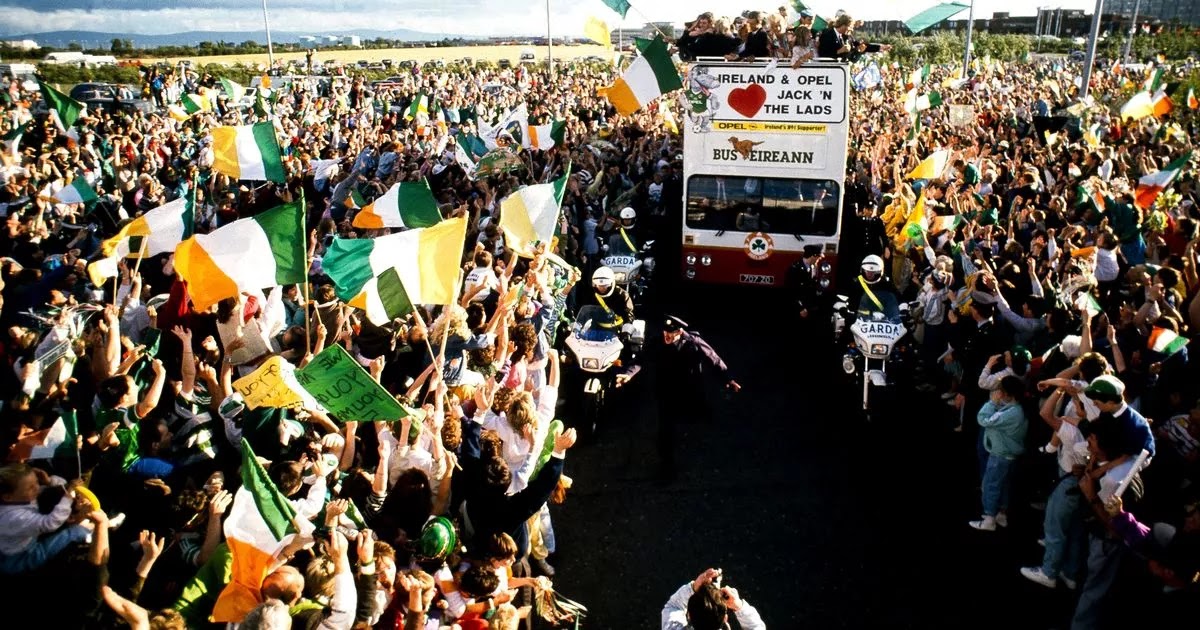
Walkinstown is also renowned for the spontaneous public celebrations that occurred there after Ireland reached the quarter-finals of the 1990 World Cup in Italy.

You can watch five minutes of it here. God bless Daithí Ó hAirtnéada, who had the foresight to film it in those pre-mobile phone days.

It's hard to convey just how crazy the country went over the 1990 World Cup. It seems to have been one of those unique moments in social history where conditions are just right to bring about an unprecedented and unrepeatable phenomenon.

The Walkinstown celebration might be the most famous, but there were similar scenes all around the country. 

I had little if any interest in the tournament as it began, but I was gripped with excitement as it went on. It was really contagious. As you can see from the video, there are as many women celebrating as men. Everybody got in on it.

I was an avid soccer fan (and player) for about five years after that, although my interest slowly diminished over the next five years or so. These days I don't follow any sport, although I sometimes feel mildly ashamed of this. I think it's good for people to play and follow sports. I wouldn't go as far as to say that everybody should, though. There are lots of other good things to do, after all.

But people who refer dismissively to "sports-ball" or "twenty-two men chasing a pig's bladder around a field" seem like unimaginative killjoys to me. You could apply such a reductive description to any activity human beings perform for its own sake-- which would leave us with a depressingly utilitarian existence. (Yes, I've made this argument often on this blog. Apologies to long-term readers.)

At the time, I didn't realize how unique Italia '90 (as it was termed) would remain. There has never been anything like it since. I was Ireland's first World Cup. We qualified again in 1994, with many of the same players, and actually beat Italy (who were eventually runners-up) in the first game, before getting knocked out in the second round by Holland.

Home come the heroes...

But it wasn't the same, probably because it wasn't as spontaneous. There was incredible hype beforehand (for months!) but it just couldn't live up to the magic of the first time.

The uniqueness of Italia '90 in Ireland transcends sport. I've never known any national event like it, or even close. It has always remained my ideal of national togetherness, national consciousness. Perhaps because I didn't experience John Paul II's visit to Ireland, when a million people went to see him in the Phoenix Park. (Well, I actually did. I was there. But I was only a year old, so I wasn't taking much in.)

One of the things I like about this video is that Walkinstown is such an ordinary suburban sort of place. I firmly believe the suburbs have to be enchanted.

The early nineties in Ireland were a special time in themselves, actually. I've written a blog post about it here. (One of my many posts that got no comments.) It wasn't all good, of course-- the Church took a real hammering-- but it certainly had a distinctive character, and a certain excitement.

I talk about Italia '90 so much that someone bought me a badge of the Italia '90 logo, last Christmas. I wear it all the time. (At least, whenever I put that coat on.)


(The only public event that even remotely resembles Italia '90, in my experience, is all the hype and discussion around the Lord of the Rings films at the start of the millennium. Everybody seemed to be watching them and talking about them. It was also the beginning of my time in UCD, which makes it more memorable to me. Obviously, though, this wasn't unique to Ireland, and didn't have the same quality of a communal event shared in real time as Italia '90. But it was still very special, and seems even more special in retrospect.)