Wednesday, December 11, 2024

A Hoary Christmas-Tide Tradition

Traditions! I never shut up about them, do I?

Indeed, I briefly had a blog called Traditions Traditions Traditions!, which lasted only four posts, but which I sometimes think of reviving.

Well, this blog has its own tradition of posting "The Burning Babe" by Robert Southwell at Christmas. I've just checked and I've done this every year since 2015!

I did a quick search for critical literature on the poem, and discovered that it's inspired a whole book, written by Anne Sweeney and published in 2006. It's titled Robert Southwell: Snow in Arcadia: Redrawing the English Landscape 1586-1595.


Here's how it begins:

‘The Burning Babe’ is probably the only poem most readers will know of Robert Southwell’s. I recall reading it as a child; it seemed pleasantly atmospheric to a childish imagination, the holy Babe appearing like a bright bauble against the dark of a snowy English Christmas evening. It is homely, yet cryptic in the Elizabethan style, and blessedly short, a silly sentimental thing that manages, apparently on these merits, to make its way into most anthologies of the English poetic canon. It came as something of a shock to me as an undergraduate to learn that Ben Jonson, with his reputation as a hard man of letters, had singled out this bagatelle for admiration – indeed, he wished he himself had written it; there can be no greater possible encomium from a great ego. What did he admire in it? There have been some fine commentaries on Robert Southwell’s life and work, but none of them has explained to my satisfaction why a man like Jonson would have admired this poem so. This book is an attempt to answer that question.

A "bagatelle", really? Presumably Sweeney is provocative in her choice of words, and she doubtless revised her estimation of "The Burning Babe" if she wrote an entire book on the subject. (I guess I'll find out, since I've put the book next on my reading list.)

Anyway, decide for yourself. Here it is:

As I in hoary winter’s night stood shivering in the snow,
Surpris’d I was with sudden heat which made my heart to glow;
And lifting up a fearful eye to view what fire was near,
A pretty Babe all burning bright did in the air appear;
Who, scorched with excessive heat, such floods of tears did shed
As though his floods should quench his flames which with his tears were fed.
“Alas!” quoth he, “but newly born, in fiery heats I fry,
Yet none approach to warm their hearts or feel my fire but I!
My faultless breast the furnace is, the fuel wounding thorns,
Love is the fire, and sighs the smoke, the ashes shame and scorns;
The fuel Justice layeth on, and Mercy blows the coals,
The metal in this furnace wrought are men’s defiled souls,
For which, as now on fire I am to work them to their good,
So will I melt into a bath to wash them in my blood.”
With this he vanish’d out of sight and swiftly shrunk away,
And straight I called unto mind that it was Christmas day.

And here is a fine spoken rendition of the poem, by a chap who modestly refrains from giving his name.


Monday, September 2, 2024

My Fifty Favourite Poems of All Time

I spent a sleepless hour or two after midnight, this weekend, coming up with this list. 

Why fifty? Well, it seems a manageable sort of number.

Despite the title of the post, I can't really claim this is my definitive fifty favourite poems. In another mood, at another time, it might have looked somewhat different. But these are all poems which have a huge personal significance to me, lines from which regularly come unbidden into my memory, and (most importantly) which move me immensely. Most of them are poems that I've loved for decades now. I can't even imagine my life without some of them.

I tried to put them in vague order of preference, but for the most part, this is very fuzzy. It's really the top ten or so where the order matters the most. I can pretty confidently assert that "Ulysses" by Tennyson is my single favourite poem of all time, and that "To Helen" by Edgar Allen Poe comes second. I'm not particularly confident of the placing after that-- is "The Burning of the Leaves" really more important to me than "Locksley Hall?"-- but I'm fairly sure that there's nothing in the top twenty that doesn't deserve to be there.


Beyond that, the placing of a poem is less important than its presence on the list.

Arthur Quiller-Couch, the first editor of The Oxford Book of English Verse, famously wrote that "the best is the best, though a hundred judges have declared it so". Well, this list makes no claim about what's best (these are my personal favourites, nothing more) but I share his general sentiment. Pretty much all of the poems here are standards of poetry anthologies, although many of the Irish choices would only be encountered in Irish poetry anthologies. Popular taste, over time, is a sure sign of greatness in poetry-- although my guess is that this requires a poetry-reading public, which today (for the first time ever?) doesn't exist. Hopefully this is just a hiatus.

Having said that, I've omitted a few of the most popular poems of all time. (You can compare my selection with the BBC's "favourite poems" poll of 1995.) There's no "Daffodils", no "Road Not Taken", no "Elegy in a Country Churchyard". It's not because I don't love those poems. I do, especially the first. I just couldn't put them above other poems on my list. Similarly, there's no John Betjeman on my list, even though I'm a huge admirer of Betjeman. There's just no stand-out poems among his works that appeal to me so much they would get in the top fifty.

On looking at this list, somebody said to me: "You like Yeats, don't you?". Yes, I like Yeats. In fact, I could easily have filled half of the places on this list with Yeats poems.

I think "Lines on a Young Lady's Photograph Album" by Philip Larkin might be the template for half the poems I've written. But don't hold that against it!

"Fanfare for the Makers" by Louis MacNeice is a poem (or excerpt from a poem) that had a massive influence on my as a teen, and indeed ever afterwards. But I don't like the last line. Life can't be confirmed by suicide. Suicide only confirms despair.

Anyway, I hope the list affords you some diversion, and perhaps introduces you to some new favourites of your own.

Ulysses by Tennyson

Friday, August 23, 2024

The Poetry of Words and Phrases

The miracle of language never ceases to beguile me. With my tongue, lips and vocal chords, I can create vibrations in the air which, when they reach your ear, are decoded into ideas and pictures and emotions. This process, already magical and wondrous, can be captured by words on a page-- so that words can travel over continents and through the ages. Every now and again, the whole phenomenon strikes me with fresh wonder.

I've written a lot about poetry on this blog. People have given various definitions of poetry, but one of the more memorable ones is "the best words in the best order". In a way, though, I think words are a sort of poetry even before they're put into any order. You might even say that every word is a poem in itself, although "detergent" and "update" aren't particularly lyrical. (Ironically, the word "poetry" isn't inherently poetic, in my view.)

On the other hand, many words are inherently poetical. Others are  more subjectively appealing.

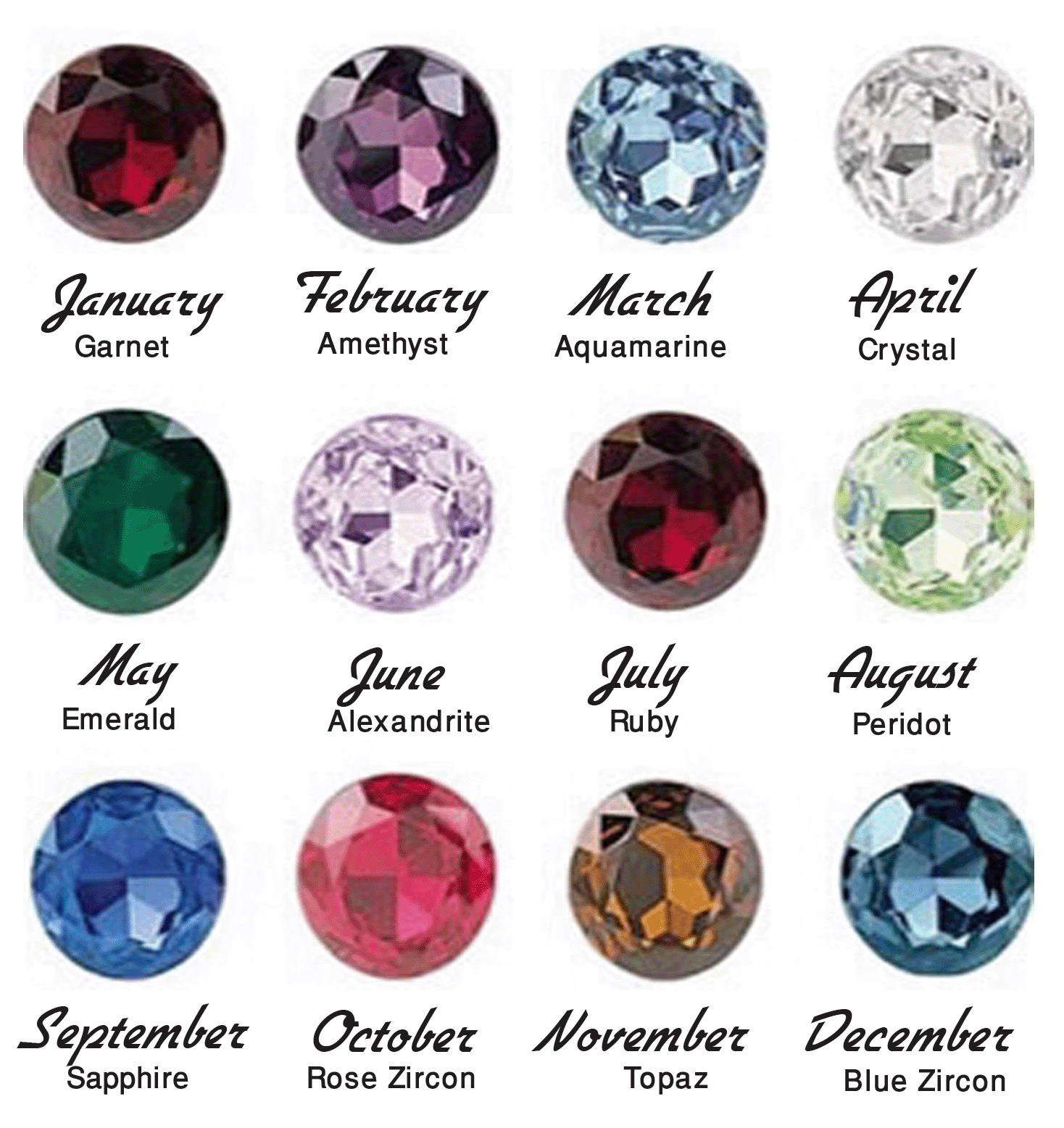
What sort of words are inherently appealing? Well, the example that comes to my mind most readily are the names of gemstones: sapphire, amethyst, aquamarine, chalcedony, emerald, obsidian, and so forth. Now, you might say these words are appealing because of their association with the gemstones they describe, but I think that's only part of it. And quite often I have no image or knowledge of a particular gemstone and I still find the word poetic.

Wilde's masterpiece of decadent poetry "The Sphinx" draws lavishly on these poetic names:

On pearl and porphyry pedestalled he was too bright to look upon:
For on his ivory breast there shone the wondrous ocean-emerald.

(There's a lot more where that comes from.)

This particular strain of poetry is also to be found in the Bible, particularly the Book of Revelation's description of the walls of the New Jerusalem: "The first foundation was jasper. The second was sapphire. The third was chalcedony. The fourth was emerald. The fifth was sardonyx. The sixth was sardius. The seventh was chrysolite. The eighth was beryl. The ninth was topaz. The tenth was chrysoprasus. The eleventh was jacinth. The twelfth was amethyst."

I'm guessing that many of these terms come from Latin and Greek, which perhaps give them that flavour of the exotic, antique and classical from which much of the poetry derives.

Colours and hues often have very poetic names, as well: indigo, heliotrope, burgundy, onyx, cerulean, turquoise, aquamarine, magenta.

Funnily enough, I would make the argument that many diseases have perversely appealing names: gonorrhea, chlamydia, rubella, melanoma, meningitis, and so forth. (You may not agree on that, though).

Another class of words that seem to be inherently poetic, although I think this certainly has a lot to do with meaning as with sound, involve faintness or obscurity: silhouette, whisper, echo, shadow, ghostly, phantasmagoric, rumour, shimmer, flicker, and so forth.


I could go on with lists of word-groups that seem to be generally appealing, but I'll move on to words and phrases that appeal especially to me.

One of my very favourite words is "lobby", and another is "foyer". Of course, "foyer" has a bit of a French glamour to it, but I think the main reason I love both these words is because they describe liminal spaces. I also love (to varying degrees) corridor, plaza, mezzanine, mall, street, alleyway, and avenue. I feel I should include "attic" in this list, even though it's not a liminal space in the same sense as the others; it's not a "between" place like the others. But it's liminal in another way, although it's hard to put my finger on its liminality. (This article addresses this very subject, although it's a bit too woke for my taste.)

Why do I like terms for liminal spaces so much? It's hard to say. There's something very exciting about a liminal space, especially one that is a mixture of "inside" and "outside". All life, all drama is lived in the space between me and you, us and them. Public or semi-public places seem ripe for this drama.

A final place-word which appeals to me enormously, even though it's not really liminal, except insofar as every place could be liminal in some way: canteen (as in, a cafeteria). I love the word canteen. It's so cheerful, down-to-earth, unpretentious, and redolent of a collective life of some kind. I like restaurants which are more like canteens, such as the restaurant in IKEA.


Here's a round-up of some other words I especially love: kaleidoscope, sepia, merry-go-round, horizon, gossamer, alabaster, brandy. I could add many, many more, and I probably will.

Poetry has already begun, in the more conventional sense, when we put words together. So perhaps it's legitimate to say that phrases are already poems, ready-made poems, as it were.

Finally, a list of phrases that excite me (mostly quarried from a previous post):

Softly-falling snow.
The cold light of day (which is supposed to be sobering, but which I find reassuring).
Deep waters.
Dizzy heights.
The morning after the night before.
Down memory lane.
The silver screen.
Till the cows come home.
All human life is there.
Blue moon. (I'm told the song of this title was my mother's party piece.)
The dead of night (also the title of one of my favourite films, Dead of Night from 1945).
The middle of nowhere.
The back of beyond.
In at the deep end.
Burning the midnight oil.
The last bus home.
Night train. (There was a radio show with this title in my childhood, which was broadcast all night long-- or at least, that's the impression I got.)
The graveyard shift.
The old, old story.
The small hours.
The wee hours.
Any phrase involving "country", in this sense: bandit country, cowboy country, gator country, Brontë country, Kavanagh country, etc.

What are some of your favourite words and phrases? No, really, tell me!

Monday, July 29, 2024

The Irish Passenger at Adlestrop

Remember Adlestrop? Like I'd forget!
My train stopped there one day. I don't know why.
The driver was some class of idiot.
It was so hot I thought that I would die.

Someone beside me had a coughing fit.
I was half-deafened by the hissing steam.
The platform had a sign, and that was it.
The whole thing was like some unholy dream.

I sat there staring out at trees and weeds
And stooks of hay. The clouds stood in the sky.
The kind of sight that no-one ever heeds
When they can just as easily pass by.

And then I heard the birds-- thousands of birds--
Hundreds of millions of birds, from everywhere
Singing a song too beautiful for words
Like choirs of angels floating in the air.

Thursday, July 25, 2024

Something Stupid

Going through your drafts folder is very diverting. At least, for me. And generates blog content!

I've long had a fascination with the phrase "the eternal debate", and the concept behind it. So much so, that I once started making a spreadsheet of how many "hits" I could find of that phrase on the internet, and which debates they referenced. And how often each debate was mentioned.

I'd completely forgotten about this. You wouldn't be up to me. (An exclusively Irish phrase meaning: "That person/group always has some scheme going." Usually understood disreputably, but not necessarily.)

As with most of my projects, I gave up and forgot about it. But here's my findings as they were when I gave up.


Analogue vs. digital 1

Arminianism vs. Calvinism 1

Bernoulli vs. Leibniz 1

Blonde vs. brunette 1

Cardinal vs. ordinal data 1

Determinism vs. non-determinism 1

Einstein vs. Bohrs 1

Faith vs. science 1

Female genre vs. femininity 1

Freedom vs. security 1

God's justice vs. God's mercy 1

Ideal vs. reality 1

Ketchup vs. mustard 1

Left vs. right (toilet paper hanging) 1

Mentalists vs. idealists 1

Modernism vs. Postmodernism 1

Monism vs. dualism 1

Moral universalists vs. moral relativists 2

Nature vs. nurture 2

Optimism vs. pessimism 1

Windows vs. Mac 2

Poetry vs. prose 1

Politics vs. justice 1

Privacy vs. security 2

Quantity vs. quality 2

Rationalists vs. empiricists 1

Reason vs. faith (Islam) 1

Relatives vs. friends 1

Show vs. Tell 1

Simplicity vs. customization 1

Solidarity vs. charity 1

Sovereigntists vs. Federalists (Canada) 1

Storytelling vs. gameplay 1

Strength vs. skills 1

Tea vs. coffee 1

Thoughts vs. emotions 1

Tower vs. trough 1

Renting vs. buying 1

Bartending school vs. learning on the job 1

Kirk vs. Picard 1

Java vs. C/C+ 1

Chicken vs. pig (breakfast) 1

Urbanites vs. surburbanites 1

Liberal vs. conservative 1

Index investing vs. dividend investing 1

Men vs. women 1

Republicans vs. Demorats 1

Blackwing Technician vs. Dark cultist 1

Old money vs. new money 1

Owls vs. owlets 1

Science vs. religion 1

Knowledge vs. skill 1

Mountains vs. beach 1

Lights weights vs. heavy weights (muscle growth) 1

Wednesday, July 17, 2024