Wednesday, July 10, 2024

A Quick Thought

It often occurs to me that there are two main drives in social life. We can roughly call them to drive for excellence, and the drive for solidarity.

I remember reading a book about primitive man which described "the cult of excellence" as the first distinguishing feature of human beings. Even the oldest fragments of human jewellery, pottery, etc. shows evidence of an urge to make things much better than they need to be.

We all feel this urge towards excellence. Even the stereotypical dude sitting at home playing video games in his underwear. He's trying to be as good at the video game as possible. Human beings always seem to be striving towards something, no matter how stupid. (And maybe reaching the last level of a video game is no more stupid than owning your own yacht.)

And every human activity attests to this. School, work, sport, romance-- we are all striving to be the best that we can, and often competing with each other.

But then there is the counter-drive, the drive towards solidarity. Or perhaps we can simply say "love". The perception-- common to most of us-- that the value of a human being is not in their accomplishments and their achievements, and perhaps not even in their moral character, but simply that they are a human being-- made in the image of God, for Christians.

This tension even seems to exist in Christianity. Christ told us to be perfect, but he also told us that the rain falls on the just and the unjust. Perhaps the parable of the tax collector and the Pharisee encapsulates this whole dilemma. I think we've all found this parable perplexing at some level. Isn't the Pharisee at least trying? Isn't there a danger of the tax collector saying: "Thank God I am not like this Pharisee?". There seems to be an apparently impossible balance here. Perhaps only the saints achieve it-- saints whose protestations that they are the chief of sinners seem sincere.

Every philosophy of life and society seems to hover between these poles, somehow. Socialism is obviously titled much more towards solidarity. Capitalism is tilted much more towards the quest for excellence. I would say that conservatism leans more towards solidarity, while liberalism leans more towards excellence.

This duality pervades every relationship-- parenting, friendship, all kinds of authority. Love is surely wanting someone to be the best version of themselves. But we also have to love unconditionally. We are all familiar with the pitfalls of parenting-- the indulgent parent who spoils their child, or the opposite extreme of the "stage mother" who fills them with insecurity and fears of inadequacy.

I'm reading Roots by Alex Halley. It opens in a small village in the Gambia, back in the eighteenth century. It's easy to see how, in such small communities, balancing the quest for excellence and the quest for solidarity seems much easier. How do you balance them in our huge, complex, diffuse societies? It seems like one of the eternal human dilemmas.

Monday, July 8, 2024

Autumn Sequel by Louis MacNeice: One of a Possible Series of Posts

I very often, and increasingly often, berate my contemporaries for not reading enough poetry, and especially for not reading enough long poetry. Well, just like the doctor who chain-smokes, I should also berate myself, and I do. I haven't read nearly enough poetry, and I haven't read nearly enough long poetry.

Case in point: I have been trying to finish Louis MacNeice's Autumn Sequel for about thirty years, and I only succeeded a few weeks ago.


This despite the fact that Autumn Sequel has been an extremely important poem in my life, parts of which I've had memorized since my late teens.

I first discovered Autumn Sequel because a section from it was included as an epilogue to one edition of the Oxford Book of English Verse. About two pages of it was excerpted, and I'll only quote a few lines (you can read the whole excerpt here):

A cloud of witnesses. To whom? To what?
To the small fire that never leaves the sky.
To the great fire that boils the daily pot.

To all the things we are not remembered by,
Which we remember and bless. To all the things
That will not even notice when we die...

The whole excerpt thrilled me, but these lines especially. "The great fire that boils the daily pot" was the sort of affirmation of the ordinary, the daily, the social, that I yearned for as a teenager. It evoked the same mood as Chesterton's line, "The strong incredible sanities of the sun".

It's good to affirm life-- it's crucial, in fact-- but it raises problems. There are different ways we can affirm life. There's the approach taken by Walt Whitman in Leaves of Grass, a sort of mystical affirmation of everything equally:

I believe a leaf of grass is no less than the journey-work of the stars,
And the pismire is equally perfect, and a grain of sand, and the egg of the wren,
And the tree-toad is a chef-d’Ĺ“uvre for the highest,
And the running blackberry would adorn the parlors of heaven,
And the narrowest hinge in my hand puts to scorn all machinery,
And the cow crunching with depress’d head surpasses any statue,
And a mouse is miracle enough to stagger sextillions of infidels.

Could this indiscriminate ecstasy be sustained, and does it not risk reducing everything to sameness? Indeed, it can create moral problems, as with the penultimate line of the very excerpt in the Oxford Book of English Verse from which I've just quoted, which is: "As life can be confirmed even in suicide." No, life cannot be confirmed in suicide.


G.K. Chesterton articulates the danger of affirming everything in his Autobiography, where he writes: "What could I have said, if some tyrant had twisted this idea of transcendental contentment into an excuse for tyranny? Suppose he had quoted at me my verses about the all-sufficiency of elementary existence and the green vision of life, had used them to prove that the poor should be content with anything, and had said, like the old oppressor, "Let them eat grass." "

Happily, although MacNeice certainly affirms life in Autumn Sequel-- including the ordinary, everyday things of life-- it's not an indiscriminate affirmation. He is questioning his own ideas throughout the poem, and he is not blind to the problem of banality-- real banality, the banality of commercialism and the mass media and the routine. At the time he wrote the poem, MacNeice was writing for the BBC, and in one section he describes his work on a documentary about Mount Everest. He is unsure whether he is justified in taking something grand and heroic, such as the conquest of Everest, and packaging it as entertainment:

What price
Should we demand for turning what was rare
Into a cheap couvade or proxy paradise

Just one more travelogue to make the groundlings stare?
Groundlings will never see why Mallory answered why
Men should climb Everest: because it is there.

("Because it is there" is one of the many phrases used as recurring motifs in the poem.)

But MacNeice is certainly not a snob, either. His ideal of a poet has been quoted many times, including on this blog. However, it deserves to be quoted again: "I would have a poet able bodied, fond of talking, a reader of the newspapers, capable of pity and laughter, informed in economics, appreciative of women, involved in personal relationships, actively interested in politics, susceptible to physical impressions."


The depth of the poem comes, among other things, from the contrast between MacNeice's immense erudition (he won a first-class degree at Oxford and was at one point a lecturer in classics) and his openness, often even his delight, in the everyday and modern.

I've written a lot about the flux of daily life on this blog, and my fascination with it. I've also written about my concept of "streams of time". This is very much the flavour of Autumn Sequel. It describes MacNeice's journey through the autumn of 1953, ending in a train journey on Christmas Day, in an all-but deserted carriage. (This part might appeal to Peter Hitchens.) We see him working, returning to his student haunts in Oxford, visiting an art gallery, attending the funeral of his close friend Dylan Thomas, and doing many other things. All the while he is pondering the meaning and value of his experiences, and applying them to the human condition in general.

Autumn Sequel is written in terza rima, a devilishly hard rhyming scheme to pull off. It's the rhyming scheme Dante used for the Divine Comedy, but it's much better suited to Italian than English. MacNeice very often has to use rather contrived rhymes to follow it. If you're bothered by (for instance) the use of the word "fife" to rhyme with "life", you might not like this poem. But why should you be bothered?

Why is it called Autumn Sequel? Because the poem is a follow-up to a previous long poem, Autumn Journal, which is critically much more highly regarded. (I'm not sure I can add "popularly", since neither of them seem popularly regarded at all.) I recently read a diary entry by an Irish writer, who recalled telling MacNeice that a friend of his had been reading Autumn Sequel. "I suppose he prefers Autumn Journal, like everybody else", said MacNeice. He was pleased to hear the contrary.


I hope to return to Autumn Sequel in future posts, but I will finish this one with a section from Canto 23. Since the European Championships are currently taking place (soccer, in case you didn't know), I thought MacNeice's meditation on sport might be suitable:

I slip off to where the unlettered hinds
And miners watch an oval ball cavort
In a huge roaring box, a black shirt grinds

A red shirt in the mud; the joy of sport
Identifies oneself with X or Y
Or even with that ball, which one minute gives short

Change with its bounce and at the next will fly
Madly beyond and over; while this crowd
Also is something to identify

Oneself with, lose oneself in, on one loud
Raised beach one pebble in fifty thousand, tinted
Pink by the sinking sun; those muddy but unbowed

Players are me, this crowd is me, that undinted
And indestructible mischievous ball is me,
And all the gold medallions ever minted

By sinking suns are mine..

[..]

Is it absurd
To have preferred at times a sport to works of art?
Where both show craft, at times I have preferred

The greater measure of chance, that thrill which sports impart
Because they are not foregone, move in more fluid borders.
Statues and even plays are finished before they start,

But in a game, as in life, we are under Starter's Orders.

Thursday, July 4, 2024

A Trek Through Dublin Churches IV: St. Monica's, Edenmore

As I mentioned in the previous instalment of this "trek", my knowledge of Dublin is scandalously bad, especially considering that I'm a lifelong Dubliner. I suppose this has its good side. My own city is still full of discoveries for me.

I knew nothing about Edenmore before I made my way to its church. Not even the name. It's an estate that was built in the sixties. Wikipedia says that, although it's officially part of Raheny, it has its own distinct local identity.

This is certainly true. The town centre is like a little village, and even has its own clocktower-- with every face of the clock stopped.

I grew up on the Northside of Dublin and I much prefer it. I've lived on the Southside for the last four years, and it's been very handy for access to UCD. But I feel much more at home on the Northside. Even hearing the local accent cheers me up.

It's ridiculous, but I think of the Northside and the Southside as Rohan and Gondor (a comparison drawn entirely from the films; I don't know the books well enough). The Southside has much more history and culture, for the most part, but the Northside always seems (metaphorically) windswept and rugged and salubrious. Which is ridiculous, because I'm pretty sure there's much more obesity north of the Liffey.

Enough of that. St. Monica's church is right next to a very pleasant park, and a little bit away from the shopping centre pictured above. It has a very distinctive exterior, which looks faintly Alpine or something.

Inside, the church is bright, clean, plain, and barn-like. Yes, reader, you guessed it, I like St. Monica's very much.


For a weekday morning Mass, there was a reasonable congregation (the pictures above were taken some time before it began). I was sitting near the wall of the church, and children were playing in the park directly outside, while white light came through the windows. It felt quite heavenly. Afterwards, one of the parishioners led the rosary. There was no homily.


I especially liked the simple coloured windows. Behind the altar, there was a white and red coloured window, which puts me in mind of the Divine Mercy. I got a picture of it, but it's blurry. (I feel self-conscious taking pictures when there's people nearby, or looking at me. It was just after the rosary.)

Is this St. Monica? She was in a niche with St. Francis Xavier and St. Patrick.

There was recorded music playing in the church when I entered. I've mentioned before that I like this. There is a piano in the church, and one of the parishioners was sitting at it as I left, but it wasn't played during the Mass itself.

I particularly liked the plaques to the old parish priests and the members of the Edenmore Ladies' Club.


I found St. Monica's church in Edenmore completely charming. My kind of church!

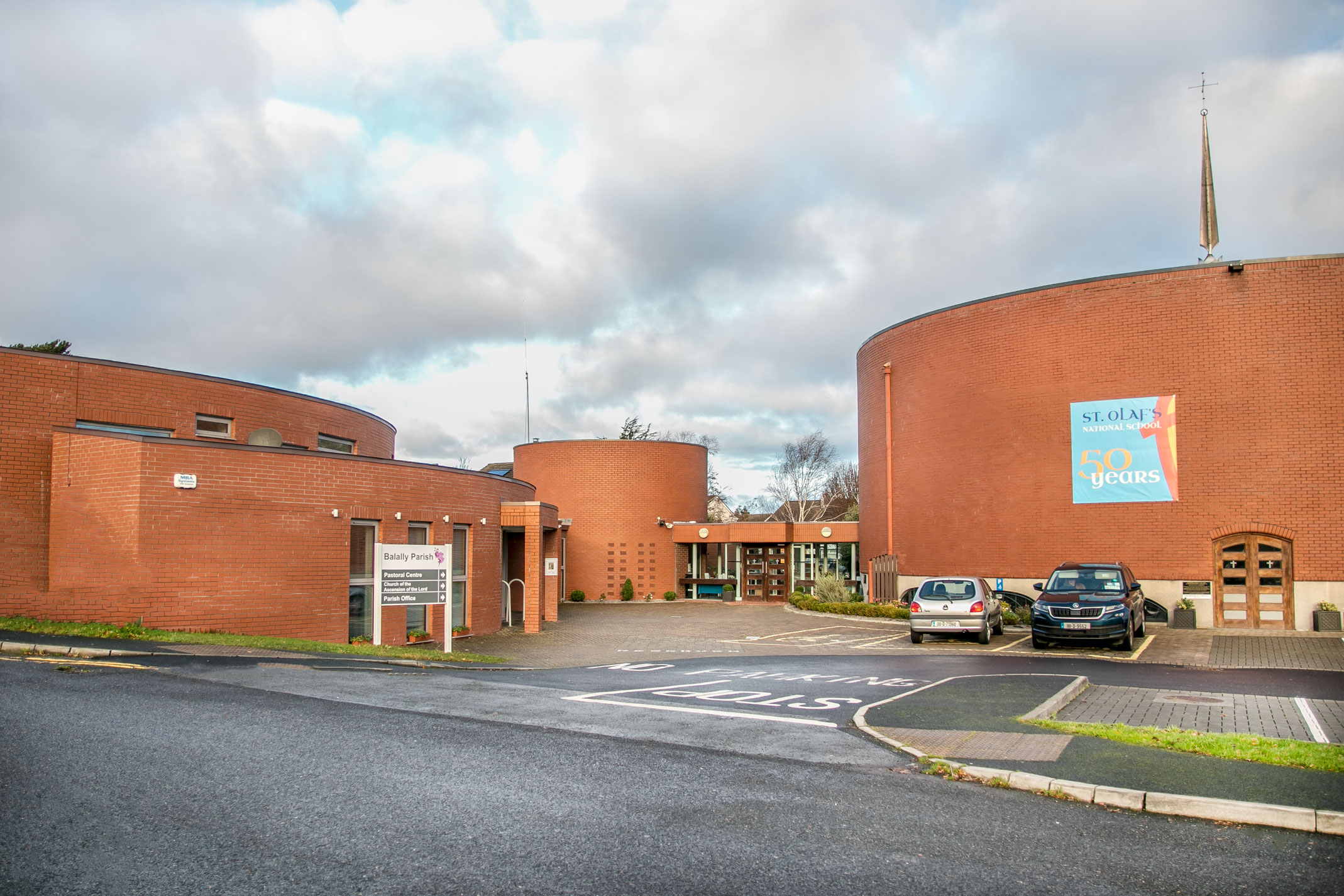
A Trek Through Dublin Churches III: Church of the Ascension of our Lord, Balally

For a lifelong Dubliner, my knowledge of Dublin geography is astonishingly bad. If you'd asked me where Balally was this time last week, I would have shrugged my shoulders, and not even known it was in Dublin. In terms of my own experience, it's close to the Beacon Hospital, which has featured prominently in my recent life. That puts it on the south side of Dublin city. There are lots of car showrooms in this area, which indeed seems more amenable to motorists than pedestrians.

The church is beside a small, rather run-down shopping centre.

This is how the church's website describes itself: "The Parishioners of Balally built this Church with great effort and generosity. It was finished in 1982. Many of the first Parishioners are still active in the community, and many have gone home to God.


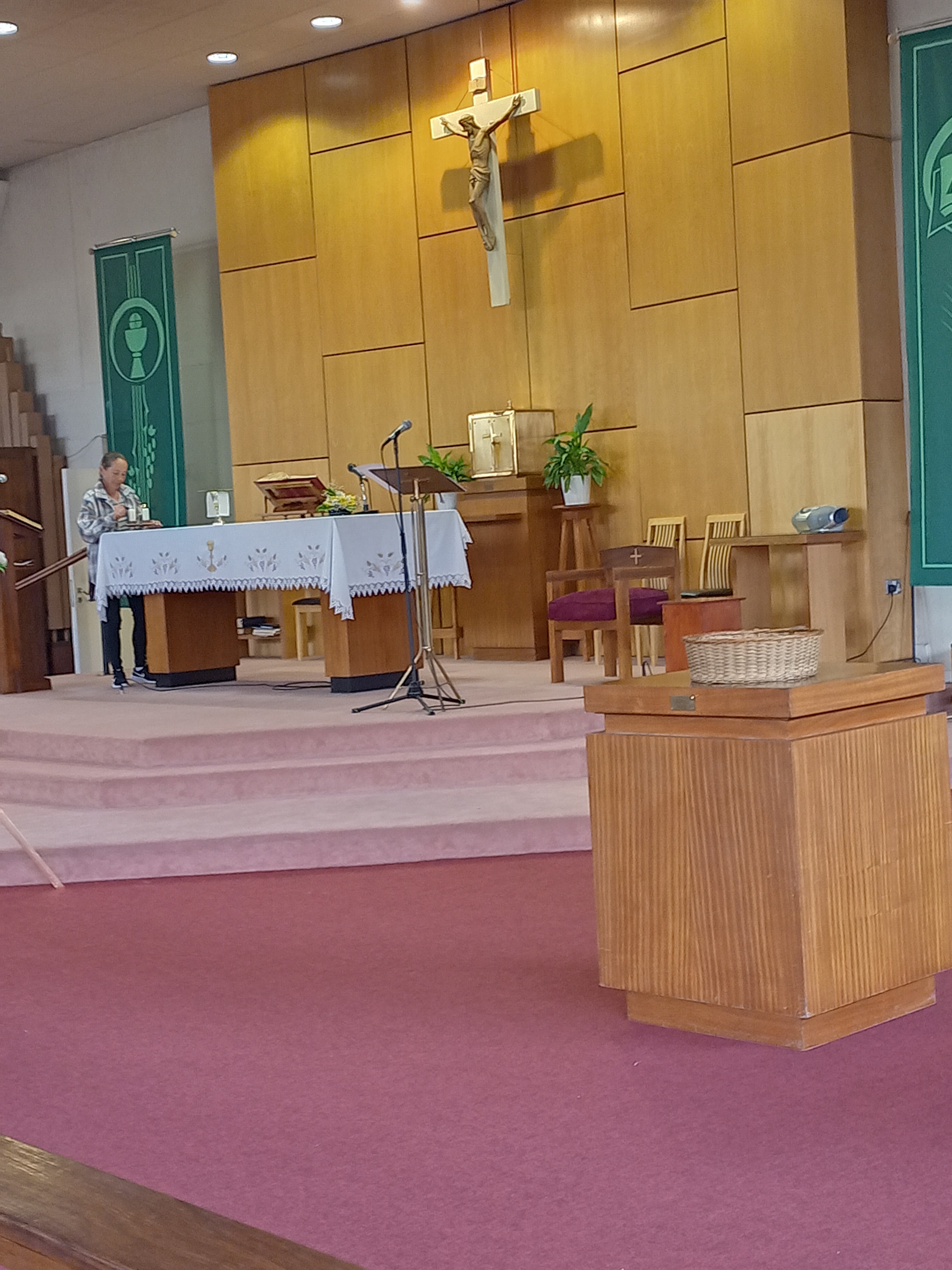
"The Church structure is unusual as Churches go, but its building was inspired by the Second Vatican Council. Its layout highlighted the belonging to the family of God. From the tapestry of the Burning Bush (at the very centre behind the Tabernacle) the walls extend like open arms and embrace all who enter and immerse them in the Divine Presence. That Divine Presence is underscored by each of the windows which are dedicated to the opening verses of the Book of Genesis.


"The configuration of the building facilitates the participation of each and every member in the liturgy. No one feels far away or distant from the Altar, and all can be seen. At the middle of the Altar, there is the icon of the Washing Of The Feet inviting all who enter to serve others as Christ has served us."


There is also a John Main Icon Chapel attached to the church, though it wasn't opened when I visited. I suppose, dear reader, you've had the experience of hearing about something for the first time and then hearing about it again surprisingly soon after. The Benedictine priest-monk and promoter of Christian meditation, Fr. John Main, crossed my radar for the first time only a few weeks ago. It felt very strange that I discovered a chapel dedicated to him so soon after.

I attended Balally church on a Saturday evening, for Vigil Mass. Access to the church is through the parish centre. There was a fairly large congregation, mostly elderly but with a fair sprinkling of young people. Interestingly, there is a portrait of Blessed Columba Marmion  hanging beside the altar.

Sadly, the most memorable part of my visit to Balally church was a serious liturgical abuse that I witnessed. Most of the communicants took the Host from one extraordinary minister, walked to another extraordinary minister, and dipped the Host into the Precious Blood. I felt pretty sure this was a serious abuse when I witnessed it, and I confirmed it later. (See here for one of the many, many sources that clarify this.) I'm sure the parishioners have no idea that there's anything wrong with this, but the priest should know better. The Creed was also left out "because the Gospel was so long".

As for the church itself, I liked it well enough, although it was a bit dark for my taste. It's certainly very modern, but I don't mind that.

The one element that I found jarring was the crucifix above the altar, which shows Jesus making a peace sign with his left hand. Of course, our Lord's arms were nailed into the cross, which makes this depiction rather incongruous. Nobody says a crucifix has to be realistic, especially since our Lord's Passion has a timeless element to it, as well as an historic one. But there's a certain bathos to the image.


The congregation chanted a mantra after Mass: the word "maranatha", which also features in the decoration of the altar. I suppose this is appropriate enough, given the connection to Fr. John Main. The priest introduced it as "our mantra", so it's obviously a regular thing. Which is fine. But if you have time for an extra-liturgical addition like a mantra, you should have time for the Creed.


I'm sorry to have had so many negative comments on this "stop" of my trek. I quite liked this church, and it obviously has a lively Christian community around it. There was a warm atmosphere in the church, and most of the congregants seemed to know each other.

(Incidentally, I don't take pictures during Mass. It's always before or after. So, if the congregation seems tiny to you, that might be the reason.)

From now on, I'm going to dedicate a single blog post to each church. And don't worry, the blog isn't going to be completely dedicated to this "trek" from now on.

Thursday, June 27, 2024

A Trek Through Dublin Churches, Part Two

 For the second part of my series, I've taken three churches that are very familiar to me.

The first is the Holy Spirit Church in Ballymun.


I can fairly say that this is the church most familiar to me in the whole world. It was right across the road from the flat where I grew up and where I spent the first twenty-three years of my life. I could see it from my kitchen window. Many of the landmarks in my family history occurred there, including my mother's funeral. 

The Holy Spirit church is ten minutes walk from its virtual twin, the Virgin Mary. Many landmarks in my family history also occurred in the Virgin Mary, including my father's funeral and my First Communion.

It will come as no surprise that the Holy Spirit is my favourite church in the whole world, and in fact my ideal church. It's the kind of bright, modest, plain, comfortable suburban church that appeals to me immensely. This is the sort of church in which I feel most at home, an obvious consequence of childhood associations and nostalgia. This despite the fact that I had no great grá for going to church as a child, and in fact the only time I enjoyed it was on Christmas Eve.


In fact, the Holy Spirit was my first church a second time around; when I started going to church of my own accord, many many years later, I went to the Holy Spirit. Not immediately, though; I was so unsure about genuflections and responses that I spent a few weeks getting the hang of it in Our Lady of Victories in Glasnevin, a safe distance from anyone who might recognize me and see me floundering!


My second church today is Our Lady Seat of Wisdom church in University College Dublin. I don't know how often I've been to Mass in this church, but it's undoubtedly hundreds of times. We are blessed to have lunch-time Mass on campus in UCD.

Again, Our Lady Seat of Wisdom is the kind of plain, warm church that greatly appeals to me, especially the prominent use of wood in its interior.


This year, the church acquired a beautiful new altar, which has John Henry Newman's motto "Cor ad cor loquitur" carved into it. As you may already know, Newman was instrumental in the founding of the Catholic University in Dublin, the predecessor of UCD. There's also a portrait of Newman hanging to the right of the altar, as you can see above. It was painted by the late brother of one of the chaplains. (It's been uncharacteristically sunny in Ireland recently, hence the haziness of some of the pictures.)


This is actually the second Taizé cross which has hung above the altar. I like it very much. I'm not particularly a fan of realism in sacred art; realism often fails to convey an appropriate sense of wonder and the sacred.


The confessionals are in regular use.


The shrine of Mary lights up when you step towards it. I love this statue. Its unpainted, unvarnished simplicity seems very appropriate to Our Lady.


Both the statute of our Lord with his arms outstretched, and the stations of the Cross, are new. Praying the stations of the Cross in this church is always a very moving experience; Friday is always a quiet day on campus, and the church is often deserted.

My third church is Our Lady Queen of Peace in Merrion Road, where I've been living since 2020. It's right across the road from me.


I'm not particularly fond of this church. It's huge and cold and grey, although it was also built in the sixties (as were the other churches featured in this post). The round-tower is a nice touch, though.


The huge crucifix behind the altar, with the cross set against a shiny gold disc, is its most distinctive feature. I like its strangeness and its otherworldliness.


There is a shrine to St. Oliver Plunkett, something I've never seen in any other church in Ireland.


My least favourite thing about the church is the fact that QR-code stickers are plastered all over the pews, soliciting donations. Wherever you sit, there's one right in front of you. I think it's tacky and in bad taste. The parish is run by Opus Dei, who I assume are not hard up for a few quid. On the plus side, it's open from early morning until late evening, and the preaching is suitably orthodox. It also provides the latest Sunday Mass in Dublin, that I know of, at nine p.m, and confession is regularly available.


Tuesday, June 25, 2024

Towards an Irish Counter-Revolution

The full version of Roger Buck's latest video, a preview of which I mentioned recently, has now been released. There's a fairly long comment from me in the comments section.


Thursday, June 20, 2024

A Trek Through Dublin Churches, Part One

Recently, I formed the ambition of visiting all the churches in Dublin. Of course, I've been to a fair few of them already. Whether it's realistic to visit them all, I'm not sure, but I'm going to try. In a leisurely fashion, of course.

I'm interested in churches for many reasons, but one reason is that most churches occupy that ambiguous territory between scenic and mundane. Obviously, cathedrals and otherwise magnificent churches firmly fall within the "scenic" category, and are duly included in guidebooks and the like.

But most churches are neither one nor the other. They are, as Samuel Johnson said about the Giant's Causeway, worth seeing but not worth going to see. (In Philip Larkin's famous poem "Church Going", the narrator reflects that "the place was not worth stopping for".) They are generic, for the most part, but not nearly as generic as a supermarket or a block of flats.

I've always been interested in such "liminal spaces", to use a vogue term. It's the same reason I'm interested in the recent past.

I had a three-day weekend this week so I visited three churches. The first was a church in Milltown, which bears the rather cumbersome title The Church of the Assumption of the Blessed Virgin and Saints Gall and Columbanus. It was built in 1819 and added to in 1935. It was originally built on the site of a stable, and it still has a stable-like aesthetic all these years later (not a bad thing).


This church was pleasant enough, and I was interested to see a bust of St. John XXIII. At the same time, I found something strangely dispiriting about my visit, and I'm not sure why. I attended a vigil Mass there, and the congregation was fairly sparse, mostly elderly. The homily was unobjectionable but I don't remember much of it. (The gospel that Sunday was the parable of the sower.) Everybody seemed to know each other.

The next church I attended, on Sunday morning, was St. Joseph the Artisan church in Bonnybrook, Coolock, which was built in the 1960's. Although I've often been to Coolock (a place I like, especially the Northside Shopping Centre), I'd never even heard of Bonnybrook. (I'm fascinated by these places which are so local, you never hear the name used in general discourse.)


I really, really liked this church. It's almost the classic example of what I appreciate in a church. It's unmistakeably suburban, a long way away from the city centre. It's bright and clean and well-maintained. It's plain, but not excessively plain. And I liked the mild modernism of the altar, with the light shining behind the cross.

The homily was good, too. It compared the cult of productivity to God's patience. When the priest said: "Our worth is measured in productivity by capitalism", I thought: "Ho, hum". When he added: "And socialism", I sat up.

There was a good congregation, with a mixture of ages and ethnicities, and a community atmosphere. A young couple with two infant children were sitting beside me.

On Monday morning, I went to the church of St. Pius X in Terenure, for ten o'clock Mass. This church was built in 1960.


I was really taken aback by this church. It's huge, and remarkably ornate. I found the sheer size a little alienating, but it's undeniably beautiful. The statue of St. Pius X is very appealing, and a helpful reminder of the richness of Catholic history. 

Perhaps my favourite detail of this church is the frieze with portraits of saints that runs around the ceiling. There are dozens if not hundreds of individual saints portrayed there, identified by name. I've never seen anything like that and it really gives me an appreciation of the community of saints.

I liked the brown brick exterior of the church. I'm not a fan of every church being made of grey stone. It also reminded me of St. Benedict's in Richmond, Virginia, a beautiful church with reverent services, which I often attended when dating my wife-to-be and which nourished my faith.

From the sublime to the mundane, I also liked that it had a signposted, accessible bathroom. Every church, and every building open to the public, should have this.

The congregation was small and mostly elderly, but that's hardly surprising on a Monday morning. The gospel text was about turning the other cheek, and the priest gave quite a scholarly homily, which was mostly good but a little simplistic when he applied the text to the current situation in Israel.

I also appreciated the recorded choral music which was played during Communion. I know it's a terrible thing to admit, but I prefer recorded music in churches to live music. There's less fuss and ostentation about it; fewer busy-bodies at the microphone before the opening blessing ("Good evening, our opening hymn today.."), no danger of applause, more subdued, and it's not drawn out unreasonably. 

I'm not saying I would like to see church choirs abolished. I wouldn't at all. But I do like recorded music in churches. One of my happiest memories is walking into the huge Our Lady of Consolation church in Donnycarney, one day around Christmas, and hearing soft festive music in the background. It was being played on a constant loop.

Anyway, that's the beginning of my trek. Tell me if you find this sort of post interesting.