Wednesday, July 6, 2016

Catholic Without Apologies 9: The Easter Vigil, Bad Hymns, Saint John Paul II, and Clerical Celibacy


The Drama of the Resurrection

I doubt whether there is anything more impressive in the whole world, from the point of view of drama, than the Easter Vigil liturgy.

I have only attended three of these in my whole life. Back when I was a non-practicing Catholic (or, it might be more accurate to say, a highly sceptical agnostic), I was entirely unaware of their existence. And even when I did start to practice, I never attended Vigil Mass (always preferring morning Mass) so I continued to miss out. It was only when I heard the Easter Vigil liturgy described as the highlight of the liturgical year that I made it my business to go. And I was swept away.


Of course, the full impact of the thing is only really achieved if you’ve made some effort to observe Lent. The atmosphere of death and rebirth, of emerging from the darkness of the tomb to the glimmering and then splendid dawn, depends on having journeyed through a season of austerity. The contrast is greatly heightened if you’ve also participated in the Stations of the Cross and the celebration of the Lord’s Passion on Good Friday, those incomparably sombre rituals.

The Easter Vigil is an example, I think, of those elements of Catholicism which a whole generation of Irish people took for granted, but which are rediscovered with surprise and joy by a younger generation. Even though I attended a Catholic school and come from a solidly Catholic family, and even though I have done a huge amount of reading on the Faith in the last few years, I am often surprised by how much I don’t know about Catholicism, compared to older Irish people—and I mean non-religious people, just as much as religious people.


Every Irish person over the age of fifty seems to have a kind of inbuilt awareness of holy days, devotions, pilgrimages, Irish Church history, saints, prayers and other aspects of Catholicism that puts my own knowledge to shame. Only very recently, I was rather presumptuously explaining to a friend  (who is a good bit older than me, and not especially religious) all about Gaudete Sunday when she promptly quoted the first few lines of the Latin Christmas carol of that name—with as much ease as she would have recited “Twinkle, twinkle little star”. That certainly put me in my place.

Beauty Ever Ancient, Ever New

In one way, this loss of cultural Catholicism is a tragedy, and I feel it vividly when I stand in silence at Mass while the rest of the congregation (mostly older people) sing some traditional hymn or prayer that I don’t know. But there’s a good side to it, too. Many aspects of Catholicism are fresh to the post-Vatican II generations. They never became blasé about them, as many members of an older generation have.  And it makes the beauty, integrity and profundity of these traditions all the more apparent to them.


It’s hard to imagine how anyone ever becomes blasé about the Easter Vigil. It’s spine-tingling from start to finish; from the paschal fire to the darkened church, from the sweeping tour through salvation history in the Scripture readings to the ringing of the bells at the moment of consecration, from the litany of the saints to the renewal of baptismal vows (“do you renounce Satan and all his works, and all his empty show?”). And personally, I don’t think that the Easter Vigil in St. Peter’s, or in any of the great cathedrals or basilicas around the world, would be quite as impressive as the Easter Vigil in an ordinary suburban church, which is how I’ve always experienced it. The contrast between the everyday life outside, going about its business as ever, and the blaze of glory inside, is very powerful.

Unfortunately, there was one particular stain on the Easter Vigil, this year and every other year that I’ve attended. In fact, it’s a stain on every Sunday liturgy I’ve attended in this particular church (I won’t name the church), and it’s a widespread problem elsewhere.

From Majesty to Mediocrity


I’m talking about the hymns; the banal, insipid, lifeless modern hymns that are such a feature of worship in Catholic Churches today.

One of the hymns that was sung in the Easter Vigil I attended is so bad that it has a kind of Monty Python hilarity to it. The refrain is “How great is our God, how great is His name, how great is our God, forever the same”. This is bad enough, but its verses are comically awful:

He rolled back the waters of the mighty sea
And He said, 'I'll never leave you, put your trust in Me'.
And: He sent His son Jesus to set us all free
And He said, 'I'll never leave you, put your trust in Me'.

Compare this to the Scripture reading that preceded it, from the Book of Ezekiel: “I will take you from the nations, and gather you from all the countries, and bring you into your own land. I will sprinkle clean water upon you, and you shall be clean from all your uncleannesses, and from all your idols I will cleanse you. A new heart I will give you, and a new spirit I will put within you; and I will remove from your body the heart of stone and give you a heart of flesh. I will put my spirit within you, and make you follow my statutes and be careful to observe my ordinances. Then you shall live in the land that I gave to your ancestors; and you shall be my people, and I will be your God.”

Ezekiel. Don't you recognize him?
 
How can anyone fail to see the ludicrous incongruity between these two texts? The reading from Ezekiel is grandiose, magisterial, resounding. But “I’ll never leave you, put your trust in me” is the equivalent of a nudge, a wink and a ‘Bob’s your uncle’. (It reminds me of the ‘Buddy Christ’ statue that appeared in the religious comedy movie, Dogma.) Such ludicrous nonchalance is completely at odds with the tone of Scripture, and is like a bucket of cold water thrown on any ordinary person’s yearnings for the divine and the sacred. How could it have ever appeared on a hymn-sheet in a Roman Catholic church?

This is the worst example I have ever encountered, but it’s far from isolated. There are examples almost as egregious being sung in churches all over the land, and probably all over the English-speaking world, and further afield. Surely something can be done about this, if enough people speak up? How can congregations ‘lift up their hearts’ when their hearts are being dragged down by such banal jingles? I find myself dreading any Mass that 
involves hymns.

Two New Saints


The entire Church (and perhaps much of the entire world) is rejoicing at the canonization of the two Popes, saints John XXIII and John Paul II. Very fittingly, there have been torrents of articles written on the two saints’ lives, their different but complementary approaches to the Papacy, their legacies, and so forth. The canonisations (which will have taken place when this article appears) are even going to be shown in certain cinemas here. All of this is cause to be thankful.

I was only a year old when St. John Paul II was elected Pope. My earliest memories of school include the sight of his photograph on the classroom wall. I was in my late twenties when he died. All through my childhood and teens, he seemed as much a fact of nature as the Dublin Mountains.

For most of my life, he was simply the Pope, and that was that. Later on, in my late teens, I became aware that he was considered ‘conservative’. It was several years after his death before I became aware, with considerable surprise, that he was in fact extremely radical in the unprecedented number of saints he canonized, the distances he travelled, his approval of the New Charismatic Movements that he might have been expected to abhor, his apology to the Jewish people for ill-treatment at the hands of Christians through the centuries, and in many other ways. Orthodoxy is not always the same thing as conservatism, though sometimes it has to be.

Two Simple Phrases


Of course, it’s impossible to evaluate St. John Paul’s legacy, less than a decade after his death. But one aspect of his achievement that I think has been underplayed is his coining of two phrases that have attained more and more importance in the life of the Church; ‘the New Evangelisation’ and ‘the culture of death’. (As far as I can discover, he coined both these phrases. But even if he didn’t, he certainly popularised them.)

Let us take just one of the phrases and examine it. Think about how those three little words, ‘culture of death’, disarm all the justifications and prevarications and plausible lies that have attached themselves to the sins of abortion and euthanasia, and to other sins whereby the sacredness of human life is compromised. We are constantly told that these matters are complicated. But in essence they are not complicated, and those words ‘culture of death’ express with perfect clarity why they are not complicated. A culture of death can never be a healthy culture.

Such powerful phrases have a crucial role in clearing the mind, in capturing the imagination and in firing the spirit. It won’t do to identify them with ‘our era of spin and sound bites’. Our Lord himself did not disdain to use pithy phrases—you might even say that he used slogans. And his servant Karol Wojtyla, in coining those two wonderful terms ‘the New Evangelisation’ and ‘culture of death’, was simply following in his footsteps—and leaving a wonderful gift to his Church.

Archbishop Diarmuid Martin
  
Should Father Get Married?

Archbishop Diarmuid Martin says that he is “open to dialogue” on the matter of married priests, following the lead of Pope Francis. His words, as reported by the Irish Independent, were: “The Pope said he is open to the question, he wants to listen to local churches. But he said no local church, no national church should go on its own”. He added that he would “wait and see” what Pope Francis decides on the subject.

Dialogue can only be a good thing. And everybody knows that mandatory clerical celibacy is a matter of discipline rather than doctrine. It is not even universally applied in the Church (for instance, in the case of married Anglican priests who become Catholic priests). And it’s certainly the case that we are staring into a serious shortage of priests in the Western world, and in Ireland in particular, and that opening the priesthood to married men is one possible way to address that.


In spite of all that, I think that changing the current policy on clerical celibacy would be a terrible mistake for the Church to make, for a whole host of reasons.

Perhaps the biggest reason is that it would be a giant step backwards. Most Catholics would be aware of St. Paul’s stipulation, in his first letter to Timothy, that a bishop should be ‘only married once’. From this, and from other sources, it’s obvious that priestly celibacy was not the universal practice in the earliest centuries of the Church.

But the important thing is that celibacy was the ideal—as St. Paul also said, “I would that every man were even as myself”. Popes, councils and synods long recommended the ideal of clerical celibacy, and increasingly sought to enforce it, despite much opposition and many reversals. The Catholic Encyclopedia  describes the “long final struggle” to establish celibacy as coming to an end in the First Lateran Council in 1123.

What Would Really Happen?

GOOD Church!
Allowing all priests to marry would not be a ‘progressive’ measure, therefore, but the opposite. We have all become familiar with the term ‘the pilgrim Church’. What kind of pilgrimage involves a U-turn? How can the Church be growing in holiness if she retreats from an ancient ideal?

Besides, I don’t even think that the abolition of celibacy would have the desired practical results. The ‘unique selling point’ of the Catholic Church in the modern world is its fidelity to tradition. No matter how much the distinction between discipline and doctrine is drawn, the world would feel in its bones that the Church had compromised on a matter of great importance, and would accordingly lose a huge deal of its respect for it, if the requirement of priestly celibacy were abolished. Instead of a flood of new vocations, idealistic young people would find themselves asking if they could really give their lives to an institution that seemed to have backtracked on such an important part of its own tradition. Isn’t this exactly what happened after the reforms of Vatican II were applied so clumsily?

Sunday, July 3, 2016

Billy Liar by Keith Waterhouse


I have never really been much of a novel reader. The list of great novels I have read without deriving any benefit from them would fill pages. Here are a few: Crime and Punishment by Fyodor Dostoyevsky, The Trial by Franz Kafka, Middlemarch by George Eliot, To The Lighthouse by Virginia Woolf, Women in Love by D.H. Lawrence, Rabbit Redux by John Updike...well, you get the message.

Nor let it be thought that it's only 'great' novels that have left me cold. I've read plenty of popular novels that have had the same lack of effect, too.

In fact, there's something very random about the small list of novels that really spoke to me, through the years. Here are some: Porterhouse Blue by Tom Sharpe; A Fairytale of New York by J.P. Donleavy; I Am Alone by Walter Macken; Carnival by Compton Mackenzie; The Stand by Stephen King. Pretty eclectic, right?

Keith Waterhouse was an unlikely literary hero of my youth. I wrote a little bit about him in this post, specifically about his collection of newspaper columns Monday, Thursday.


My grá for Waterhouse was based on two books; Mondays, Thursdays and Billy Liar. The latter is, beyond all comparison, his most famous work. It was made into a film, for which he wrote the screenplay, and which is a classic in its own right. He also wrote a sequel, Billy Liar on the Moon, which is OK. And there was a TV series spawned from it, as well. I haven't seen the TV series, and it was never rerun. (This isn't necessarily a mark against it, by the way.)

Billy Liar is one of the few novels that I have enjoyed in the way that you're supposed to enjoy a novel. At least, according to E.M. Forster in Aspects of the Novel. In that book Forster contrasts the kind of enjoyment that is based on pure suspense-- what happens next-- with an appreciation of the novel's structure, characters, atmosphere, and so forth. Well, that might be simplifying Forster's argument, but my point is that my enthusiasm for Billy Liar was of quite a refined nature, even though I was very young when I read it. Like the young man developing a strange fluttery feeling at the sight of a particular young lady and saying to himself: "Golly! So that's what they mean by love! I'd always wondered!", when I read Billy Liar I found myself thinking, "Golly! So that's what they mean by literature! I'd always wondered!".

So what's it all about, guv?


Billy Liar is the story of a young dreamer. He's not a particularly endearing character-- in fact, I wonder if Waterhouse made him too much of a selfish git. His dreams are not dreams of a better world, they're mostly straightforward wish-fulfilment fantasies. He is involved with three different women at once, even convincing two of them that he is engaged to them. He wants to be a comedy writer and to move to London, but at the moment he works (or pretends to work) for an undertaker and he lives with his parents (who are even more unpleasant than he is).

The novel is set in Yorkshire in the fifties. It's very English, it's very provincial (I only like provincial novels), and it's very much of its time. The sixties are just around the corner and Billy, like almost everybody else, is dazzled by the glamour and promised freedom of the society he sees on television. ("You have to get him special bloody wheat flakes because he's seen them on t'television", his father laments to his mother at one point.) But he remains stuck in dour, small-town Yorkshire.

Although, flicking through the book, I see that the Yorkshire Waterhouse portrays seems to be in a limbo, no longer traditional but still far from the Swinging Sixties. Here is Billy reflecting on a nostalgic passage by a local newspaper columnist, Man o' the Dales. and imagining a conversation with him:

My No. 1 thinking often featured long sessions with Man o' the Dales in whatever pub the boys on the Echo used, and there I would right him on his facts...

The cobbled streets, gleaming or others, had long since been ripped up with the tramlines and relined with concrete slabs or tarmacadam...As for the honest native stone, our main street, Moorgate, was-- despite the lying remiscinces of old men like Councillor Duxbury who remembered sheep troughs where the X-L Disc Bar now stands-- exactly like any other High Street in Great Britain. Woolworth's looked like Woolworth's, the Odeon looked like the Odeon, and the Stradhoughton Echo's own office, which Man o' the Dales must have seen, looked like a public lavatory in honest native white tile. I had a fairly passionate set-piece all worked out on the subject of rugged Yorkshire towns, with their rugged neon signs and their rugged plate-glass and plastic shop-fronts, but so far nobody had given me the opportunity to start up on the theme.

"Dark satanic mills I can put up with", I would say, pushing my tobacco pouch along the bar counter. "They're part of the picture. But'-- puff, puff-- "when it comes to dark satanic power stations, dark satanic housing estates, and dark satanic teashops--"

"That's the trouble with you youngsters", said Man o' the Dales, propping his leather-patched elbows on the seasoned bar. "You want progress, but you want all the Yorkshire tradition as well. You can't have both."

"I want progress," I retorted, making with the briar. "But I want a Yorkshire tradition of progress."

"That's good. Can I use that?" said Man o' the Dales.

One of the strengths of Billy Liar is that manages to be nostalgic and anti-nostalgic at once. This fits with Keith Waterhouse's outlook as expressed in his newspaper writing. Nostalgia was a frequent theme of his columns. He waxed nostalgic, he upbraided himself for waxing nostalgic, he defended himself for waxing nostalgic, and he admitted how much he had once hated the kind of nostalga that he eventually found himself purveying. The novel is written from the point of view of Billy, who hates his life and his home and yearns for the bright lights of London. But even as a kid who'd never had a job or any responsibility, I realised there was something rather idyllic, in a doomed and transient way, about Billy's free and easy life, and about the moment of history he inhabited. It's like Waterhouse is looking through both sides of the telescope at once.

In a way, the novel reminds me of Lucky Jim by Kingsley Amis, with its famous set-piece in which Jim gleefully takes a (rhetorical) sledge-hammer to the idea of 'Merrie England'. Waterhouse was of the same generation as Amis, as Philip Larkin (on whom Lucky Jim is based), and as the Angry Young Men, a collection of young English writers of the fifties and sixties who railed against society in various ways. (Indeed, he is listed as an 'associated writer' of the Angry Young Men on Wikipedia.) Famously, the Angries seemed to be caught between a contempt for nostalgia and a hankering for it. Billy Liar thrives on this ambivalence.

But that's all a bit exalted. On the simplest level, I loved Billy Liar for its use of what I suppose I should call 'internal monologue'. It's not internal monologue in the strictest sense-- we're not give a sentence-by-sentence account of what's going on in Billy's head-- but it's pretty close.

More than anything else, I loved Billy Liar because it described quirks of thought that I noticed in myself, but that I had never seen represented anywhere.

Tom Courtenay in the excellent movie version

Billy obligingly explains his own thought processes to us at the start of the book:

I was spending a good part of my time, more of it as each day passed, on this thinking business. Sometimes I could squander the whole morning on it, and very often the whole evening and a fair slice of the night hours too. I had two kinds of thinking (three, if ordinary thoughts were counted) and I had names for them, applied first jocularly and then mechanically. I called them No. 1 thinking and No. 2 thinking. No. 1 thinking was voluntary, but No. 2 thinking was not; it concerned itself with obsessional speculations about the scope and nature of disease (such as a persistent yawn that was probably symptomatic of sarcoma of the jaw), the probably consequences of actual misdeameanours, and the solutions to desperate problems, such as what one would do, what would one actually do, in the case of having a firework jammed in one's ear by mischievous boys. The way out of all this was to lull myself into a No. 1 thinking bout, taking the fast excursion to Ambrosia, indulging in hypothetical conversations with Bertrand Russell, fusing and magnifying the ordinary thoughts of the day so that I was a famous comedian at the Ambrosia State Opera, the only stage personality ever to reach the rank of President.

Ambrosia! How have I not mentioned Ambrosia yet! Ambrosia is...

But no. I'll come back to Ambrosia. Ambrosia is the cherry.

Here's an example of the kind of internal monologue that delighted me, from the second page of the novel, where Billy is getting up late for work:

I put on the old raincoat that I used for a dressing-gown, making the resolution that now I must buy a real dressing-gown, possibly a silk one with some kind of dragon motif, and I felt in my pocket for the Player's Weights. I was trying to bring myself up to smoke before breakfast but this time even the idea of it brought on the familiar nausea. I shoved the cigarettes back in my pocket and felt the letter still there, but this time I did not read it. "He scribbled a few notes on the back of a used envelope". The phrase had always appealed to me. I had a pleasing image of a stack of used envelopes, secured by a rubber-band, crammed with notes in a thin, spidery handwriting.


This kind of thing thrilled me, as a kid. I recognised that kind of thinking perfectly, and I was enthralled that writing could capture it.


The story progresses to a breakfast scene with Billy's nagging parents and grandmother, and his announcement that he has been offered a script-writing job with a London comedian-- quite an exaggeration, as we later learn. (Appropriately enough, nobody takes the announcement very seriously.)

Here's another example of the kind of thing I loved in this book:

"And you can buy your own bloody razor and stop using mine", he [Billy's father] said without stopping. I called "Eighty-four!" supposedly the number of times he had used the word 'bloody' that morning, a standing joke (at least with me), but he had gone out.


I idenfitied with this because, all through my childhood and teens, I yearned for in-jokes and standing jokes and running jokes, for family folklore and school folklore and nicknames and anecdotes and all the rest, but nobody else seemed especially interested. Someone told me a story of our school's minibus, which chugged and wheezed on the way to hurling games, and which the kids frequently had to get out and push. (I never played sports.) How I clung to that story! There was precious little besides.

The novel's observational flair isn't restricted to Billy's thoughts, but to the atmosphere of particular situations:

It was long past any time at all for a working morning. The last late typists, their bucket bags stuffed with deodorants and paper handkerchiefs, had clacked past on their way to the bus shelter. A morning hush had settled over the house. There were specks of dust in the sunlight and a stiff smell of Mansion Polish. The radio emphasised the lateness with an unfamiliar voice, talking about some place where they had strange customs; it was like going long past one's situation on the last train.

I can still remember the sense of awe with which I used to read that paragraph-- the detail of the radio especially. It wowed me.


I'm not going to go through the whole book, which would be tedious. A very brief synopsis; Billy goes to work at the undertaker's, where nobody seems to do any work. His manager (played by a middle-aged Leonard Rossiter in the movie but described as being in his twenties in the novel) tells him he cannot accept the resignation letter he recently submitted, since there are too many outstanding matters to be taken care of-- such as dozens of promotional calendars that Billy was given to post, but which he never posted, pocketing the postage money instead. (Billy spends much of the book fretting about these, and attempting to get rid of them-- at one point, by flushing pages from them down the toilet at work.) We see his dalliances with three different girlfriends, and his various enticements of marriage to them. (He only seems to have genuine feelings for one.) In the evening, he goes to a dance-hall, and falls out with his co-worker and best friend Arthur, who is also a would-be writer and is unnecessarily jealous at Billy's supposed success. Outside the dance hall, he makes love to the one girl with whom he seems to have a real connection, the free spirit Liz, and opens his soul to her. She persuades him to escape his paralysis and take the train to London with her that very night, and he resolves to do so.

Does he? Well, what do you think, dear reader?

For the rest of the post, I want to concentrate on passages and scenes that appealed to me particularly.

One is Billy's conversation with Councill Duxbury. Councillor Duxbury is the senior partner of the firm in which he works. Billy and his two colleagues view him as a semi-imbecile, a doddering old man who is a caricature of the kind of 'Man o' the Dales' nostalgia that Billy likes to mock.

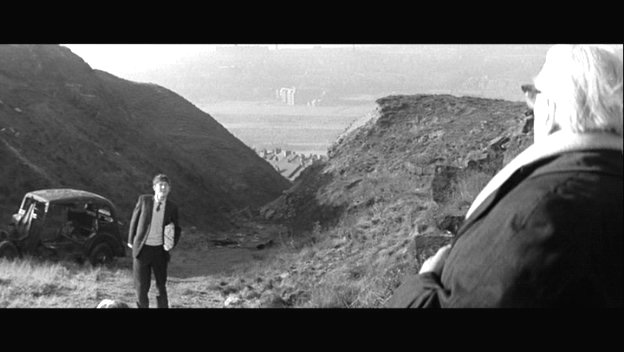
The setting of this passage is particularly delicious to me. The novel is notable for capturing the differences of atmosphere in an ordinary work day in an ordinary town; each scene and setting has its own flavour. Being a Yorkshire novel, it needs a scene set on the moors and this is the one. Billy has gone to bury some of the calenders in the ash-pit and he runs into Councillor Duxbury, taking his stroll.


I loved the description: I enjoyed walking here. Given a quiet day I could always talk to myself, and it was easy to picture the clifflike, craggy boundaries of the moor as the borders of Ambrosia. The sun was still out, in a watery sort of way, and there was a hard, metal-grey shine on the afternoon. The faint waves of shouting, and all other noises, sounded remote and not very real, as though they were heard through a sheet of glass. (I've always loved this kind of atmosphere myself; especially hearing faint sounds from far away.)

The conversation between Councillor Duxbury and Billy is too long to transcribe in its entirety. Suffice it to say that Billy loses no time in mocking the stolid Councillor, launching into a variant of his Man o' the Dales routine. But then he worries he has gone too far: I suddenly realised he knew perfectly well that I did not talk in dialect all the time, and also that it was ridiculous to imagine that he did not know I worked for him. Billy tries to row back, but too late, as the Councillor realizes he is being made fun of:

"Is ta taking a rise out o' me, young man? Just talk as thi mother and father brought thee up to talk. Ah've had no education, ah had to eduate myself, but that's no reason for thee to copy t'way I talk." He spoke sharply but kindly, in a voice of authority with some kind of infinite wisdom behind it, and at that moment I felt genuinely ashamed.

Billy has already wondered, earlier in the conversation, 'if it were true that there were wise old men, and he was one of them". Now, as Councillor Duxbury tells him that Shadrack, the junior partner in the firm, has asked Duxbury to speak to BIlly's father,  and that he is undecided on what he should do, Billy suddenly finds himself responding to the old man's avuncular manner:


'Straighten thi back up! That's bitter. Now sither. Ah don't know what ah'sll do. Ah'sll have to think about what's best. But sither--' He gripped my arm. I did not feel embarrassed; I was able, even to look steadily into his eyes. 'Sither. Tha'rt a young man. Tha's got a long way to go. But tha can't do it by thisen. Now think on'.

He released my arm, leaving me feeling that he had said something sage and shrewd, although I was unable to fathom quite what he was getting at. He was stuffing his handkerchief into his pocket, preparing to go. I did not want him to go. I felt a kind of tentative serenity and I wanted him to go on with his old man's advice, telling me things I should do...

He turned and began to make his way gingerly down the gentlest slope of the ash-pit....I looked down after him, only just beginning to realize that for the first time I wanted to tell someobdy about it, and that I could very probably have explained it all to him. I had to resist an impulse to call back after him.

I stood there until he was safely on the grass perimeter surrounding the stretch of cinders. I had a feeling, one that I wanted to keep. It was a feeling of peace and melancholy. I was not at all afraid. I walked happily along the rough stone path through the allotments to the quiet moorland beyond, and even while I was burying the calendars the feeling was still with me. 

End of chapter.

I imagine my readers (if anyone is still reading!) will have had such an experience themselves-- unexpectedly yearning to open up to a person who you've previously ignored or despised. And yet I don't think I've ever read an account of these moments of unexpected catharsis, which are frequent in real life.


The description of the Roxy, Stradhoughton's dance hall, is very piquant in its picture of a provincial town stumbling towards the Swinging Sixties:

The Roxy was the last splash of light before Stradhoughton petered out and the moors took over. It was supposed to be a suburban amenity or something; at any rate its red, humming neon sign spluttered out the words 'Come Dancing!' six nights a week, and all the grownup daughters of the cold new houses round about converged on it in their satin frocks, carrying their dance shoes in paper bags advertising pork pies. Youths who had come from all over Stradhoughton for the catch sat around on the low brick banisters by the entrance, combing their hair and jeering at each other

The Roxy is where all Billy's lies and misdeeds catch up with him. His friend Arthur sings a song they composed together, and announces from the stage that Bily is off to London to work for Danny Boon, the famous comedian. This precipitates a bitter falling-out. Two of Billy's girlfriends run into each other, one of them wearing a cross that Billy has given both of them at different times, leading to another scene. And Shadrack, the junior partner in the undertaking firm (who is at the Roxy, like everybody else) tells Billy he has been temporarily suspended from work.

All of this leads to one of my favourite paragraphs in the whole book:

My palms gritty with sweat, I gripped the balcony rail and peered into the bright lights of the dance floor. As in some manic kaleidoscope I could see Arthur, looking belligerent, about to sing; the Witch striding purposefully out of the cafeteria with her handbag swinging on her shoulder; Rita, standing around looking dazed; to the left, Stamp, standing at the bottom of the staircase, and Shadrack brushing up past him. I saw them, or thought I saw them, all in one shrieking moment, and looking up, there was the youthful Man o' the Dales, glaring with what looked like suspicion at our table. I had a sudden histrionic urge to stand up and shout: "Ladies and gentlemen, here are my fountain pen and my suéde shoes. Crucify me the modern way!"


That is like the moment in a symphony when the music crashes to a crescendo. I think every novel should have a paragraph like this; a paragraph where the entire action is concentrated into one tableau or montage, where the character has a momentary bird's eye view of the whole drama. Even as a kid, I savoured its contribution to the structure of the novel. (I also love the word 'kaleidoscope').


However, we are still coming to my absolute favourite scene in the novel. In fact, this post was only meant to be about this one scene. Several hours later, it has become a review of the book.

It's the scene where Billy tells Liz about Ambrosia. But, reader, I haven't told you about Ambrosia yet, have i?

Ambrosia is Billy's imaginary country. His daydreaming frequently involves fantasies of his role in liberating and subsequently ruling Ambrosia.

Ambrosia was of special interest to me because, all through my childhood and teens and well beyond, I had my own imaginary country. Sometimes it was simply a metaphor for myself-- I always found myself spontaneously imagining my own life in terms of history writing, or in terms of Winston Churchill's World War Two oratory, and so forth. (My country was always based on England, the sceptred isle.) At other times, my imaginary country was more consciously thought-out. I designed a flag for it, and I even worked out its parliamentary system in some depth. The different parties represented the different inclinations in my own mind and character.

Billy as liberator of Ambrosia


(When I learned about C.S. Lewis's Boxen and the Brontë's Gondal and Angria, I was rather relieved to be in such good company, having always felt rather sheepish about this activity, or this mental quirk.)

Billy goes for a walk with Liz, the free spirit who is his only real boon companion, outside the Roxy, in a wooded area with the unglamorous name Foley Bottoms. Their conversation turns to hopes, dreams, marriage, and children (Liz wants lots and lots of them), and eventually leads to outdoor lovemaking. (Although Billy has been unsuccessfully trying to seduce his other girlfriends throughout the novel, he doesn't seem to be quite a virgin.) But before they make love, Billy bares his soul to her, in a section of the novel that I found unbearably exciting as a teenager. Liz, complaining about small town, tongue-wagging Stradhoughton, has just told Billy that she wishes she could be invisible:

"Liz", I said urgently. "Liz, listen, listen." I took her hands, trembling almost, and began to speak rapidly, leaving staccato, deliberate pauses between my words.

"Liz, do you know what I do? When I want to feel invisible?" I had no experience of wanting to feel invisible, but the text was perfect. I was doctoring my words as I went along, quickly and carefully. "I've never told anybody. I have a sort of-- well, it's an imaginary country, where I go. It has its own people--"

"Do you do that? I knew you would," cried Liz triumphantly. "I knew you would. Why are we so alike, Billy? I can read your thoughts. A town like Stradhoughton, only somewhere over by the sea, and we used to spend the whole day on the beach. That's what I used to think about."

I was full of excitement, frustrated, painful excitement at not being able to tell her properly, yet at the same time knowing she would understand. I wanted to drag her into my mind and let her loose in it, free to pick and choose.

Julie Christie as Liz

I began counting to slow myself down, and said, only half-feverishly:

"This is more than a town, it's a whole country. I'm supposed to be the Prime Minister or something. You're supposed to be the Foreign Secretary or something--"

"Yes sir", said Liz with grave, mock obedience.

"I think about it for hours. Sometime I think, if we were married, and living somewhere in that house in the country, we could just sit and imagine ourselves there--"

"By a log fire", said Liz softly. "And the fir trees all around, and no other house for miles."

I looked at her squarely. She was as excited as I was, in her own settled way. I was tossing a coin in my head, teetering on a decision. heads I tell her, tails I don't. Heads I tell her this last thing.

"I want a room, in the house, with a green baize door," I began calmly. "It will be a big room, and when we pass through it, that's it, that's Ambrosia. No one else will be allowed in. No one else will have keys. They won't know where the room is. Only we will know. We'll make models of the principal cities, you know, out of cardboard, and we could use toy soldiers, painted, for the people. We could draw maps. It would be a place to go on a rainy afternoon. We could go there. No one would find us. I thought we would have a big sloping shelf running all the way down one wall, you know, like a big desk. And we'd have a lot of blank paper on it and design our own newspapers. We could even make uniforms, if we wanted to. It would be our country." I stopped, suddenly aware of the cold and black, peeling branches all around us and the ticking quiet of it all. I had talked myself right through the moment of contact. Liz, her old self, was grinning, pleased with life, seeing it all as our old fantasy, a kind of mental romp in the long grass. "And let's have a model train, that the kids won't be allowed to use", she said. "And a big trench in the garden."

I sank back, spreadeagling my hands in the grass to rid them of the webbed sensation that was coming back into them like a nervous tic.

"Liz", I said, all the thoughts exhausted in me. "Will you marry me?"

C.S. Lewis and his brother also had imaginary countries

This scene excited me so much that I thought I was going to die. I knew exactly what Billy meant by 'frustrated, painful excitement'.

The scene ends in farce, after Liz and Billy have made love, when it emerges that a group of his acquaintances have been listening in all along. One of them shouts "Can I draw your maps for you, to play with?" as they run away.

After that peak, the rest of the novel is diminuendo.

In fact, this is the point at which there comes a plot development I have always thought was a mistake on Waterhouse's part. (Stop reading now if you are one of those people, unlike me, who care about 'spoilers'. The rest of the post will be spoilers.) Billy learns that his grandmother is ill, goes to join his mother in the hospital (his father is at a social event and hasn't heard yet), and learns that she has just died. Even worse, there is some suggestion that he is indirectly responsible, having (possibly) provoked her into taking a fit earlier on. The grandmother is not particularly likeable-- with the exception of Liz and Councillor Duxbury, hardly anybody in the novel is-- but this introduces a note of tragedy that I've always thought rather out of tone with the book.

Even worse, Billy persists with his plan to go to London that very night. I always found this hard to believe. He's a pretty self-centred character, but he hardly seems such an absolute swine as to leave town the night of his grandmother's death. His mother only seems a little shocked at his determination.


The novel ends in the train station, in the early morning hours. The particular desolation of that atmosphere is well-captured:

The station was ablaze with white, cold light. The booking hall was deserted except for a fleet of electric trollies piled high with newspaper parcels. The last Harrogate diesel was just pulling sleekly away from platform two.

The inquiry office was closed....all the windows but one at the ticket office were boarded up. I waited under A-G until a tired man in shirt-sleeves appeared, and I bought a single second-class to St. Pancras. It cost thirty-five shillings. I looked up at the big station clock. It was ten minutes to one.

Below the ticket office was the buffet and main waiting room. The buffet end was closed, its counter still lined with thick cups and the floor littered with crusts of bread, but there were about a dozen people still in the waiting room, most of them asleep with their feet up on the scratched tubular chairs or their heads down on the rockety tables, amongt the flattened straws and empty lemon-squash cartons. I went in and stood by the door, under one of the large, empty-looking pictures of fields and hills that lined the walls. A few people were awake; half-a-dozen soldiers, all in civvies, going home on leave, three old prostitutes, a man in a large black coat.


Liz appears, for the climactic moment of the novel. Will Billy follow his dreams and take the train to London, or won't he?

Well, this is a provincial novel. What do you think?

The book, however, ends on a suprisingly upbeat note, and I think this is one of the best closing paragraphs I have ever read:

I walked across Bull Ring and up Moorgate. Suddeinly I began to feel excited and buoyant, and I was almost running by the time I reached Town Square. I began to whistle 'March of the Movies' and to march in step with it. There was nobody about. When I came to the War Memorial I transferred my suitcase to my right hand and at the correct moment I saluted with my left-- up, two, three, down, two, three, head erect, shoulders back. I brought the whistling to a huffing crescendo and wheeled smartly into Infirmary Street. I dropped into a normal step, and then I began the slow walk home.

The end.


When I was a teenager, I wanted to be Keith Waterhouse when I grew up. He was one of those literary workhorses I find so very inspiring-- he wrote endless newspaper columns, novels, screenplays, stage plays, a guide to good English, and goodness knows what else besides. I liked that he was a family man (he often mentioned his wife and children in his columns). I liked his particular brand of Englishness and of manliness-- gently nostalgic, cultured but not excessively so. An atmosphere of comfortable pubs, second-hand bookshops, Fleet Street, family life, and public events like general elections seems to hang over his work-- not to forget the smell of typewriter ink, of course. (I can just about remember the era of the typewriter myself.)


As I said in my earlier post, though, it's not enough. There isn't really anything of the transcendental or the sublime or the sacred in Waterhouse's books. Religion and politics are mostly avoided, as befits a newspaper columnist trying to appeal to the greatest amount of readers. He seems to have been on the political left-of-centre, but mildly conservative on cultural and social matters. He died in 2009, and when I found myself reading about his life I wondered how someone could be so contented to be a writer and nothing else. I have much more admiration for figures like G.K. Chesterton and W.B. Yeats and Peter Hitchens, writers who throw themselves into public debates and have something of a missionary zeal about them-- even if this is done indirectly, as was the case with someone like J.R.R. Tolkien. Writing solely to entertain seems rather tawdry to me now.


All the same, Billy Liar was one of the books that awakened me to the joys of reading. I recommend it to you, if anything in this over-long post has appealed to you, and wish the blessings of God on the soul of Keith Waterhouse.

Saturday, July 2, 2016

Catholicism Without Apologies 8: Pop Culture, Historical Feuds, and Religious Vows


A Divine Double Feature

Noah

As I was pondering what to write for this issue’s ‘View from the Pew’, one subject seemed to suggest itself automatically. On the very day that I type these words, the Irish movie Calvary has been released. Most readers will probably know that this is an Irish movie starring Brendan Gleeson, and a sequel to The Guard, a well-received comedy that appeared some years ago.

The ads for Calvary show Brendan Gleeson in clerical garb walking along a beach, and the tag line is: “Killing a priest on a Sunday, that’ll be a good one”. I know from seeing the trailer, and from pre-release publicity, that it features a priest who is an idealist, rather than one of the collared monsters or idiots that we’ve been accustomed to seeing on the screen in recent years. Previews of Calvary have been enthusiastic.

I did go to see....and hated it

As well as this, of course, we have the Biblical (or quasi-Biblical) saga Noah hitting the big screen. This has been stirring up controversy (and attendant publicity) for months before its release. Not unreasonably, given the difficulty of turning four chapters of the Book of Genesis into a Hollywood epic, it embellishes heavily upon the Biblical account. The generally reliable Fr. Robert Barron, however, has given it a good review and defended its additions to the Scriptural story.

So, for a keen cinemagoer like me, this seemed like the obvious way to go. I would watch both these films, and surely find plenty to say about their treatment of God, the Catholic Church, and the place of religion in modern Ireland.

Except….

Entertaining Doubts

…I felt a strange reluctance to do so, and it took me a little bit of reflection to figure out why.


This is why. It bothers me that we are today so infatuated with the entertainment industry, and with pop culture, that the release of a Hollywood blockbuster based on the Bible is guaranteed acres upon acres of coverage, both in the Catholic press and on Catholic websites. And it’s not just coverage of the movie itself that is guaranteed, but coverage of its subject matter. How many articles about Noah’s Ark will have appeared in the last month or so, just because Russell Crowe happens to be playing that Patriarch on the big screen?

It’s not that I have anything against movies themselves. If I had no other duties, I could happily go to the cinema every day of the year. And I’m not complaining about people enjoying television shows, popular music, comic books, professional sport, or computer games. Life is hard enough without its entertainments, and many’s the movie or TV show that not only entertains, but also inspires and uplifts.

What really troubles me, and what I think should trouble all of us, is how pop culture has become our whole mental landscape, our whole mental atmosphere.


I am scared by the extent to which our attitudes, our vocabulary, our quotations, our jokes, even the metaphors we use, are drawn from pop culture. Pop culture is our lingua franca. It’s our mythology, our folklore, almost our entire way of life. Even supposedly ‘serious’ newspapers and radio shows seem obsessed with it.

Not so long ago, I spent a fair amount of time (reluctantly) overhearing the conversation of a group of colleagues, all in their thirties and forties. These were educated, intelligent, well-read people. And their conversation revolved, almost exclusively, around TV, celebrities and the entertainment industry. I’ve met adults whose mental energies seem more or less devoted to pop culture. It’s not a recreation to them. It’s almost the meaning of their lives.

Well, So What?

At this point, you may be asking what business it is of mine if people choose to take pop culture so seriously. Who are they hurting, after all?

I think we are all hurt by this. I think we are impoverished in our intellectual, social, cultural and spiritual lives. If we live in a pop-culture-obsessed society, we can’t help breathing its atmosphere.

Pass the sick bucket.
 
I’m not claiming that all TV shows and movies and pop songs are unwholesome, or banal, or a bad influence in some other way. Many are just the opposite, on all counts. But pop culture is less concerned with content than with style and attitude. It’s not the stories or themes or melodies themselves that lodge in the collective mind. It’s the images (‘iconic images’), the snatches of dialogue, the styles of dress, the makes of car, the physiques, and so on.

The bits of pop culture that tend to rise to the top, the ones that we see pictured on tee-shirts and posters,  that we hear quoted as latter-day proverbs, and that are endlessly ‘referenced’ in internet ‘memes’, tend to celebrate brashness, insouciance, wealth, power, irreverence, a casual attitude to sex, and that indefinable but poisonous concept known as ‘cool’. 

Iconic!

Think of James Dean with his collar raised. Or Marilyn Monroe having her skirt blown upwards. Or the line ‘Frankly, my dear, I don’t give a damn’ from Gone With the Wind. Or a bejewelled Audrey Hepburn smoking a cigar in the lobby of a luxury hotel. Or Quentin Tarantino’s gangsters strutting along in slick suits. Is there any ‘iconic’ piece of pop culture that reflects humility, or reverence, or charity, or poverty, or remorse? I can’t think of any. 

And if we have all this tawdry stuff swirling around our brains, poisoning our imaginations, how can it fail to impact our spiritual lives?

 An Unholy Rosary

Now think about the prayer that often concludes the recitation of the Rosary: “Grant, we beseech Thee, that while meditating on these mysteries of the most holy Rosary of the Blessed Virgin Mary, we may imitate what they contain and obtain what they promise.” We meditate upon the images of the Rosary in the hope that they will raise our thoughts to higher things, that they will nourish our souls. This is also the idea behind icons, sacred art, stained glass, stories of the saints, and other devotions like the Stations of the Cross and the Sacred Heart. The Church, in its supernatural and human wisdom, has always known that our souls are shaped by what comes in through the eyes and ears, by what the mind and the imagination dwell upon.


Pop culture, on the other hand, gives us a kind of unholy rosary of its own. Instead of the Blessed Virgin kneeling before the Archangel Gabriel, we have Rolls Royces being driven into swimming pools. Instead of ‘”I am the handmaiden of the Lord”, we have “I’m as mad as hell and I’m not going to take it any more”.  These are the scenes and sayings that modern society ‘ponders in its heart’. I think the effects of this have been simply inestimable. In the words of Emerson, “You become what you think about all day long”. It may not make us violent or anti-social, but it makes us that much more disposed towards arrogance and egotism and worldliness, without our even realising it.

I still look forward to seeing Calvary. (Noah seems a little too overwhelming for my taste.) I happily watch Star Trek, The Office and other TV shows. My point is not that we should boycott popular culture. My point is that we should resist the insidious process by which it is becoming the new religion. And part of that resistance is to avoid treating cinema releases, and hit TV shows, as though they are momentous social and cultural events. Because even when they are, they shouldn’t be.

Over it, or Just Past it?


The State visit of President Michael D. Higgins to the United Kingdom has been the subject of much celebration. The general view seems to be that this is a welcome sign of improved Anglo-Irish relations, and of the animosities of the past being finally overcome.

I don’t disagree with that view, and (being a lifelong anglophile, as well as an Irish patriot) I’m certainly in favour of good Anglo-Irish relations. But I can’t help wondering if—on this occasion, and on many others—we are mistaking indifference for tolerance.

For good or for ill, the centuries of conflict between Ireland and Britain were based upon the idea that national identity was something precious, almost priceless. Both countries now seem to have more or less jettisoned this idea. (When is the national anthem of either country ever played anymore, outside sporting fixtures?) So what is there left to be at odds about? To have genuinely reconciled the ancient bitterness would have been a noble thing indeed. But I fear it has simply been shrugged aside, a case of two bald men being magnanimous over a comb.


Prince Charles. Not a Catholic.
 
This reminds me of the controversy, raised every now and again, about the right of succession to the British throne. As we know, a Catholic cannot succeed to the throne, nor can the spouse of a Catholic. Today this is often viewed as a ridiculous anachronism—which is exactly why I would not rejoice in its removal. It would not be religious tolerance, but rather religious indifference, which would lead to its abolition.

In the same way, we like to make fun of the Dublin theatre-goers who rioted against The Playboy of the Western World back in 1907, or the draconian censorship laws under which so many celebrated Irish writers had their works banned here in the first few half-century of independence. But are we really more tolerant today? Or do we simply take ideas and the written word less seriously? I suspect the latter.

The Vow Factor

There is an interesting article in the March/April issue of Religious Life Review, a Dominican Publications magazine, entitled ‘Christ Received in Religious Profession’.


 The article, by Bonaventure Chapman OP, examines the concept of religious vows, using the ideas of the German philosopher Edmund Husserl, founder of phenomenology.

That might sound pretty heavy stuff, but the article is very readable. I especially liked these lines, on the vows of poverty, chastity and obedience: “Each vow gives something to us, presents something as given and only as given in a mode appropriate to the vow itself. Of course the ultimate given of each vow is Jesus Christ, and each vow allows Jesus to give himself to us in a particular way, as the poor Christ, the chaste Christ, the Christ who is obedient.”

In his final lines, Br. Chapman calls for religious orders to “go back to the very foundation of all religious life, back to the poor, chaste, and obedient Christ himself.” The author entered the Dominican Order in 2010. I hope he is typical of the new breed of consecrated religious.

"I have a vison of the future, chum..."

Why are religious vows so difficult for the contemporary Western mind to understand? I suggest that it is because we lack an appreciation of specialness. We cannot, for instance, understand that God is indeed omnipresent, but present in a church or holy place in a special way, and present in the Blessed Eucharist in the most special way of all. We struggle with the idea of special times, such as Lent, when fasting and prayer and alms giving are especially appropriate. We struggle with the idea of intercession, of a patron saint having a special charism.

It's a pity, because a world without specialness is a drab and dreary world, a world where everything is equally boring. Here's hoping contemporary society gets bored of such uninspiring sameness sooner rather than later.