Saturday, June 18, 2016

A Short History of my Priggishness

Readers are warned that this post is going to be even more introspective and idiosyncratic than usual. Perhaps 'navel-gazing' is a better term. Nevertheless I feel the urge to write it. Nobody has to read it-- that is the great thing about blogging.

I wanted to write a few thoughts on my history as a prig.

I have always been a prig. I think I will always be a prig. I am trying to learn where priggishness is good and where it is bad.

Chambers English Dictionary, eleventh edition, describes a prig thus (and the definition is rather poetic): "A precisian, a puritan; a person of precise morals without a sense of proportion; a sanctimonious person, certain of his or her blamelessness and critical of others' failings; a coxcomb".

I think the only part of that definition that applies to me (in the sense I mean here) is 'a puritan'. I have always been a puritan, though my puritanism has been more aesthetic or cultural (or maybe behavioural) than moral. 

I have always had a craving for the purified, the consecrated and the intentional, over the mixed, the ambiguous and the matter-of-fact.

I have often written (to the point of tedium, I hear my reader think) about the Halloween party that fired my childish imagination. The thing that excited me was the sense of consecration-- this night was consecrated to all things spooky. It had a flavour and an atmosphere and a character all of its own.

A time to be spooky

I wanted, and have always wanted, everything to have a flavour and an atmosphere and a character all of its own. I wanted, from my earliest age, human beings to be avatars. I wanted each one to be a vessel of a particular ideal and way of looking at the world. I didn't really care what that way of looking at the world was, as long as it was there. Teenagers who were heavy metal fans I could understand. Adults who were proponents of some political viewpoint, I could also understand. But people who weren't really anything...who expressed no obvious view of the world, whether idealistic or hedonistic or otherwise....I couldn't 'deal' with them. They disgusted me, in the literal sense of that word.

Of course, I could never have expressed all this in words, as a child. But it was there.

I loathed what Yeats called 'the casual comedy' in his famous poem Easter 1916; the banal, business-like, humdrum attitude towards life that, the poem tells us, had been superseded in the Ireland of that time by the high tragedy of the Rising.

W.B. Yeats
The philosphical depth of that poem amazes me more and more, as I grow older. Yeats managed to encapsulate (and anticipate) all the debates about the 1916 Rising in one poem, indeed, in one phrase-- "a terrible beauty". But it has a philosophical depth beyond its historical subject, too. In one passage from the poem, one which I did not even understand when I read it as a teen, Yeats expressed both the seduction and the peril of this urge towards purity, towards single-mindedness:
 
Hearts with one purpose alone   
Through summer and winter seem   
Enchanted to a stone
To trouble the living stream.
The horse that comes from the road,   
The rider, the birds that range   
From cloud to tumbling cloud,   
Minute by minute they change;   
A shadow of cloud on the stream   
Changes minute by minute;   
A horse-hoof slides on the brim,   
And a horse plashes within it;   
The long-legged moor-hens dive,   
And hens to moor-cocks call;   
Minute by minute they live:   
The stone's in the midst of all.

Too long a sacrifice
Can make a stone of the heart...

Jean-Paul Sartre believed that human beings, out of a desire to escape from the existential freedom which we find so unbearable, aspire to become a thing rather than a person.  I don't believe this exactly, but I think it shows considerable insight.

Yeats himself, who said that poetry is created out of the argument with ourselves, was also drawn to the idea of purity in his own way. "One day when I was twenty-three or twenty-four this sentence seemed to form in my head, without my willing it, much as sentences form when we are half-asleep: "Hammer your thoughts into unity." For days I could think of nothing else, and for years I tested all I did by that sentence." 

When I was a boy, I knew a couple called Holly and Harry. (I am changing the name and the details to protect the innocent.) When I visited their flat, i was delighted with their way of life. They had a piece of sculpture on their bookshelf, and a large and rather artistic painting on their wall. They gave me curry, which was unimaginably exotic, with chopsticks! They had poufs to sit on. I think there was incense involved, as well. It seemed to me they were living the refined way of life that I craved. 

Later on, I realized that they watched game shows and listened to rap music and followed sport like everybody else. And, to make matters worse, they quickly moved away from the aspirations of their early years. I felt unutterably betrayed and disillusioned.

In school, when I was about ten or eleven, we read a story taken from Little House in the Big Woods by Laura Ingalls Wilder. It was a tale-within-a-tale in which children are told how strict Sabbath observance was in their grandfather's day. Their grandfather (as a boy) goes out to play with a sled on a Sunday, when his own father is asleep, despite Sunday being utterly devoted to Bible reading and solemnity. My sympathies were not with the boys, but with the solemnity of the Sunday. I had never heard of such solemnity and consecration before and I craved it. 

Another time, I fell in calf-love with a girl who was several years older than me in school. I didn't know her name but she seemed to me like a vision of rather vampiric beauty. She had raven-black hair, slanted eyes and an alabaster complexion, and she moved and smiled with a demure grace. She looked very intellectual and as though she came from an upper-middle class family. I imagined her life as being one of art exhibitions, concerts, bike rides, intellectual debates around the dinner table, reading poetry in a meadow, etc. etc.


She should be reading poetry.

I remember how crushed I felt one day when the thought occurred to me: "She watches television. Of course she does. Like everybody else." I was about fifteen. I watched lots of television.

Lord of the Rings was a source of fascination for me; particularly Rivendell. I wanted everything in life, and everything in society, to be graceful and ceremonious and meaningful and stately like it was in Rivendell. Indeed, even the Shire seemed to me more gracious and ceremonial than the 'casual comedy' I saw around me.

I wanted this...


Not this...


...or this.
It is understandable that such a boy should be drawn towards cultural nationalism, as I was. When I learned about the Irish Revival, or the Gaelic Revival, of the late nineetenth to early twentieth century, it completely enchanted me. Indeed, that enchantment has never gone away, though I reacted against it for some years.

The Gaelic Revival was part of a wave of cultural and (important adjective) romantic nationalism that swept Europe in the nineteenth century and onwards. Romantic nationalism saw the art, folklore, dress, cuisine, literature etc. of a particular nation as being an expression of its national soul. Where those things had decayed, it sought to revive them.

(All my life, while despising revolutions of the destructive kind which seek to wipe the slate clean and start again, I have been fascinated by the idea of a revolution which transforms everything but which destroys nothing. The title of the much-mocked spoken word album by William Shatner, The Transformed Man, has always beguiled me.)

Thefore, in an Ireland that had been losing its national culture and ways of life for generations, a massive campaign was launched, amongst cultural nationalists, to revive our national language, our national folklore, our national games, our national music, our national architecture etc. in a particularly Gaelic idiom. Traditions would be revived-- and where there were no traditions, new ones would be invented.


This was manna to me. The essence of the thing was that which was unthinking and incidental would become deliberate and intentional-- that which was almost arbitrary would become meaningful. Dressing and storytelling and painting and eating and making speeches and sending Christmas cards would become an expression of the Folk Spirit, as well as everything that they were already.

I have never aspired towards the kind of 'spontaneous' national identity that some cultural nationalists aspire towards. I remember, in one Irish language class, the teacher taking one of my class-mates to task for writing, in an essay, that a particular Irish language writer had "a great love for the Irish language". "Nobody ever says that English writers have a great love for the English language", she moaned. "It's just the language they naturally write in."

But that was exactly what I did not want-- for Ireland to regain her national traditions and way of life just to become blasé about them. This was long before I came across a quotation of Chesterton's which exactly expresses my dislike of this attitude: "This is the great fall, the fall by which the fish forgets the sea, the ox forgets the meadow, the clerk forgets the city, every man forgets his environment and, in the fullest and most literal sense, forgets himself". Chesterton somewhere else describes this as: "Losing a thing as soon as you find it."

Obligatory G.K. Chesterton picture
I will go further. I have never been able to really regret that Ireland lost her language and traditions and has had to regain them. I don't wish we spoke Irish today as the French speak French or the Spanish speak Spanish-- matter-of-factly. I think there is something heroic and life-giving in the project of revival. Chesterton said that the way to love something is to think that it might be lost. Ireland had lost so much, and yet-- would we have loved it so much if it had not been lost? Wasn't the 'turn' towards tradition in itself a noble thing, especially when it was an all-but-disappeared tradition?

Kathleen Ni Houlihan; Ireland's Uncle Sam
My cultural nationalism was a romantic, backward-looking, traditionalist, poetic form of nationalism, one that idealized the Irish countryside and traditional ways of life and that personified Ireland herself as Kathleen Ni Houlihan. I simply did not see the point of any nationalism that was not a 'thick' nationalism in this sense-- that did not want to "Irishify" everything in the national life.

When I realised that there were indeed nationalists who had contempt for this attitude, I was shocked to my core. Kathleen Ni Houlihan they considered sexist and outmoded and naive-- they wanted a bullish, anti-sentimental nationalism that wanted to make Ireland a progressive, modern, secular, multicultural nation. Aside from removing the British presence from Northern Ireland, and providing 'language equality' for Irish speakers-- because even seeking to revive the language was a bit too conservative for their liking-- they seemed willing to ditch the entire project of cultural revival. Wearing Aran sweaters and putting up paintings of Blasket Islanders in your living room were out. Bob Dylan songs and blue jeans and plays about tortured sexuality were in. This, in part, caused my strong reaction against nationalism for many years.

I'm not bashing gays-- but why does it have to be so tacky?
I could go on to describe the influence of my priggishness upon my religious faith, but this essay is already longer than I intended it to be.

I'll mention two things in conclusion.

The first is-- ladies and gentlemen, please do not consider me an out-and-out prig. Indeed, I harbour in my soul quite the opposite hankering, too, though it is not nearly as strong. There is a part of me that revels in 'the casual comedy', the infinite openness and indeterminacy of life, and of society. I do want to get outside, or at least to know there is an outside-- I do want fresh air. I have known the rather bracing sense of dizziness when it is borne upon one, through a snatch of overheard conversation perhaps, that other people have preoccupations and ways of looking at the world that are utterly different from one's own. I sometimes revel in the 'messiness' of modern liberal democracy. Louis Macneice's 'Snow' is one of my favourite poems. I even had these lines printed onto a t-shirt once:

World is crazier and more of it than we think,
Incorrigibly plural. I peel and portion
A tangerine and spit the pips and feel

The drunkenness of things being various.

Louise Macneice, renowned tangerine eater
And yet I think the cleavage is not as simple as that, either. Just as Chesterton said that, if you leave a white fence to itself, it will not remain a white fence but become a muddy grey, so I think that the diversity of the world actually requires a solicitude for singleness and purification. Perhaps tangerines only exist through the unnatural selection of fruit-eating human beings over the generations, as certain dogs have been bred for their distinctiveness. Even if this is not the case with tangerines, you know what I mean. Volumes could be written on this tension, this paradox, this dialectic, or whatever you may call it, between essentialism and pluralism.

Finally, I want to leave you with an image. I have been practicing mindfulness for several months now-- something I dismissed as a fad, but I have been compelled to accept as having genuine scientifically-established merit, and something that is of particular usefulness to me. There are many forms of mindfulness, but I have hit upon my own favourite-- staring into the flame of a candle for twenty minutes, focusing entirely upon that flame.


Staring into the flame makes me realise how important fire imagery has been to me all my life. In the Bible, some of my favourite stories involve fire-- the Burning Bush and Pentecost in particular. And one of my epigraphs you will find at the bottom of this blog is from our Blessed Lord: "I have come to bring fire to the Earth."

And then there is one of my favourite lines in all English poetry, the last line of this verse from the poem The Burning of the Leaves by Laurence Binyon:
 
The last hollyhock's fallen tower is dust;
All the spices of June are a bitter reek,
All the extravagant riches spent and mean.
All burns! The reddest rose is a ghost;
Sparks whirl up, to expire in the mist: the wild
Fingers of fire are making corruption clean.


The wild fingers of fire are making corruption clean. That is what I have craved, intermittently, all my life. That is what makes me a hopeless prig. And, although there is much to be said against priggishness, I think there is something to be said for it, as well.

Wednesday, June 15, 2016

I Have Fought the Good Fight: A Hymn


For some years now I have been meaning to write hymns. For two main reasons; because I dislike the quality of contemporary hymns so much, and because if one succeeds in writing a good hymn it might be something that endures. I've only written a few. I was privileged to have one performed in my local church, set to music by another parishioner.

Tonight I tried my hand again and something came to me very quickly. I realise it is rather Victorian in terms of diction and inversions, and I don't care-- in fact, it's intentional. But mostly I wanted to write something stirring, in contrast to all the wishy-washy hymns I've sat through. It is based on St. Paul's second letter to Timothy. Anyone who wants to set it to music is very welcome!

(I have even included Oxford commas to please their enthusiasts.)

Incidentally, this is my thousandth post on this blog!

I Have Fought the Good Fight

The mighty apostle St. Paul wrote this
To Timothy, son of his spirit:
I am leaving you for an unending bliss
A glorious crown to inherit.
I have preached the Lord Jesus in every place
I have walked the path narrow and straight.
I have fought the good fight, I have finished the race,
And I have kept the faith.

And I have kept the faith
I have fought the good fight, I have finished the race,
And I have kept the faith.

Five times I received forty lashes but one
Three times I was beaten with rods
I was stoned, I was shipwrecked, and all but undone
By the priests of idolatrous gods
But I care not for dungeons or death or disgrace
When the prize I pursue is so great.
I have fought the good fight, I have finished the race,
And I have kept the faith.

And I have kept the faith
I have fought the good fight, I have finished the race
And I have kept the faith.

Like a drink to my Master my life has been poured,
My mission I pass on to you.
In season and out, preach the word of the Lord,
Though men cry for all that is new.
And many the torment and threat you must face
To fill an apostle’s estate.
You must fight the good fight, you must finish the race,
And you must keep the faith.

For you must keep the faith
You must fight the good fight, you must finish the race,
And you must keep the faith.

Catholicism Without Apologies 3: American Catholicism, Thanksgiving, The Joy of the Gospel, and More....

My first ‘View from the Pew’ column appeared in The Catholic Voice in December 2013. My original idea was to write the column in the form of a diary, with several subjects per column, each linked to my personal experience. I moved away from this idea in later months.

December 2013
              
This year, I spent the week of Thanksgiving in Richmond, Virginia. It was a relief to get away, if only for a few days, from the Irish media’s non-stop campaign against the Catholic Church, not to mention its incessant cheerleading for abortion, euthanasia, and same-sex marriage. I have been in Richmond many times, but I had never been in America for Thanksgiving before.

St. Benedict's Church in Richmond Virginia

Richmond has a strong Catholic presence. The parish of St. Benedict’s is a vibrant and traditionally-minded Catholic community, a home to many young people who take their faith very seriously. It’s a treat to go to Sunday Mass and to see many young parents with babies and infants in the pews, to hear Latin being used so extensively in the liturgy, and to feel the presence of a whole Catholic culture and way of life.

In Dublin, it seems to me, Mass-going is mostly an individual activity. But in Richmond, whole families go to Mass together.

One evening, a couple of years ago, I attended a “Theology on Tap” event in Richmond. This was a Catholic talk given in a local bar. The speaker was a young man who had converted from Presbyterianism to Catholicism, after deep study and reflection. The place was packed with young people, mostly in their twenties. When the speaker asked for questions, there was no shortage of them—and they were thoughtful, theologically literate questions, too. I couldn’t imagine such a scene in Dublin—and bear in mind that Richmond is a fraction of Dublin’s size.

Of course, it’s easy to idealize. Although America seems much more friendly to Christianity than the Ireland of today, Stateside Christianity is often skin-deep at best.

To take an example, I was pleased to come across a stand of Christian books in a supermarket in Richmond, and couldn’t help remarking how unlikely such a sight would be in a supermarket tin Ireland. But, flicking through some of the books, I quickly realised they were little more than standard self-help books with a sprinkling of Scriptural quotations. The motivational books of the “mega-church” pastor Joel Osteen (Every Day a Friday, Become a Better You), crowd the bookshops, and seem to be Christian only in the most nominal sense imaginable. And it’s clear that a lot of church-going and church adherence in America is a matter of tribalism or identity, as was the case in Ireland until recently—what might be termed “bumper sticker Christianity”. 

 
But the difference between the Irish and the American attitude to religion is still a meaningful one, in spite of all this. It can be seen in little things—like the way words like “God” and “Jesus” roll effortlessly off the tongue of Americans, while they seem to stick in the throat of Europeans, even religious Europeans. It can be seen in the unselfconsciousness with which Americans will say grace in a restaurant, or indeed in their own house. It can be seen in more significant things, too—like the thirteen per cent increase in applications to US seminaries in the last ten years, a stark contrast to our own dribble of new seminarians.

I put all such broodings aside, however, as I determined to enjoy my first American Thanksgiving.

When I was younger, I actually thought Thanksgiving was the American equivalent of Christmas. And, until I experienced it at first hand this year, I had a foggy idea of what it actually involved. I knew it involved a big dinner, and lots of people frenetically trying to traverse great distances to be with their families, as in the wonderful movie Planes, Trains and Automobiles.  But what else was there to Thanksgiving?

Not a whole lot more, as it turns out. Thanksgiving seems extraordinarily close to being a holiday for the sake of a holiday.

We made an enormous turkey dinner in the afternoon, and in the morning we watched (on television) the big Macy’s parade from New York, followed by the final of the National Dog Show, which is always televised on Thanksgiving.  (How delicious quaint is that particular tradition?) An American foxhound called Jewel was the deserving winner this year.

Jewel, champion American foxhound

Perhaps just as interesting as Thanksgiving is the day that follows it—Black Friday, so called from the fact that many shops don’t go “into the black” until that day of the year. It is not only the biggest shopping day of the year in America, but a scene of pandemonium in many stores as bargain-hunters rush to pick up the best buys.

Unfortunately, Black Friday is no joke, but a very disturbing spectacle of consumerism gone mad. My wife wisely advised that we should stay inside that day, but we watched internet videos of shoppers literally fighting and trampling each other for the bargains, all over the nation. A few years ago, a Wal-Mart employee actually lost his life in the Black Friday crush. And this year a man was stabbed, in the very State I was visiting—over a space in a shop’s car park.

If you ever find yourself wondering whether Christians make too much heavy weather over “consumerism”, or whether claims that shopping is used to fill a spiritual vacuum are rather far-fetched, just look at “Black Friday”.

This festival of greed is also eating into the holiday the day before, as shops open earlier on the Friday morning, or on Thanksgiving Thursday itself, denying their staff the opportunity to spend the day with their families and friends.

Such naked exploitation was one of Pope Francis’s targets in The Joy of the Gospel (Evangelii Gaudium), the apostolic exhortation on the New Evangelisation, whose release was the week’s big Catholic news.


Knowing what a travesty the media would make of the Pope’s carefully-considered words, I decided to ignore the coverage, download the document to my smart-phone, and read it for myself on the plane back to Ireland.

I wonder if people who don’t read Papal documents realize what they are missing? Or whether non-Catholics ever suspect what intellectual pleasures there are to be found in the study of the Faith? Some recent Papal encyclicals—like Blessed John Paul II’s Faith and Reason and The Splendour of Truth, or Pope Benedict’s In Hope We Are Saved, are deliciously meaty extended essays worth reading again and again, as much for enjoyment as instruction.

Apart from a few hours of sleep, I spent the entire flight home mulling over The Joy of the Gospel. I don’t mind admitting that a few passages moved me to tears.

When Pope Benedict retired, I was distressed and anxious. I suspect the gentle Bavarian will always be my favourite Pope. But who could fail to see an initiative of the Holy Spirit in the arrival of Pope Francis, and the astonishing outpouring of enthusiasm and energy he has sent through the Church, and through the whole world? It’s extraordinary how many churches already have his image hanging over their main entrance.

The Joy of the Gospel is the strongest expression yet of a theme that the previous two Popes often raised—that is, that mission and evangelisation should be the central goal of the Church, that (to quote the document) her “customs, ways of doing things, times and schedules, language and structures can be suitably channelled for the evangelisation of today’s world rather than for her self-preservation.” And it is brimful of this Pope’s oft-repeated theme that it is better for the Church to take risks, and to find new ways to take the Gospel to the world, than to sit tight on the laurels of tradition and triumphalism.

It resounds with this Pope’s trademark pithy phrases. “There are Christians whose lives seem like Lent without Easter…an evangeliser must never look like someone who has just come back from a funeral.” “Evangelisers…take on ‘the smell of the sheep’.”God asks everything of us, yet at the same time he offers everything to us.” “Nor is it fitting [for a homilist] to talk about the latest news in order to awaken people’s interest; we have television programmes for that.” “The Church urgently needs the deep breath of prayer”.

The document is over two hundred pages long and covers an impressive range of subjects, all connected to the central theme of evangelisation. It is freely available on the internet and I encourage you to read the whole thing for yourself, even if it takes a few sittings. It is simply impossible to write a brief overview of a document so deep and many-sided.

One thing, however, that I will mention about The Joy of the Gospel is its civil, even genial tone. All too often, traditionally-minded Catholics (like myself) fall into the trap of taking the term “the Church Militant” to mean that we should be abrasive in our presentation of the Gospel, that we should pull no punches and mince no words, that we should almost exult in offending modern sensibilities at every opportunity. This is not Pope Francis’s attitude, any more than it was the attitude of his two illustrious predecessors.

Michael Voris of Church Militant TV. Well-intentioned, often right, but....

In this document, the Pope has warm words for other religions (especially Islam), for lapsed Catholics, and for the non-religious. He calls for evangelisation to be a dialogue rather than a full-frontal assault.

And there is no mistaking his attitude towards those who put all their hope in a fervent return to tradition. He criticizes “those who ultimately trust only in their own powers and feel superior to others because they observe certain rules or remain intransigently faithful to a particular Catholic style from the past. A supposed soundness of doctrine or discipline leads instead to a narcissistic and authoritarian elitism, whereby instead of evangelising, one analyses and classifies others, and instead of opening the door to grace, one exhausts his or her energies in inspecting and verifying”.

Above all, the message of the document is a call to evangelisation by all Catholics, both lay and clerical, learned and unlearned. “I invite everyone to be bold and creative in this task of rethinking the goals, structures, style and methods of evangelisation in their respective communities.”

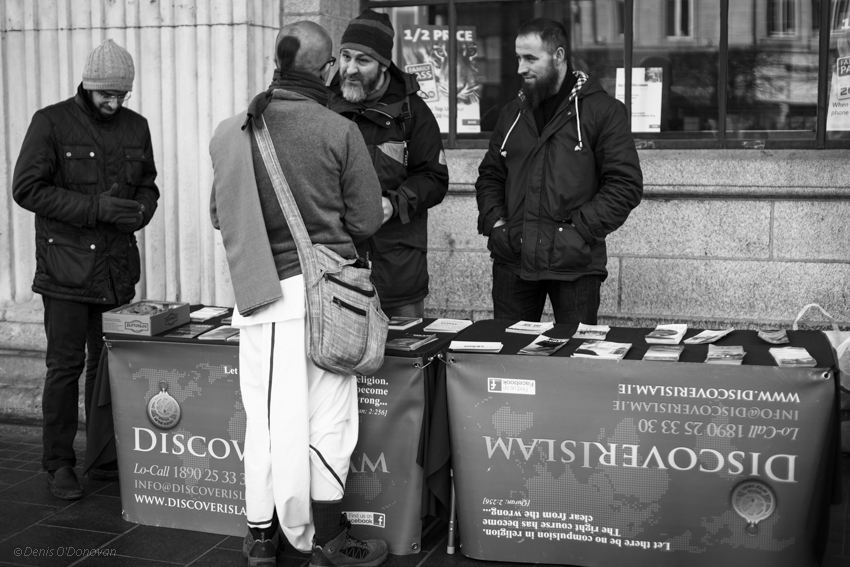
This puts me in mind of an idea of my own. It bothers me that a walk through Dublin city centre on a Saturday afternoon is likely to pass Muslim street preachers, Evangelical Christian street preachers, Mormon street preachers, and every sort of street preacher except Catholic. Surely there is room for a Catholic stand outside the G.P.O….but perhaps, instead of hectoring and embarrassing passers-by, a rotating raft of speakers could simply read aloud from the four Gospels, while having Catholic pamphlets and books available for those who enquire further. I submit this suggestion to the proper ecclesiastical authorities, who would need to give it the necessary sanction and supervision.


I arrived in Dublin in time to attend the eleven o’clock Mass in Our Lady Queen of Heaven, the airport Church. Watching the priest bless the Advent wreath beforehand, I felt a deep sense of comfort. How could the frenzy of consumerist society, or the spin cycle of the Irish liberal media, ever prevail over the gentle and ancient rhythms of the liturgical year? The white and pink and purple candles, so simple and gracious, seemed like a symbol of something infinitely more enduring than all the furious forces that seek to snuff out the light of faith in Ireland, America, and everywhere else that it shines.


Saturday, June 11, 2016

Catholicism Without Apologies 2: How and Why I Became a Catholic


How and Why I Became a Catholic


The emotional moment in Grafton Street that I describe in the preface to this book was, of course, just that—an emotional moment. It came and went. But it was a foretaste of things to come, because eventually I found the question of God’s existence (in general) and the claims of the Catholic Church (in particular) impossible to ignore any longer. This is an account of the long and difficult process by which I came to accept the truth of the Catholic faith, as published on the website Why I’m Catholic.

(Note to my blog readers: this is obviously not a new piece to the internet and you may have read it before. It is, in fact, the only part of the book that was previously on the internet, but I include it for the sake of completeness.)

The most astonishing aspect of most reversion stories—and mine is no exception—is how little cradle Catholics think about the faith they inherit, or indeed about the very nature of their existence, until they hit some spiritual crisis. Somehow, for years on end, we manage to toddle along through this gob-smacking experience called life without wondering very much about how we got here, or whether it means anything. We imbibe a set of stories about a God-man who died and rose from the dead two thousand years ago, without being too bothered about whether it's true or not.

I wonder if most Christians remember when they first heard the name of Jesus. I certainly don't. Nor can I remember, as a child, believing in Him, or disbelieving in Him. He was just something to know about, like the fact that dinosaurs once walked the earth, or that the earth revolved around the sun. Children are often romanticized, rather inconsistently, as being both remorselessly skeptical and infinitely credulous. They see fairies at the bottom of the garden, and they see through the Emperor's New Clothes. I did neither.

I do, however, recall moments in childhood when I glimpsed the sublime through the forms of Christianity. I don't think I was even aware of this at the time; they were like seeds that dropped into the soil of my consciousness, only to shoot forth many years later.

The Chi Ro symbol
 
There was a banner with the Chi-Ro symbol hanging in my classroom in my second year of schooling, when I was seven or eight. (Most Irish schools were Catholic schools back then—in fact, the situation is only beginning to change today.) I recognized, in some deep part of my young mind, that this symbol spoke in a register altogether different from any of the posters on the classroom walls or any of the pictures in our schoolbooks, with their smiling cartoon faces. It undercut them; it belonged to a different order, by virtue of its grown-up mysteriousness, its sober colors, its refusal to be blatant or sugar-coated. It was like a lowered tone in a grown-up conversation; instantly, the child realizes that there's something going on here.

Holy pictures, too, fertilized my imagination, seemingly without my even noticing it. I remember two holy pictures in a bedroom in my step-grandfather's house. One of them showed a Madonna and child, I think; at first I thought the haloes were astronauts' helmets. I don't even remember what the other showed. But I can remember the feelings they inspired in me. Once again, they seemed to belong to some deeper reality—both more solemn and more romantic—than the technicolored, glowing, kinetic carnival around me, on TV and in shop windows and comics. I preferred the day-glow carnival, for sure. I loved kids' cartoons and brightly painted collectible action figures and the glass and neon of Dublin city centre. Anything somber or earnest gave me the creeps. But somehow, those flashes of religious awe still pierced through the haze of a commercialised, banalised, infinitely distracted late twentieth-century childhood—by the grace of God.

There is also the memory of an afternoon singing Christmas carols with my class in the local shopping centre, on a crisp December day. I remember thinking our voices sounded like the voices of angels, and feeling the magnetic pull of the transcendent in the words we were singing. Of course, I didn't understand my own feelings at the time.

I had a brief conversion at the age of fourteen or fifteen. I was visiting my aunt, a farmer's wife, for the summer holidays. In her little village, everybody went to Mass, and a full church is itself a stimulant to a dormant religious imagination. But it was the gospel text that electrified me. "I am the vine, you are the branches"—for the first time, as far as I can remember, a religious idea had appealed to my sense of wonder. This was at an age when I was discovering poetry and the beauty of ideas. That Christianity could be something pulse-quickeningly romantic had never even occurred to me.

I remember, during this holiday, somehow acquiring rosary beads and (I think) a miraculous medal, along with a poster displaying the Ten Commandments. I remember taking a keen interest in another country church I visited, and writing a poem about the Resurrection on a glossy-leaved notepad when I got back to Dublin. I also remember, when I went back to school, looking at a statue of St. Francis and feeling grateful that I was attending a secondary school run by nuns, and that I was surrounded by an atmosphere of picturesque piety. But my mini-conversion soon fizzled out, one way or the other, and I slid back into my religious indifferentism.

I was a keen writer of poetry at this time, and I remember writing satirical poems that used Scriptural allusions. One attacked the women who gossip together after Mass, the other attacked the nuns who ran my school—both very unfair attacks. But in neither did I attack Christianity itself. I can't remember ever being hostile to the Catholic Church, despite having gone through the inevitable communist phase rather early. (I remember reading John Reed's Ten Days That Shook The World in the school study hall.)

I don't remember ever going to Mass aside from the times when I was taken by my mother. I didn't even realize that Sunday and holy day attendance was a requirement for a Catholic.
The religious instruction we received was poor, apart from our first year, where an old and intensely loveable nun taught us about the mysteries of the rosary, the Fatima apparitions, the story of Maximillian Kolbe, and other solid fare. After that, religion class became, more or less, a succession of inspirational videos (mostly feature films like Shadowlands and Not Without My Daughter) and pop psychology. I don't really blame our religion teachers for this. My generation had become so hardened to religion, through the propaganda of television and pop culture, that catechesis had become almost impossible. Whatever doctrine the teachers did try to impart was met with taunting questions and smirking incredulity, for the most part.

Maximillian Kolbe
 
One thing did stick in my mind, to an extent I never could have anticipated. In our fourth year, our religious teacher asked us to define a mystery in the religious sense. One boy replied, "Something you can never understand". The teacher told him that was a negative way to view it, and that a better way was to think of it as "something about which you never stop learning more." Already, as a teenager, I was haunted by the idea that the waters of life were too shallow for my yearnings—that it was possible in principle to come to the end of all thought, of all discovery, of all fulfilment. This existential anxiety was to grow in the years to come, and I never forgot that single sentence that held out such hope.

Meanwhile, something odd had happened to me, something that wasn't supposed to happen to any young person in an Ireland that was going full steam ahead towards becoming a modern, progressive country. Slowly, bit by bit, I became a cultural and social conservative. I knew by my early teens that I loved the poetry of Yeats and Wordsworth and Keats, and despised the free verse of Seamus Heaney and his school. (I refused to write about Seamus Heaney in my Junior Certificate exam, and suffered in my grade as a result.) I read the poems and speeches of romantic nationalists from Ireland's recent past—a past that has fallen into disfavour with our national elites, and much, if not most, of the general population—and fell in love with their agrarian, anti-modern vision. Black and white photographs of Irish social life in the early twentieth century seemed to show me a nobler, simpler, more aesthetically-pleasing spectacle than the vista of supermarkets and designer fashions I saw around me every day.

How miserable and repressed they look!

I was the only kid in my school who was in favour of school uniforms. When I went to college, I ended up arguing with my whole class, including the lecturer, against the legalization of cannabis, and for the censorship of sick movies. The world I had been born into seemed utterly drained of innocence, reverence, tradition, community—everything, I thought, that gave life splendour and depth. I became a conscious contrarian and rejoiced in swimming against the tide of fashion, in being considered a young fogey.

Patriotism, poetry that rhymed and scanned, traditional gender roles, and the superiority of the countryside over the city, monarchism—I embraced them all. But still I didn't set foot inside a church, or get on my knees to pray, or make any effort to practice the faith I had been born into. In fact, by this time, I had become a definite atheist, though a reluctant one. I only admitted my atheism on a handful of occasions, and I would have rushed to defend the Catholic Church against any of its critics. In his memoir Gentle Regrets, the English conservative philosopher Roger Scruton describes his own, ultimately frustrated, approach towards Catholicism. He writes that he could happily assent to every article of Catholic faith, except the existence of God. I was in the same boat.

Why couldn't I believe in God? In Surprised by Joy, C.S. Lewis describes a mental disposition that had grown up in him from the misfortune of lacking one joint in his thumb. He believed that the clumsiness to which this doomed him had made the whole cosmos seem hostile. Things would never come right; stubborn reality would always frustrate him. Ergo, there could be no Supreme Being. At least part of my unbelief could be traced to a similarly illogical idea. I was a shy, impractical, scatter-brained, lonely young man. Nothing I tried seemed to come to fruition. Yearning was always disappointed, I observed; and since the deepest of our yearnings is for the divine, there could be no such reality.

C.S. Lewis

Besides, the rather Spenglerian thrust of my conservatism was that all things were in a state of decline. Suburbs replaced villages. Popular culture drowned out national culture. Chivalry gave way to hustle and salesmanship. The death of God fitted in pretty well with this trajectory.

Then, in my early twenties (I had studied journalism in college, but by this time was working in a university library, as I still do) I started to write intensively. I had always written poetry, but now I started writing fiction, dramatizing (amongst other things) the sacrifice of tradition and custom and ceremony to the all-devouring god of progress. I wrote two fantasy novels, a horror novel, and a collection of horror short stories (all still unpublished).

Anyone who writes knows that writing is a journey; a journey in search of meaning. You simply cannot write without seeking for something below the surface of life, something that links moment to moment and incident to incident, something that gives profundity and purpose to a story's climax. My fingers tapping on the keyboard were drawing me through the labyrinth of human life; and, as G.K. Chesterton says, nothing is more horrifying to man than the thought of a maze without a centre.

But how could there be a centre, a direction, a purpose worth caring about, without God, the Alpha and Omega, the magnetic North of all existence? What was the point of any story if, as Macbeth said, life itself was a tale told by an idiot, signifying nothing? Because it couldn't mean anything, if the atheists were right; that much was horrifyingly clear. I fell into the deepest depression of my life, for several months. It became a kind of mental torture, at times. Nothing in my life, nothing I could even hope to achieve, meant a thing without God. I craved ultimate meaning as a man in the desert craves water.


And, for the first time in my life, I began earnestly searching for God. The Catechism of the Catholic Church tells us that the search for Him demands "every effort of intellect." I had never thought more deeply or more furiously than I thought in these summer months, when the entire cosmos seemed as insubstantial and pointless as a bubble floating in air, a bubble that could disappear at any moment. I read G.K. Chesterton and C.S. Lewis and several other Christian authors. I browsed the internet, a silent follower of the shrill and never-ending God debate in cyberspace. I watched debates between apologists and skeptics on Youtube. Nothing, nothing, seemed important except this ultimate question—and how could anyone think otherwise? How could I ever have thought otherwise?

I wanted to believe so badly and yet I was so frightened of being hoodwinked by delusion—after all, look how Arthur Conan Doyle, creator of the arch-sceptic Sherlock Holmes, had fooled himself with table-rapping and fairy photographs, in an effort to prove to himself that his deceased wife and his son were not lost forever. I needed something cast-iron. Prose poetry and Pascal's wager wouldn't be enough.

It would be easy for anyone to say that my powerful desire to believe in God had decided the issue before hand, and it would be impossible for me to prove that was untrue. But, in reality, quite the opposite was the case. I stress-tested every argument for God to a ridiculous extent, far beyond any standard of proof I would apply to any other claim or theory, even if my life depended on it. CS Lewis has written (I forget where) that wanting something to be true can just as well prejudice us against it as for it. This is certainly true in my case. I have a defence mechanism against wishful thinking that has gone rogue and makes everything desirable seem a priori implausible. Even as I sought God, all my prejudices were against Him, all my defences were up.

The choice was between Catholicism and atheism. I was sure of that. No other force on earth showed the same dedication to its message, the same refusal to submit to the spirit of the age, as the Catholic Church. No other institution defended the good things of life—family, community, purity, patriotism, festival, masculinity and femininity, ritual and ceremony—so assiduously. Every other religion fudged, temporised, showed itself plainly to be "human, all-too-human". It was Rome or bust.

G.K. Chesterton. My all-time hero!

Two books, in the end, were decisive in bringing me peace and conviction; two books published a century apart. One was GK Chesterton's masterpiece and spiritual memoir, Orthodoxy. This book convinced me that the Christian faith was the key that fit the lock of life; not Christianity seen as a set of propositions, but as the lived faith of the saints and of the Church through the centuries. Christianity was staggeringly different from everything else in the human story; and Christianity had simply kept finding the answers to man's problems and yearnings, century after century, in a way that guaranteed its supernatural origin. But how can I summarize Orthodoxy? Those who have read it will understand, and those who haven't shouldn't waste another day before doing so.

The other book was The Last Superstition, a spirited reply to the New Atheists (Richard Dawkins and his cronies) by the American Thomist philosopher Edward Feser. It was tough going, and I had to read it twice (and slowly). But I lapped up every word. Here was someone delivering the goods-- at last! No appeal to mystery. No maiden-aunties scolding of atheist arrogance or irresponsibility. No special pleading. Simply a lucid, watertight demonstration that philosophical materialism could not possibly be true, that the existence of an all-wise, all-good, all-powerful God was logically inevitable, and that the traditional proofs of God's existence—the proofs that every tub-thumping infidel found so simple to refute—were much more subtle than their critics realized, and were in fact unanswerable when properly understood.

Not that I understood them all; but I was convinced by the argument from contingency alone. This argues that everything in the physical world is dependent upon other things, and the chain cannot go on forever but must terminate in something outside the physical world, something necessary and eternal and perfect. This seemed, and seems, rock-solid to me. It takes further development to arrive from this eternal, necessary something to God as we understand him, but the arguments are there, and convincing.

After months of submersion, I had broken the surface of the water. I could breathe again, and the world around me was newborn.

So now I make my way to Mass every Sunday, pray the Rosary almost every day, try to give myself a long-delayed religious education, and generally do my best to swim against the tide of Ireland's ever-burgeoning secularism. Do I do this to be a contrarian? No. Do I do this because the Catholic Church is the great bastion of social and cultural conservatism? No. These things might have led me to the church porch, but once I entered, I knew they could never be enough.

 
The Light of the World by Holman Hunt


Christ will have us on His own terms, or not at all. After all, what were the Pharisees and the Sadducees but conservatives who tried to fit the living Christ into a mortal worldview? Conservatism and liberalism, tradition and revolution, service and freedom, self-fulfilment and self-renunciation—all of our categories break down in that ultimate Presence.

I know that my journey has only begun, and that even my own motives for making it remain impure and inadequate. But I also know there is only one way in which they can be purified, and that is through the sacraments and God's healing grace, as dispensed through the true Church that was founded in the holy fire of Pentecost.